What Voltage Should a Car Battery Read When Fully Charged? 12.6v
The direct answer: a fully charged car battery reads about 12.6 volts at rest with the engine off. Use a multimeter, let the battery rest first, and follow up with a load test to confirm real health.
If you’re looking for a direct answer to what voltage should a car battery read when fully charged, here it is: about 12.6 volts for a standard 12-volt lead-acid battery at rest. That reading assumes the engine is off, the battery has been sitting for a while, and no electrical loads are drawing power. Anything near that number tells you the battery is holding a full charge; readings well below it mean the battery is discharged or failing.
This guide walks you through the 12.6V standard, how to measure it correctly, what other voltage readings mean, and when a voltage check simply isn’t enough. You’ll also learn how to spot a damaged battery before it strands you.
- Target voltage: 12.6V at rest means a fully charged standard lead-acid battery.
- Test correctly: Engine off, all loads off, battery rested for hours before trusting a reading.
- Voltage isn’t everything: A load test or conductance test reveals true battery health.
- Know your battery type: AGM reads about 12.8V, and LiFePO4 reads 13.2V–13.6V when full.
- Watch for danger: Swelling, sulfur smell, or heat means stop and replace the battery.
What Voltage Should a Car Battery Read When Fully Charged? The 12.6V Answer
A fully charged 12-volt car battery should read between 12.6 and 12.8 volts when measured at rest with the engine off. Most automotive experts and battery manufacturers use 12.6V as the practical target. If your battery reads 12.6V or slightly higher after sitting for several hours, the battery is fully charged.
What “Open-Circuit Voltage” Means (and Why It Matters)
Open-circuit voltage is the battery’s voltage when nothing is connected to it and no current is flowing. In plain terms, it’s the resting voltage you measure with a multimeter after the car has been off for at least a few hours. This reading reflects the chemical state of the battery without the influence of the alternator or electrical loads.
Why does that matter? Because a battery that reads 12.6V immediately after a drive may still be weak. The alternator leaves a temporary surface charge that inflates the reading. An open-circuit voltage reading taken after the battery has rested gives you a far more honest picture of its state of charge.
Battery Chemistry 101: Why 12.6V Is the Fully Charged Standard

A standard car battery is made up of six cells connected in series. Each cell produces about 2.1 volts when fully charged. Multiply 2.1 volts by six cells, and you get 12.6 volts. That’s the chemistry behind the number.
When the battery discharges, the chemical reaction reverses and the voltage drops. A battery at 12.4V is roughly 75 percent charged. At 12.2V, it’s around 50 percent. At 11.9V or lower, the battery is nearly empty and may struggle to start the engine. For a deeper look at the danger zone, check out our article on what battery voltage is too low to start a car.
Flooded Lead-Acid vs. AGM vs. LiFePO4: Voltage Differences You Need to Know
Not all 12-volt batteries behave the same way. The three most common types in modern vehicles are flooded lead-acid, AGM (absorbent glass mat), and lithium iron phosphate (LiFePO4).
Flooded lead-acid batteries are the traditional type with liquid electrolyte inside. They typically read 12.6V when fully charged and are the most common and least expensive option.
AGM batteries use fiberglass mats to hold the electrolyte. They’re common in modern cars with start-stop systems and electronics-heavy features. A fully charged AGM battery often reads slightly higher, around 12.8V, because of its lower internal resistance.
LiFePO4 batteries are a newer option, mostly used in lightweight race cars, off-road vehicles, and some aftermarket builds. A fully charged LiFePO4 battery can read 13.2V to 13.6V, which is noticeably higher than lead-acid. If your vehicle was designed for a lead-acid battery, you cannot simply swap in a lithium battery without checking the charging system and electronics compatibility.
| Battery Type | Fully Charged Voltage (At Rest) | Common Use |
|---|---|---|
| Flooded Lead-Acid | 12.6V | Most older and budget vehicles |
| AGM | 12.8V | Start-stop systems, luxury vehicles |
| LiFePO4 | 13.2V–13.6V | Race cars, off-road builds, specialty use |
State of Charge vs. State of Health: Why Voltage Alone Can Lie to You
Voltage tells you the battery’s state of charge, which is how much energy it has right now. State of health is a different thing: it describes the battery’s ability to deliver that energy over time. A battery can show 12.6V and still be on its last legs.
Think of it like a water bottle. State of charge is how full the bottle is. State of health is whether the bottle has cracks or leaks. A cracked bottle can be full, but it won’t get you where you need to go.
The Surface Charge Problem: Why Your Meter Says 12.6V and the Car Still Won’t Start
Surface charge is a thin layer of excess voltage left on the battery plates after charging or driving. It can make a weak battery look healthy for a short time. If you measure voltage right after a drive, you might see 12.6V or even higher, but that reading fades quickly once the surface charge dissipates.
This is why a battery can read 12.6V and still fail to start the car. The surface charge masks the underlying damage. The fix is simple: let the battery rest, then test again. If the voltage drops significantly after resting, the battery has a real problem.
Load Testing and Conductance Testing: How to Measure Real Battery Health
To measure state of health, you need a load test or a conductance test. A load test applies a controlled electrical load to the battery while monitoring voltage. A healthy battery holds voltage above a minimum threshold during the test. A weak battery drops quickly.
Conductance testing measures the battery’s ability to conduct electrical current through its plates. It’s faster and less stressful than a traditional load test, and many modern handheld testers use this method. These tools give you a state-of-health percentage and a cold cranking amp (CCA) rating comparison that a voltage reading alone cannot provide.
How to Test Your Car Battery Voltage Correctly (Step-by-Step)
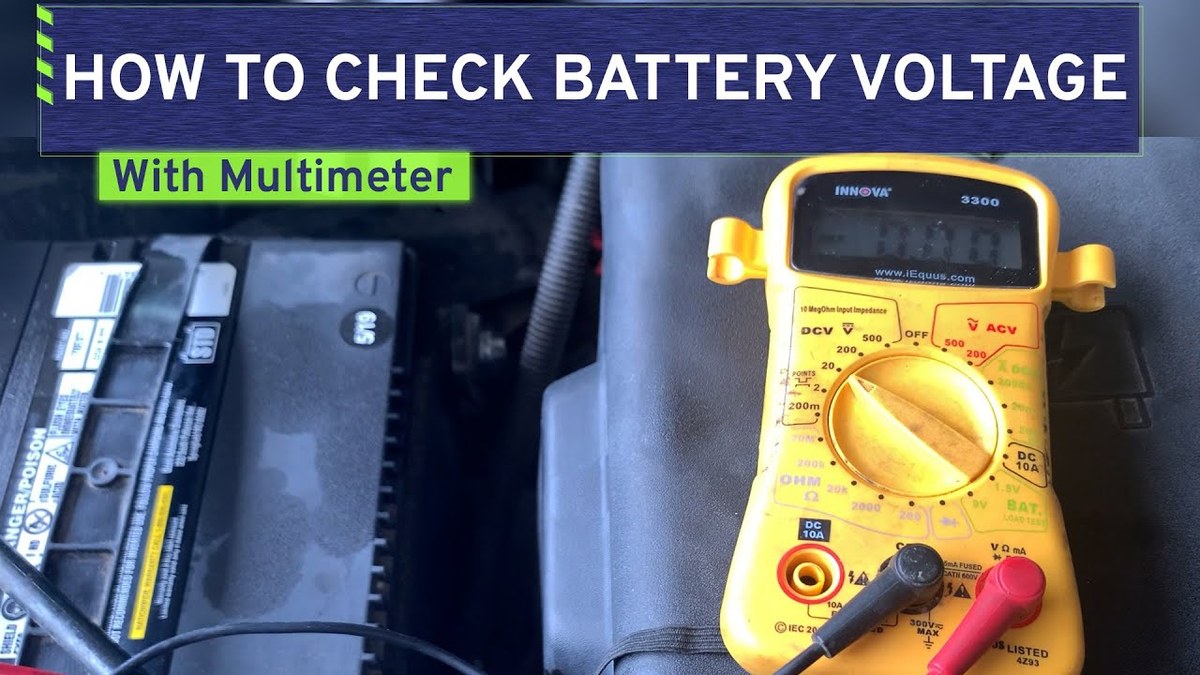
Testing battery voltage is simple, but doing it wrong gives you misleading results. Follow these steps to get a reliable reading.
Multimeter Settings, Probe Placement, and Ignition Mode
Set your multimeter to DC voltage, usually marked with a “V” and a straight line or dashed line above it. Choose the 20V range if your meter isn’t auto-ranging. Place the red probe on the positive terminal and the black probe on the negative terminal.
Make sure the ignition is off, all lights are off, and no doors are open. Even a small load like an interior light can drag the voltage down and fool you. Close the doors and wait a few minutes before testing.
Correct Connection Order and Disconnect Order (Safety First)
When connecting a multimeter, attach the red probe first, then the black probe. When disconnecting, remove the black probe first, then the red. This reduces the chance of shorting the circuit with a metal tool.
Never let the metal tips of the probes touch each other while connected to the battery. That creates a short circuit, which can spark, heat up, and damage the battery or the meter.
Battery Voltage at Rest, Under Load, and at Idle: A Complete Reading Guide
Voltage readings mean different things depending on when you take them. Here’s a quick guide to the three most important scenarios.
Cranking Voltage and Alternator Output: The 13.2V–14.8V Range
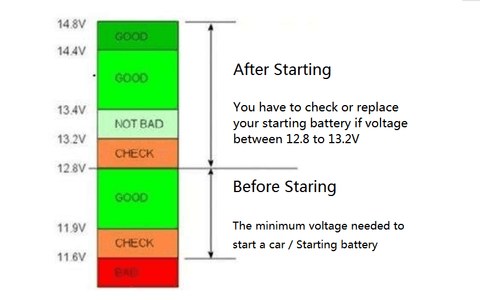
When you turn the key, the battery voltage drops as it delivers the high current needed to spin the starter. A healthy battery should stay above 9.6V during cranking. If it drops below that, the battery is weak or the starter is drawing too much current.
Once the engine is running, the alternator takes over. You should see 13.2V to 14.8V at the battery terminals with the engine at idle or slightly above. This range means the alternator is charging the battery properly. If you see voltage below 13.2V while running, the alternator may be undercharging. If you see voltage above 14.8V, it may be overcharging, which can damage the battery. For more on this, read our article on why car battery voltage drops while driving.
Common Voltage Readings and What They Actually Indicate
| Reading | Condition | What It Indicates |
|---|---|---|
| 12.6V–12.8V | At rest | Fully charged |
| 12.4V | At rest | About 75% charged |
| 12.2V | At rest | About 50% charged |
| 9.6V or higher | During cranking | Battery delivers adequate current |
| 13.2V–14.8V | Engine running | Alternator charging normally |
Damaged Battery Warning Signs: Stop, Isolate, and Replace Immediately
A battery that reads 12.6V can still be dangerous if it’s physically damaged. Voltage only tells you about charge, not about the physical condition of the case, plates, or connections.
Swelling, Sulfur Smell, and Heat: Conditions That End a Battery’s Life
Swelling or bulging on the battery case is a serious warning sign. It usually means the battery was overcharged or overheated, causing internal plates to warp or gas to build up. A swollen battery should be replaced immediately.
A rotten egg or sulfur smell coming from the battery area indicates venting gas. This can happen during overcharging or when a battery is failing internally. If you smell sulfur, stop what you’re doing, turn off the engine, and isolate the battery.
Excessive heat around the battery case is another red flag. A battery that’s hot to the touch after normal driving may be overcharging or shorting internally. Heat accelerates chemical wear and can lead to a sudden failure.
Hybrid and EV Battery Voltage: Why These Systems Are Not DIY-Friendly
Hybrid and electric vehicles have two separate electrical systems. The high-voltage traction pack that drives the wheels operates at 200 to 800 volts depending on the vehicle. The 12V accessory battery runs the lights, computer, and traditional accessories just like a gas car.
The 12V Accessory Battery vs. the High-Voltage Traction Pack
The 12V accessory battery in a hybrid or EV is what you can test with a standard multimeter. It should read about 12.6V when fully charged, just like a conventional car battery. If it dies, the vehicle may not start or may show a cascade of warning lights.
The high-voltage traction pack, however, is a completely different system. Its orange cables and components carry lethal voltage. You cannot test it with a standard multimeter, and you should never touch those components without proper training and equipment.
Maintenance and Next Steps: Maximizing Battery Life and Knowing When to Call a Pro
Regular maintenance extends battery life and prevents surprise failures. A few simple habits can add months or years to your battery’s service life.
Terminal Cleaning, Test Schedules, and Professional Replacement Thresholds
Keep the battery terminals clean and free of corrosion. A mixture of baking soda and water can neutralize acid buildup, but be careful not to let the solution enter the battery cells. Tighten the terminal clamps so they don’t wiggle, but don’t overtighten them.
Test your battery twice a year, ideally before summer heat and winter cold. Both extremes stress the battery. A simple voltage check with a multimeter takes less than a minute. A full load test or conductance test gives you a better picture of overall health.
If a battery tester shows low state of health, or if the battery is more than four to five years old and fails a load test, replacement is usually the right call. You can learn more about reading those results in our article on what low state of health means on a car battery tester.
The Bottom Line from Jake Miller: 12.6V Is Your Target, But It’s Not the Whole Story
12.6V is the number to remember for a fully charged resting battery. It tells you the battery is charged. It does not tell you the battery is healthy. A battery can read 12.6V and still fail under load, especially in cold weather.
Use voltage as your first check, then follow up with a load test or conductance test if you have any doubts. If the battery shows physical damage, don’t test it at all. Replace it or call a professional.
- Best for: Quick at-home voltage checks with a multimeter, confirming a full charge, and spotting obvious discharge problems.
- Think twice if: You rely on voltage alone to judge battery health. A weak battery can show 12.6V at rest but fail under load.
- Next step: Test your battery after it sits overnight, then run a load or conductance test before deciding whether to replace it.
Frequently Asked Questions
Yes. Set the multimeter to DC voltage, place the red probe on the positive terminal and the black probe on the negative terminal, and read the display. Make sure the engine is off and all electrical loads are off for an accurate resting voltage.
Voltage only measures state of charge, not state of health. A battery can show a full charge but lack the internal capacity to deliver the high current needed for cranking. Run a load test or conductance test to check the battery’s real condition.
A healthy charging system should produce between 13.2V and 14.8V at the battery terminals with the engine running. Below that range suggests undercharging, and above it suggests overcharging. Both can damage the battery over time.
No. 12.4V indicates roughly 75 percent charge. A fully charged battery reads about 12.6V or higher at rest. If your battery consistently reads 12.4V after a full charge, it may be aging or the charging system may not be working properly.
If the battery is below 12.4V, charging it before testing gives you a more accurate picture of its health. Test after the battery has rested following a full charge. Testing a discharged battery can produce misleading results. See our guide on whether you should charge a car battery before testing it for details.
Yes. AGM batteries typically read around 12.8V when fully charged, while LiFePO4 lithium batteries can read 13.2V to 13.6V. Always confirm your battery type before judging a voltage reading, and never swap battery types without checking vehicle compatibility.