What Voltage Should a Car Battery Read While Cranking? 9.6v Minimum
What voltage should a car battery read while cranking? At least 9.6V at about 70°F for a fully charged 12-volt lead-acid battery. If it drops below that, inspect the terminals, cables, and starter before replacing the battery.
Figuring out what voltage should a car battery read while cranking is one of the fastest ways to decide whether your battery is worth keeping. A healthy 12-volt lead-acid battery should hold at least 9.6V while the starter spins the engine at roughly room temperature, and anything lower means the battery, cables, or starter needs attention.
This guide explains the 9.6V rule, the right way to test cranking voltage, and how to read the results without replacing parts you don’t need.
- 9.6V floor: A fully charged 12V battery should stay above 9.6V while cranking at about 70°F.
- Temperature matters: Cold weather lowers cranking voltage, so compare readings taken at similar temperatures.
- Test with a multimeter: Use DC volts on the battery posts, preferably with min/max mode, and stop after.
- Confirm with a load test: Cranking voltage flags a problem; a load test identifies whether the battery, cables, or.
- Plan for resets: Disconnecting the battery can clear computer memory, radio presets, and OBD2 emissions readiness monitors.
The 9.6-Volt Minimum: The Cranking Voltage Rule Explained
A 12-volt battery contains six cells, and each rests near 2.1 volts. The instant the starter motor begins to draw hundreds of amps, the voltage sags. The 9.6V minimum equals about 1.6 volts per cell under load, which is the point where a lead-acid battery still delivers usable current.
Most load-test procedures, conductance testers, and vehicle service documents treat 9.6V as the cutoff for a fully charged 12-volt battery at about 70°F. If voltage stays above that, the battery can supply the current the starter demands. If it falls below, one of three things needs checking: the battery, the battery cables, or the starter.
Why 9.6V Is the Industry Standard
The 9.6V figure puts every cell to the same test. Each cell must hold about 1.6 volts while delivering high current, regardless of whether the battery is flooded, AGM, or EFB chemistry. That makes 9.6V a consistent threshold for a starting circuit.
The rule assumes the battery is fully charged. At 75% charge, the battery starts from a lower voltage and will read lower under load, so the test only makes sense on a charged battery.
Temperature Adjustments: Cold vs. Hot Weather
Temperature changes the numbers. On a cold morning, battery chemistry slows, engine oil thickens, and the starter needs more current. A healthy battery can briefly dip below 9.6V in extreme cold and still be fine.
In warm weather, the battery should hold more voltage while cranking. If it drops below 9.6V when it is warm out, the problem is more serious than a cold-weather sag. Write down the temperature whenever you record a reading.
Static Voltage vs. Cranking Voltage: What the Numbers Mean
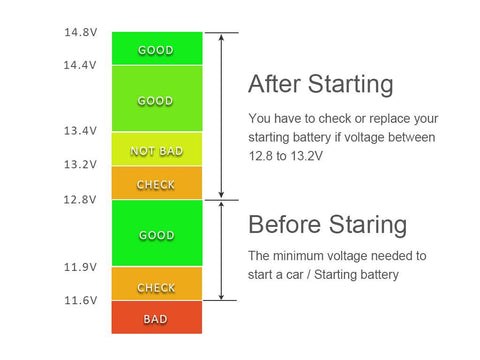
A static voltage reading, taken with the engine off, shows how much charge the battery holds. A cranking voltage reading, taken while the starter is working, shows whether the battery can deliver that charge quickly. The two answer different questions.
The question of what voltage should a car battery read while cranking is about the loaded test, not the resting test. A battery can show 12.6V at rest and collapse under load. Cranking voltage exposes that hidden weakness.
If you want to understand the resting cutoff before starting the engine, see our guide on what battery voltage is too low to start a car for the full breakdown.
State of Charge vs. Battery Health
State of charge is the amount of stored energy. Battery health is the ability to release that energy under load. A battery can be nearly full yet struggle to crank because of age, sulfation, or internal damage.
High internal resistance is the hidden cause. It makes voltage drop quickly as soon as the starter demands current. The cranking voltage test is the fastest way to notice the problem before the battery strands you.
Battery Chemistry: Flooded, AGM, EFB, and Lithium
The 9.6V rule was built around flooded lead-acid batteries. AGM batteries have lower internal resistance and often hold a higher cranking voltage. EFB batteries, common on start-stop vehicles, sit between flooded and AGM in performance.
Lithium batteries follow different rules. They hold a nearly flat voltage until they are almost empty, so the cranking minimum does not translate directly. Confirm the battery chemistry before judging a reading, and make sure your tester supports that chemistry.
How to Test Cranking Voltage Correctly
You need a digital multimeter or a battery monitor with peak capture. Set the meter to DC volts on the 20V scale. Connect the red lead to the positive battery post and the black lead to the negative post or a clean metal ground.
If your meter has a min/max mode, turn it on. Have someone crank the engine for a few seconds, then read the lowest value the meter recorded. Without min/max mode, watch the display live and note the lowest number you see.
Multimeter Setup and Safe Connection Order
Connect the red lead first, then the black lead. When you finish, disconnect the black lead first and the red lead last. Clean the battery posts and terminal clamps before testing, and never let the two leads touch while connected.
For a full explanation of this tool’s limits, read our guide on whether you can test a battery with a multimeter. It will help you avoid misreading the numbers.
Stop Conditions: When to Abort the Test Immediately
Never crank the engine for more than 10 to 15 seconds at a time. The starter motor builds heat quickly and needs at least a minute to cool between attempts.
Stop immediately if the battery case feels hot, looks swollen, or leaks fluid. Stop if you see sparks, smell burning plastic or acid, or hear the engine turning unusually slowly. These are warnings of a serious electrical issue, not just a weak battery.
Interpreting the Results: Battery, Cables, or Starter?
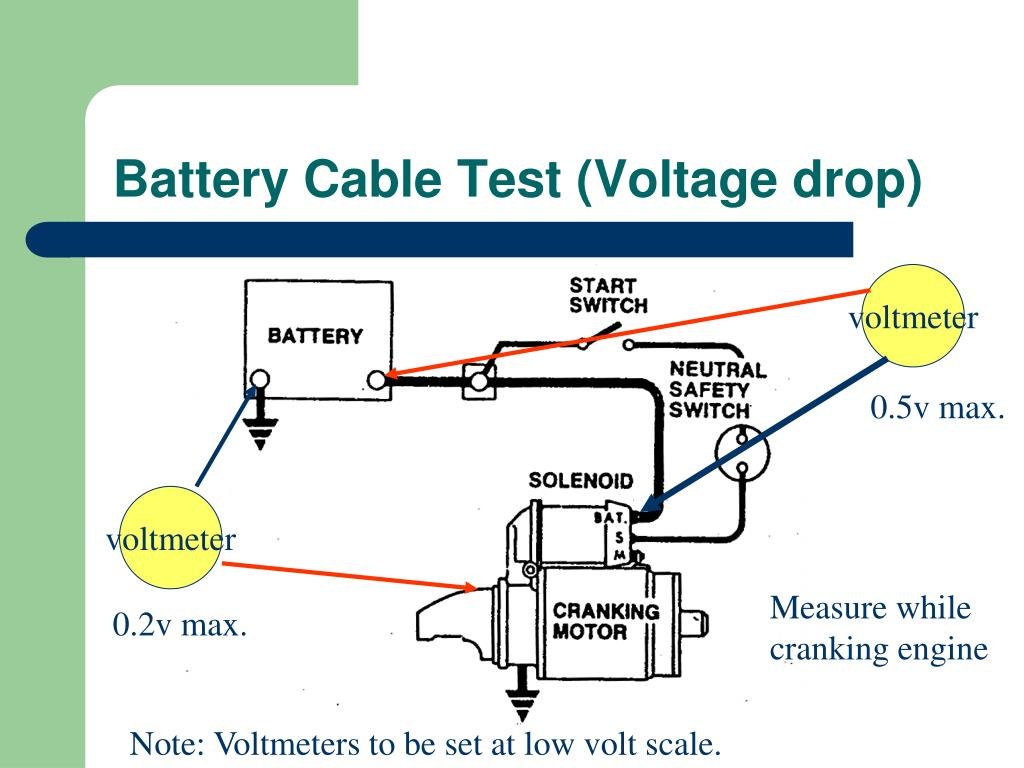
Every part of the starting circuit can drag voltage down. Corroded terminals, a loose ground strap, undersized cables, or a worn starter can all produce a low cranking reading even when the battery is healthy.
Start with the cheapest fixes: clean the terminals, tighten the clamps, and check the ground cable from the battery to the engine block and body. Retest after that before blaming the battery.
Below 9.6V: Where to Look Next
If the battery is fully charged, the terminals are clean, and cranking voltage still stays below 9.6V, the battery is the most likely suspect. Run a load test before replacing it, because a failing starter can produce the same symptom.
In cold weather, check the oil grade. Thicker oil raises the load on the starter and makes any battery look worse. In warm weather, a drop below 9.6V usually points to a real battery or starter problem.
The Starter’s Role: Don’t Blame the Battery Too Soon
A starter motor with worn brushes, bushings, or windings can pull far more current than it should. That extra draw shows up as a deep voltage sag during cranking, and the battery takes the blame for a starter that needs service.
Measure voltage at the battery posts and again at the starter solenoid while someone cranks. A difference of more than about half a volt means the positive cable or its connections have excessive resistance. If you have reached the point where the battery tester says good battery but the car will not start, this is the next area to inspect.
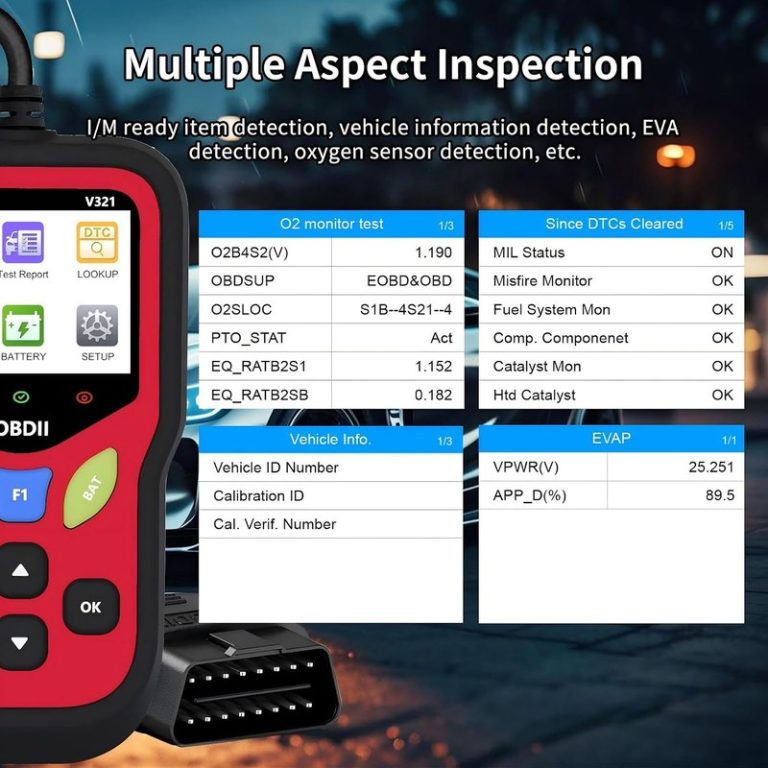
Using OBD2 Live Data to Check Cranking Voltage
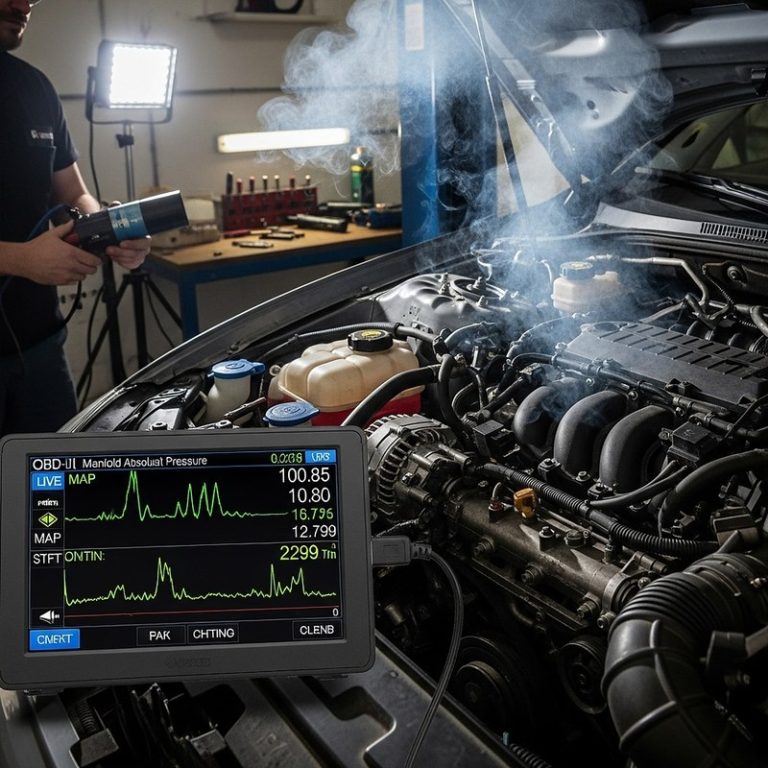
Many OBD2 scanners display live battery or control-module voltage. That is convenient, but it is not the same as watching a multimeter during cranking. The engine computer samples voltage at its own speed, and most generic scanners refresh too slowly to catch the lowest dip.
Use a scanner for a rough trend and a multimeter with min/max mode for a number you can trust.
Model-Year Coverage, Protocol, and Port Location
OBD2 is required in the US for 1996 and newer light-duty cars and trucks. The diagnostic port is usually under the left side of the dashboard near the steering column, and some vehicles hide it behind a small panel.
Plug the scanner in with the ignition off, then turn the ignition to the run position to read live data. If the scanner cannot connect, check for a blown OBD2 fuse or an incompatible scan tool before assuming the vehicle is the problem.
Ignition Mode, Live-Data Limits, and App Privacy
A real cranking test means turning the key to the start position while the meter records. Remote start will not work for this test, because the engine computer may skip the normal power-up sequence.
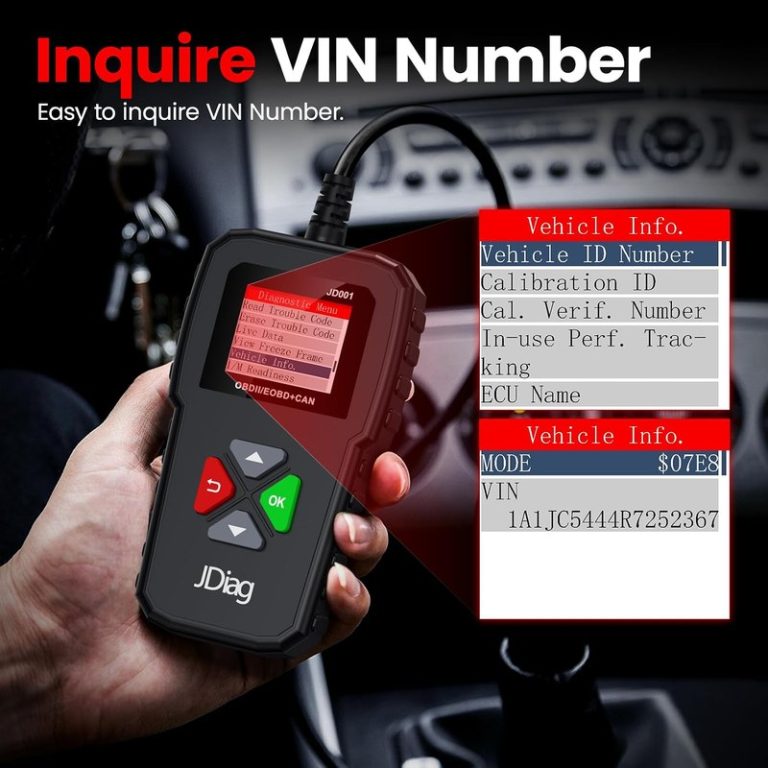
Diagnostic apps often request location, account sign-in, and vehicle identification. Review the app permissions before pairing a scanner, and write down any trouble codes before clearing them. If an app uploads your VIN, the data may not be stored only on your phone.
Temperature, Battery Age, and the Bigger Picture
A cranking voltage test is just a snapshot. Temperature, battery age, and driving habits all affect the result, so one low reading does not condemn the battery and one good reading does not guarantee next week.
CCA Ratings and Real-World Cranking Performance
Cold Cranking Amps (CCA) is a lab rating measured at 0°F. It describes how much current a new battery can deliver in cold conditions. If the battery’s CCA is far below what the vehicle needs, cranking voltage will sag sooner.
A conductance battery tester estimates the battery’s actual CCA compared with its rating. That comparison is a better sign of health than a single cranking snapshot because the test conditions stay consistent.
How Age and Climate Affect Voltage Readings
Lead-acid batteries typically last three to five years in most US climates. Heat accelerates internal corrosion, and cold exposes the damage by lowering available current. As the battery ages, internal resistance rises and cranking voltage falls.
This is separate from a charging system problem. Once the engine runs, the alternator should hold system voltage near 13.8 to 14.4 volts. If you notice numbers falling while you drive, our article on why car battery voltage drops while driving covers the causes and fixes.
Keep the battery top clean and the terminals tight. Grime and corrosion create small discharge paths that can cause false low readings during testing.
Next Steps: Charge, Load Test, or Replace
If the battery has been sitting for weeks, charge it before judging the cranking voltage. Our guide on whether you should charge a car battery before testing it explains why a low state of charge ruins the results.
Once the battery is fully charged and the terminals are clean, run the cranking test again. If the reading still sits below 9.6V, move to a proper load test.
Load Testing: The Only True Battery Health Check
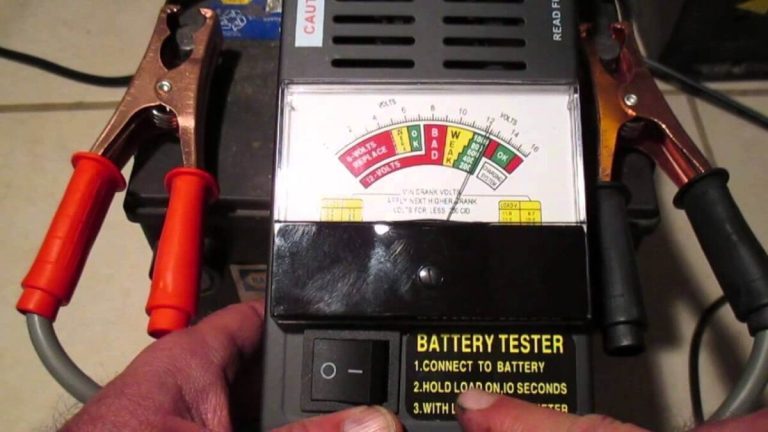
A load test applies a controlled discharge and measures how the voltage holds. Conductance testers are fast and safe, while carbon pile testers apply a real load. Both give more consistent results than a single cranking snapshot.
Use the load test to separate a battery problem from a starter or cable problem. The cranking voltage test says something is wrong. The load test says where the problem lives.
Replacement Costs, Emissions Readiness, and Reset Limitations
A replacement battery’s cost varies by type, group size, CCA rating, and retailer. Flooded batteries usually cost the least, AGM costs more, and lithium costs the most. Check current local and online prices before deciding.
Disconnecting the battery clears the engine computer’s memory. Radio presets, clock settings, seat memory, and idle-learned values can reset. On many gasoline vehicles, OBD2 emissions readiness monitors also reset to not ready until the car completes a drive cycle.
Some European vehicles require battery registration so the charging system knows the battery is new. Skipping registration can lead to incorrect charging behavior, and a shop with a bidirectional scan tool may be required to complete the procedure.
Hybrid and EV Cautions: A Different Set of Rules
Hybrids and EVs still carry a 12-volt auxiliary battery, but it does not spin a conventional starter. Instead, it powers the computers and closes high-voltage contactors. The 9.6V cranking rule does not apply the same way to every electrified powertrain.
The 12V Auxiliary Battery in Electrified Vehicles
In many hybrids and EVs, a DC-DC converter keeps the 12V battery charged from the high-voltage pack. A weak 12V battery can make the vehicle refuse to start even with a full high-voltage battery. Load-test the 12V battery first if an electrified vehicle shows no power.
Use the vehicle’s designated 12V jump terminals, not the traction battery. The owner’s manual shows the exact location and connection order.
High-Voltage Safety: When to Call a Professional
High-voltage cables in hybrids and EVs are orange and are not safe to touch. Do not cut into orange cables, probe connectors, or push tools near high-voltage components. Lethal voltage can remain present even after the vehicle is shut off.
- Best for: Owners who want a fast, free answer before replacing anything. A healthy 12V battery holds 9.6V or higher during cranking.
- Think twice if: You rely only on a cranking snapshot and skip the load test, since bad cables or a failing starter can cause the same sag.
- Next step: Charge the battery fully, clean and tighten the terminals, then run a cranking test and a real load test before spending money.
Frequently Asked Questions
A fully charged 12-volt lead-acid battery should stay above 9.6V while cranking at about 70°F. If it drops below that, the battery or starting circuit needs a closer look.
Many scanners show live battery voltage, but slow refresh rates can miss the lowest dip during cranking. A digital multimeter with min/max mode on the battery posts gives a more reliable reading.
Resting voltage shows state of charge, not battery health. If voltage collapses under the starter’s heavy load, the battery probably has high internal resistance from age or damage.
Yes. Cold slows the chemical reaction and thickens engine oil, so a healthy battery can briefly dip below 9.6V in freezing weather. Compare readings taken at similar temperatures instead of expecting the same number all year.
Not yet. Clean and tighten the terminals, charge the battery fully, and run a load test first. Corroded cables or a failing starter can drop cranking voltage even when the battery is healthy.
Corroded terminals, loose ground straps, and undersized cables add resistance to the starting circuit. A failing starter that draws too much current can also pull voltage below 9.6V. Measure at the battery posts and at the starter to locate the drop.