Can TOPDON BT200 Test Lithium Batteries? Key Limits Explained
The TOPDON BT200 cannot test lithium batteries; it is built for standard lead-acid, AGM, EFB, and GEL types only. If you own a LiFePO4 or lithium-ion battery, you need a lithium-capable tester.
The short answer to can topdon bt200 test lithium batteries is no: the TOPDON BT200 is a lead-acid battery tester, not a lithium-compatible analyzer. It uses conductance testing calibrated for standard flooded, AGM, EFB, and GEL batteries, so connecting it to a LiFePO4 or other lithium pack can produce misleading readings or trigger a stop condition. If you need to test a lithium battery, you need a different tool.
- Chemistry limit: The BT200 supports lead-acid, AGM, EFB, and GEL batteries only; lithium is not supported.
- Safety first: Never connect the BT200 to a hybrid or EV high-voltage traction pack.
- Wrong readings: Testing a lithium battery with the BT200 can produce false state-of-health reports.
- Right tool: Choose a lithium-capable tester if you own LiFePO4 or lithium-ion batteries.
- Verify before buying: Check the battery label for chemistry and CCA rating against the tester’s specs.
Does the TOPDON BT200 Test Lithium Batteries? The Short Answer
No. The BT200 is designed for 6V and 12V lead-acid batteries used in most conventional cars, trucks, motorcycles, and marine applications. It can run battery health tests, cranking tests, and charging system tests on those batteries. Lithium batteries are not on its supported chemistry list, and TOPDON does not advertise lithium testing for this model.
What the BT200 Is Actually Designed For
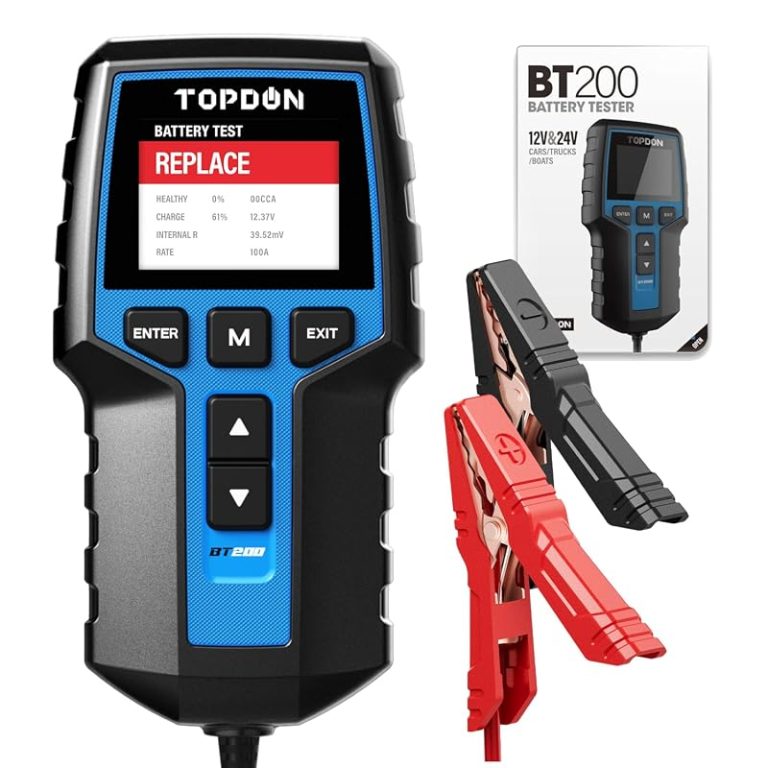
The BT200 is a handheld conductance tester with a built-in printer. It checks battery state of health, measures cranking voltage, and checks alternator output. Those three checks cover the most common electrical failures drivers face: a weak battery, a failing starter, or an undercharging alternator.
If you want to know exactly which functions the device performs, our guide on what the TOPDON BT200 tests breaks down each mode in plain language.
Why Battery Chemistry Determines Tester Compatibility
Battery chemistry changes how voltage, internal resistance, and capacity behave. Lead-acid batteries hold a fairly predictable voltage curve, so a tester can estimate state of charge from voltage and estimate state of health from conductance. Lithium batteries have a different voltage curve, much lower internal resistance, and a battery management system (BMS) that controls charging and discharging.
For example, a lead-acid battery at 12.4V is roughly 75% charged, but a lithium battery at the same voltage could be nearly empty. The voltage-to-charge relationship is simply not the same. That means a tester built for lead-acid cannot simply be reused on lithium.
How the BT200 Measures Battery Health: Conductance Testing Explained
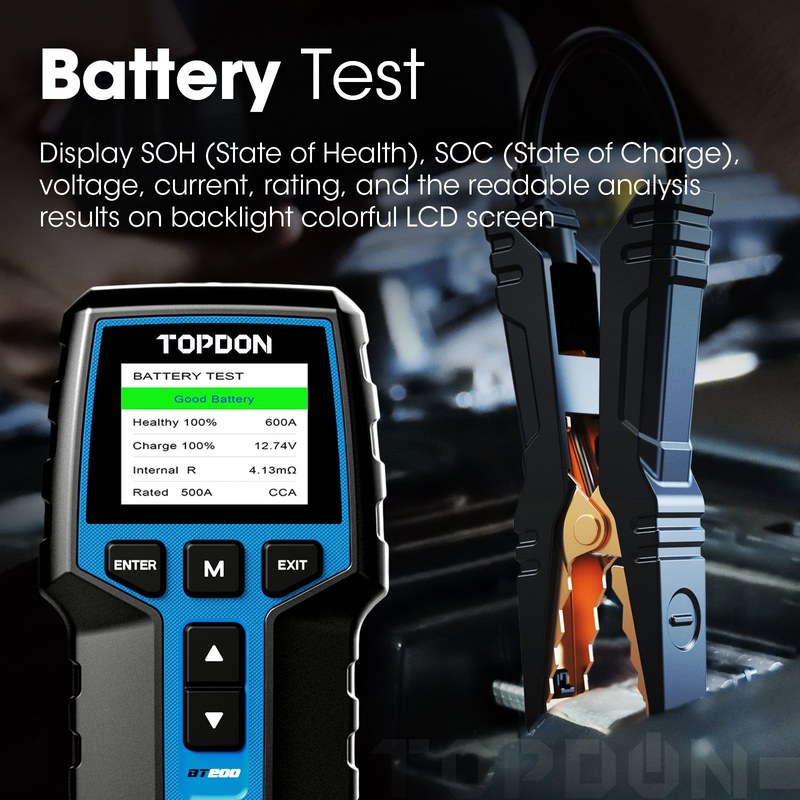
Conductance testing sends a small alternating current through the battery and measures how well the battery conducts it. Healthy lead-acid batteries conduct well; worn or sulfated batteries conduct poorly. The tester compares the reading against known values for the rated CCA and reports state of health as a percentage. The test takes only a few seconds and does not drain the battery, which makes it convenient for quick checks at home or at a dealership service counter.
Why Conductance Testing Is Calibrated to Lead-Acid Chemistry
Decades of data link lead-acid conductance to remaining capacity. The relationship is well documented for flooded, AGM, EFB, and GEL batteries. Lithium chemistry does not follow the same conductance-to-capacity curve, so the same calculation produces unreliable results on a lithium pack.
What the BT200 Measures That a Lithium Tester Would Need to Recalculate
The BT200 measures battery voltage, conductance-based capacity, cranking voltage drop, and charging voltage. A lithium tester would need to recalculate state of charge based on lithium voltage plateaus, use different internal resistance thresholds, and account for BMS behavior. The BT200 has no lithium calibration data built in, so it cannot perform those recalculations.
TOPDON BT200 Specs and Compatibility Limits
Supported Battery Types: Standard, AGM, EFB, and GEL
The BT200 supports standard flooded lead-acid, AGM (including start-stop), EFB, and GEL batteries. These cover most gasoline and diesel cars, light trucks, motorcycles, and boats with 6V or 12V electrical systems. Lithium is not on the supported list, and there is no firmware option to add it.
System Voltage, CCA Range, and Rating Standards
The BT200 works with 6V and 12V systems and supports multiple rating standards including CCA, CA, EN, IEC, DIN, and JIS. The exact CCA range depends on the standard you select. Most passenger car batteries fall well within the tester’s range, which is why it remains popular for home use. The tester also lets you adjust the rated capacity and choose the correct standard for your vehicle’s region, which matters for imported cars and motorcycles.
What the BT200 Is Not: No OBD2 Codes, No Live Data, and App Permission Notes
The BT200 is not an OBD2 scanner. It cannot read or clear diagnostic trouble codes, show live sensor data, or communicate with the vehicle’s engine computer. It is a battery and electrical system tester only. Some TOPDON companion apps request location or account permissions for firmware updates and data logging; review those permissions before installing them on your phone.
What Happens If You Connect the BT200 to a Lithium Battery?
Voltage Misreads and False State-of-Health Reports
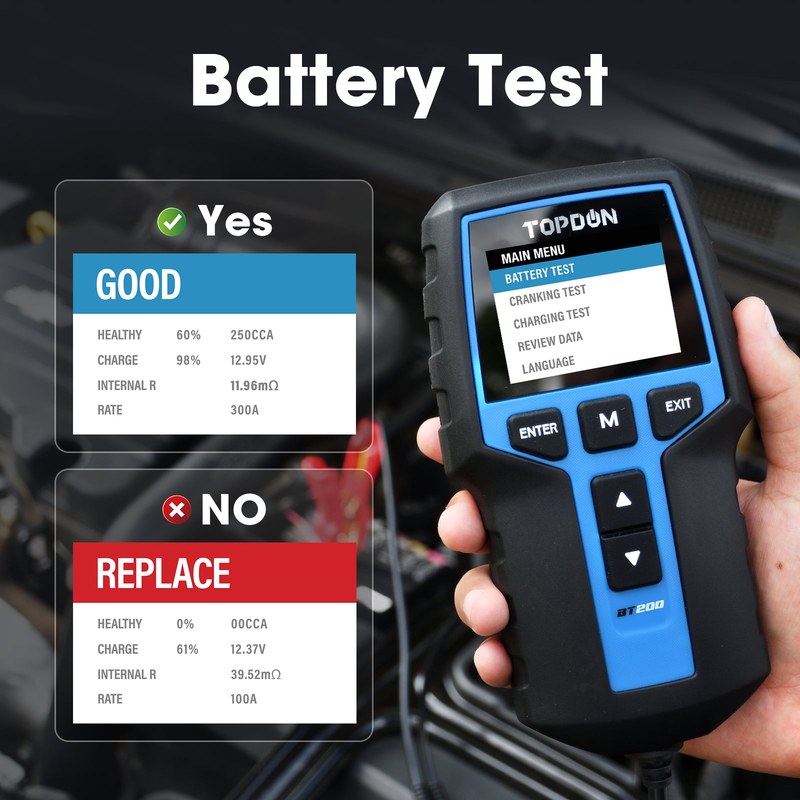
Lithium batteries often sit at a higher resting voltage than lead-acid batteries. A fully charged 12V LiFePO4 battery can rest around 13.3 to 13.6 volts, while a lead-acid battery rests near 12.6 to 12.8 volts. The BT200 may interpret that voltage as an overcharged or faulty lead-acid battery, producing a false state-of-health report that could lead you to replace a perfectly good lithium battery. The tester’s internal reference tables assume lead-acid voltage behavior, so it tries to fit lithium readings into a lead-acid model and comes to the wrong conclusion.
Damaged-Battery Stop Conditions and Built-In Safety Protections
The BT200 includes reverse polarity protection and safety stop conditions. If the tester detects voltage or resistance outside its expected lead-acid range, it may refuse to complete the test. That protects the tester, but it does not give you useful information about the lithium battery. In some cases, the tester may show an error code that is meaningless for lithium chemistry. This is safer than letting the tester proceed with bad data, but it still leaves you without a lithium health reading.
State of Charge vs State of Health: Why Lithium Needs a Different Test
State of charge (SoC) tells you how full the battery is. State of health (SoH) tells you how much usable capacity remains compared to when it was new. Lead-acid testers estimate both from voltage and conductance. Lithium testers need different math for both because lithium voltage stays relatively flat during discharge and then drops sharply near empty.
How a Lithium Battery Management System (BMS) Handles Testing
Most lithium batteries include a BMS that monitors cell voltages, temperature, and charge balance. The BMS can disconnect the battery under load or when a cell is out of range. That means an external tester may see an open circuit or a sudden voltage drop that has nothing to do with the battery’s actual health.
Which Testers Can Actually Read LiFePO4 and Other Lithium Chemistries
Several battery testers on the market now include lithium modes for LiFePO4, lithium-ion, and other chemistries. Look for a tester that explicitly lists lithium support in its specifications, not just a wide voltage range. Our roundup of the best car battery testers for AGM and lithium batteries compares models that handle both chemistries.
Hybrid and EV Cautions: Where the BT200 Stops
Testing 12V Auxiliary Batteries in Start-Stop and Hybrid Vehicles
Many hybrids and start-stop vehicles use a small 12V auxiliary battery to power lights, computers, and accessories. If that auxiliary battery is a standard AGM or EFB lead-acid unit, the BT200 can test it. Check the battery label first to confirm the chemistry and rating before connecting the tester.
Never Point the BT200 at High-Voltage Traction Packs
Hybrid and electric vehicles also contain high-voltage traction batteries, typically rated from 200V to 800V. The BT200 is not rated for those systems. Connecting it to a high-voltage pack can damage the tester and create a serious shock hazard.
TOPDON BT200 vs Lithium-Capable Testers: Side-by-Side Comparison
Comparing Test Criteria: Voltage Range, Chemistry Support, and Accuracy
When comparing battery testers, look at three things: supported chemistry, system voltage range, and rating standards. The BT200 wins on lead-acid coverage and built-in printing. Lithium-capable testers add chemistry modes but often cost more and may not include a printer.
| Option | Best for | Owner consideration | Driver consideration |
|---|---|---|---|
| TOPDON BT200 | Lead-acid battery health, cranking, and charging checks | Built-in printer saves notes; no subscription | Compact handheld; clear pass/fail readout |
| Lithium-capable tester | Owners with LiFePO4 or lithium-ion batteries | Higher upfront cost; verify lithium modes before buying | One tool covers both lead-acid and lithium vehicles |
Which Option Fits Different Drivers and Vehicles
If you drive a conventional gasoline car or truck with a lead-acid battery, the BT200 is a solid fit. If you own an RV, boat, or off-road rig with a lithium house battery, you need a lithium-capable tester. Some drivers keep both: a BT200 for the daily driver and a lithium tester for the secondary battery. Consider how many vehicles you maintain and whether any of them use lithium. A single lithium-capable tester might serve both needs if it also supports lead-acid chemistries.
Using the BT200 Correctly: Connection Order, Test Steps, and Limits
Correct Connection Order and Disconnect Sequence
Connect the red clamp to the positive terminal first, then the black clamp to the negative terminal. Select the correct battery type and rating standard before starting the test. After the test, disconnect the black clamp first, then the red clamp. Always follow the instructions in the TOPDON BT200 manual for your specific unit.
Testing Conditions: Cold Battery, Surface Charge, and Ignition State
For accurate results, test a battery that has rested for a few hours. A cold battery reads weaker than a warm one, so test at a moderate temperature when possible. Surface charge from recent driving can inflate voltage readings. Turn off the ignition, lights, and accessories before connecting the tester. If the battery was just charged or the vehicle was driven recently, let it rest first. A surface charge can make a weak battery look healthy.
When a Professional Battery Test or Shop Diagnosis Is Required
If the BT200 reports a battery as good but the vehicle still struggles to start, the problem may be a parasitic drain, a failing starter, or a charging system fault. A professional shop can run a load test and inspect the charging circuit. If you see corrosion on terminals, swollen battery cases, or unusual odors, stop testing and have the vehicle inspected. The BT200 is a screening tool, not a substitute for a full electrical diagnosis.
Verdict: Should You Buy the TOPDON BT200 in 2026?
Ideal User and Vehicle Profile
The BT200 is ideal for DIY owners with one or more conventional lead-acid vehicles. It is also useful for small fleets, motorcycle owners, and anyone who wants printed proof of a battery test. The printed output is handy for warranty claims and maintenance logs, which many owners appreciate. If you never plan to own a lithium battery, the BT200 covers your needs well for most home garages.
Drawbacks, Warranty, and Ownership Costs
The main drawback is chemistry support. It cannot test lithium, and it cannot read OBD2 codes. The built-in printer needs thermal paper, which is an ongoing consumable cost. TOPDON’s warranty terms vary by product and region, so check the TOPDON BT200 warranty guide before buying.
- Supports standard, AGM, EFB, and GEL lead-acid batteries
- Built-in printer provides instant test records
- Tests battery, cranking, and charging systems
- No subscription or smartphone required
- No lithium chemistry support
- Not an OBD2 scanner
- Thermal paper is a recurring purchase
Transparent Final Verdict and Next Steps
For lead-acid vehicles, the BT200 remains a practical, no-subscription tester with a useful printer. For lithium owners, it is the wrong tool. Check your battery label, confirm the chemistry, and choose a tester that matches your actual fleet.
- Best for: DIY owners with conventional lead-acid cars, trucks, motorcycles, or boats who want a printed battery test record.
- Think twice if: You own a LiFePO4 or lithium-ion battery and need to test its state of health.
- Next step: Check the battery label for chemistry and CCA rating, then confirm the BT200 supports that type before you buy.
Frequently Asked Questions
No. The BT200 supports standard lead-acid, AGM, EFB, and GEL batteries only. Lithium chemistries such as LiFePO4 and lithium-ion require a tester with lithium-specific calibration.
The BT200 supports 6V and 12V standard flooded lead-acid, AGM, EFB, and GEL batteries. It also tests cranking and charging systems on vehicles with those battery types.
The tester may show a voltage misread, report a false state of health, or trigger a stop condition. Disconnect it and use a lithium-compatible tester instead.
No. The BT200 is a battery and electrical system tester only. It cannot read or clear diagnostic trouble codes, show live engine data, or communicate with the vehicle computer.
State of charge tells you how full the battery is. State of health tells you how much usable capacity remains compared to when it was new. Lithium testers need different calculations for both.
Look for a tester that explicitly lists LiFePO4 or lithium-ion support in its specifications. Compare several models to confirm the voltage range and rating standards match your battery.