Cca vs Ca on a Car Battery Tester: Why Cca Is the Better Standard
The short answer: CCA is tested at 0°F while CA is tested at 32°F, so CCA is the harder test and the better number to trust. Use CCA readings to judge battery health and cold-weather starting ability.
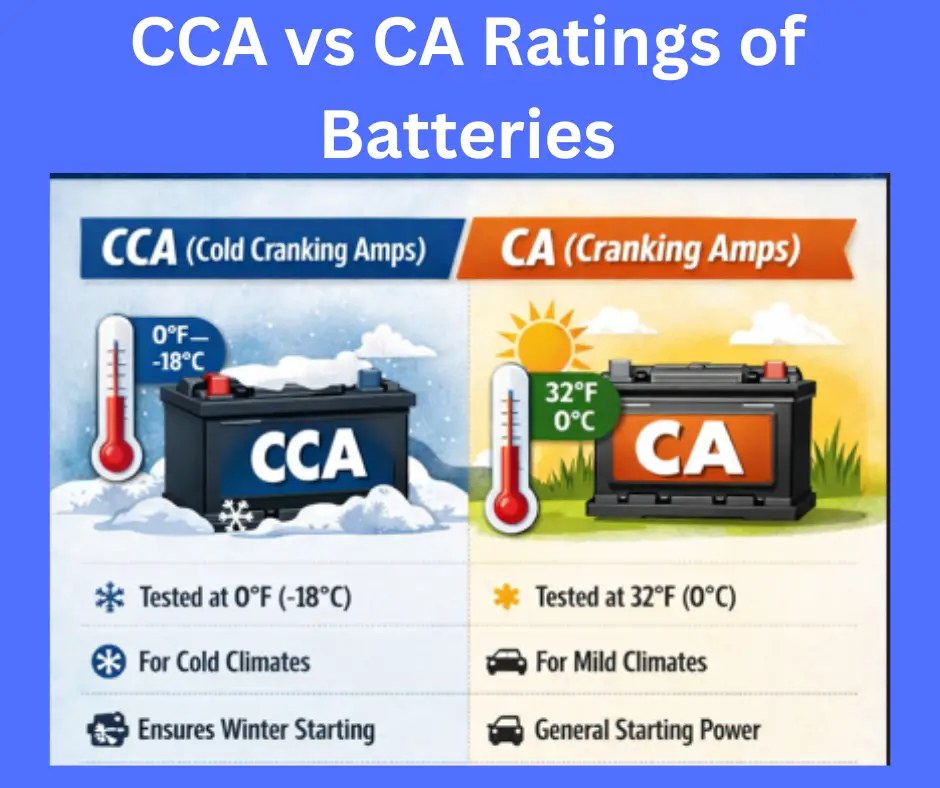
Understanding cca vs ca on a car battery tester comes down to one simple fact: the temperature of the test. CCA means Cold Cranking Amps, measured at 0°F. CA means Cranking Amps, measured at 32°F. That difference makes CCA the tougher, more honest standard.
- CCA vs CA difference: CCA is tested at 0°F; CA at 32°F, which makes CCA the stricter rating.
- Battery health: Falling CCA numbers reveal sulfation, rising internal resistance, and aging.
- Testing setup: Clean terminals, correct chemistry mode, and a rested battery matter most.
- Borderline results: Retest after a full charge before you decide to replace the battery.
- Before buying: Look for chemistry modes, a wide CCA range, and printed results.
CCA vs CA on a Car Battery Tester: The Short Answer
CCA: Cold Cranking Amps Measured at 0°F
Cold Cranking Amps is the amount of current a fully charged 12-volt battery can deliver at 0°F for 30 seconds while holding voltage above 7.2 volts. This is the common definition used across the battery industry. In plain terms, a battery rated 600 CCA should keep strong current flowing through the hardest part of a freezing-cold start.
CA: Cranking Amps Measured at 32°F
Cranking Amps uses the same 30-second test but at 32°F. Warmer temperatures lower internal resistance, so the same battery almost always shows a higher CA number than its CCA number. A 600 CCA battery might show 700 CA or more. That sounds reassuring until the thermometer drops well below freezing.
Why the 32-Degree Difference Makes CCA the Stricter Standard
Cold weather is exactly when batteries fail. At 0°F, oil thickens, chemical reactions slow, and the starter motor draws more current. CA measures at a temperature that is mild by comparison. A battery that passes CCA will almost certainly pass CA, but not the other way around. That is why technicians treat CCA as the stricter standard.
Breaking Down CCA and CA Ratings for Real-World Starting
How Temperature Affects Battery Output and Starting Power
Battery chemistry slows as temperatures drop. At 32°F, a lead-acid battery can deliver more current than at 0°F, and the engine is easier to spin because the oil is thinner. Real winter starting combines a weaker battery with a harder-to-turn engine. CCA ratings predict whether the battery can survive that exact moment.
Battery Chemistry: Flooded, AGM, EFB, and Gel Differences
Flooded batteries use liquid electrolyte and are the most common type. AGM batteries hold the electrolyte in fiberglass mats, resist vibration, and usually have lower internal resistance. EFB batteries improve on standard flooded designs and are common in modern start-stop vehicles. Gel batteries are rare in ordinary cars. Set the correct chemistry on your tester because CCA behavior differs between types.
Which Rating Matches Your Climate and Driving Habits
Drivers in cold states should treat CCA as the key number. Drivers in warmer states face less risk, but sudden cold snaps happen everywhere. Short winter trips also strain a battery because the alternator never fully restores the charge. A higher CCA rating gives you a wider safety margin in any climate.
Why CCA Is the Better Standard for Battery Health Testing
State of Charge vs True Battery Health: Know the Difference
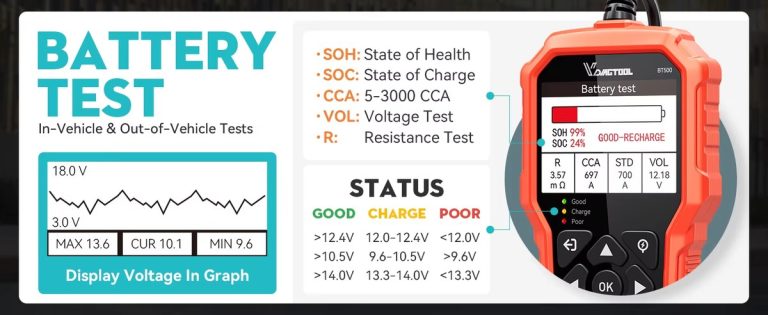
State of charge tells you how full the battery is. State of health tells you how much capacity the battery has lost through age and use. CCA feeds directly into the health calculation. A low state of charge can be fixed by charging. A low CCA reading points to permanent damage. If you see a low state of health message on your tester, here is what that result really means.
How CCA Testing Exposes Sulfation and Internal Resistance
Sulfation occurs when a lead-acid battery sits partially discharged. Lead sulfate crystals build up on the plates, shrinking the active area and raising internal resistance. Modern testers measure this resistance and compare it against the rated CCA. As internal resistance climbs, the CCA number falls. That gives you an early warning before the battery leaves you stranded.
Why CA-Only Readings Can Give You False Confidence
A degraded battery can still look healthy at 32°F because the warmer test hides the damage. The same battery may fail the stricter 0°F test minutes later. If your tester displays both numbers, rely on the CCA result. It gives a far more honest picture of real-world starting ability.
How to Read Your Tester’s CCA and CA Results Correctly
Match the Rating Scale to Your Battery Chemistry
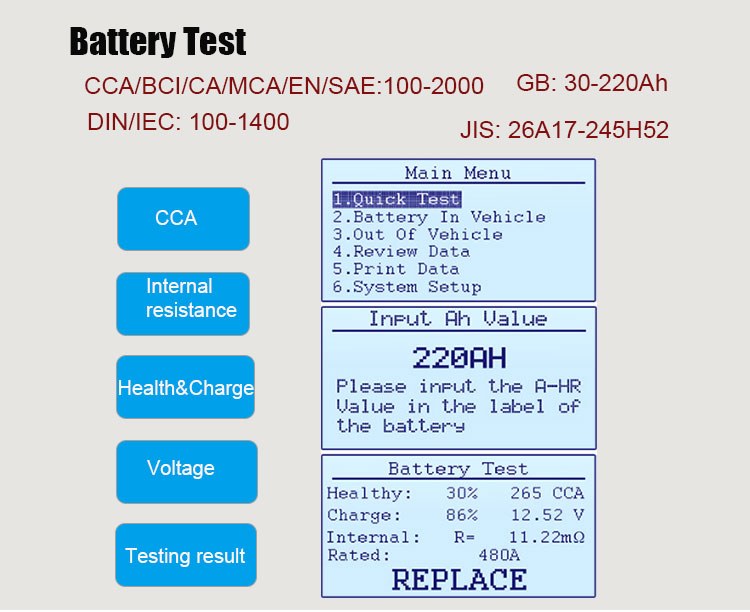
Set the battery type before you start. Most testers ask you to choose flooded, AGM, EFB, or gel. Testing in the wrong mode can shift the CCA result enough to mislead you. Check the label on the battery if you are not sure what type you have.
Check: Battery group size, system voltage (most cars use 12V), terminal location, and the rated CCA printed on the label. Limitations: Many testers only support 12V lead-acid batteries. Lithium and high-voltage hybrid packs require specialized equipment.
System Voltage and Correct Connection Order
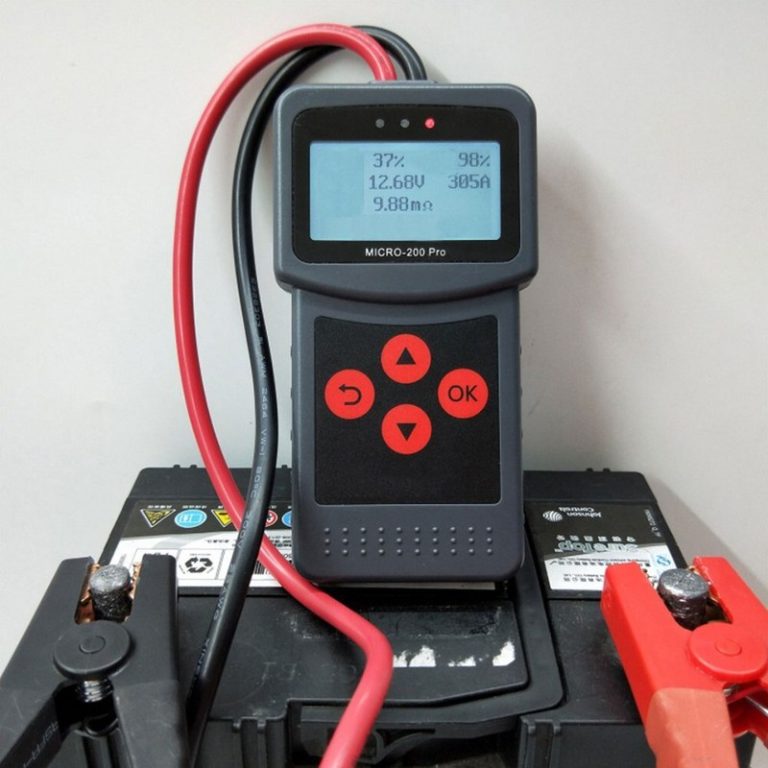
Connect the red clamp to positive and the black clamp to negative. Remove corrosion from the terminals first because a poor connection causes bad readings. A healthy 12-volt battery at rest should read close to 12.6 volts. If the tester shows a very different voltage, clean the clamps and reconnect.
Damaged-Battery Stop Conditions You Should Never Ignore
Never test a battery with visible cracks, swelling, leaks, or a strong sulfur odor. Stop and plan for replacement. Damaged lead-acid batteries can release hydrogen gas or acid, and clamping on a tester can ignite fumes. A quick test is not worth the risk of injury.
Matching CCA Ratings to Your Vehicle’s Requirements
Find the OEM Spec on the Battery Label or Door-Jamb Placard
Before you test, find the rated CCA for your vehicle. The original battery label and the driver’s door-jamb placard are the best places to look. The owner’s manual also lists the specification. Replacement batteries show CCA right on the label, and your tester needs that number to calculate health.
Aftermarket Batteries and CCA Compatibility
Aftermarket batteries often advertise higher CCA than the factory battery. That is fine in cold climates, but the physical group size and terminal orientation matter more. A battery with more CCA that does not fit the tray is useless. Always match the group size printed on the battery label.
Hybrid and EV Battery Testing Cautions
Standard battery testers are built for 12-volt lead-acid batteries. Never connect one to the high-voltage pack in a hybrid or EV. The small 12-volt auxiliary battery in many hybrids and EVs can be tested like any other lead-acid battery, but the orange high-voltage cables under the hood remain a serious hazard.
Common CCA Testing Mistakes That Skew Your Results
Testing a Battery With a Surface Charge
A battery that was driven or charged within the last few hours carries a surface charge that inflates the voltage reading. That can make the battery look healthier than it is. Wait a few hours, or use the tester’s surface-charge removal feature, before you trust the CCA result. If you are unsure, it helps to know whether you should charge a car battery before testing it.
Temperature Compensation and Cold-Battery Readings
CCA is defined at 0°F, but your garage is probably warmer. Many testers ask you to enter the battery temperature and then compensate the result. A warm battery can test higher than the same battery at 20°F. Always enter the temperature the tester asks for.
Interpreting Borderline CCA Numbers Without Overreacting
A reading slightly below the rated CCA does not always mean the battery is dead. Charge level, temperature, and connection quality all affect the result. If the message says replace but the car starts fine, charge the battery and test again. When the second test still shows low CCA, plan for replacement soon. This guide covers situations where the tester says replace the battery but the car still starts.
- Test a battery that has rested for several hours
- Clean the terminals before clamping
- Select the correct chemistry mode
- Retest after a full charge when results look borderline
- Test right after driving or charging
- Ignore a swollen, cracked, or leaking case
- Mix up the chemistry mode on the tester
- Skip recording the reading for later comparison
When to Trust Your Tester and When to Call a Professional
DIY Replacement Thresholds and Battery Warranty Claims
Most auto parts stores test batteries for free, and many provide printed results. If your home tester and a store tester agree that the battery is weak, replacement is usually the right call. Keep the receipt and the test printout as documentation. Many batteries carry a pro-rated warranty, and the store may need evidence to process a claim.
Charging System and Parasitic Drain Diagnosis Limits
A battery tester judges the battery, not the alternator or the wiring. If the battery tests good but the car will not start, the charging system or a parasitic drain may be at fault. Watching voltage while the engine runs can help, but tracking a drain usually requires a multimeter and careful measurement.
When Professional Load Testing Is Required
Conductance testers estimate CCA by measuring internal resistance. A professional carbon pile load tester applies a real electrical load and measures the voltage drop, which is a more direct test. If your tester keeps giving confusing or contradictory results, take the battery to a shop with professional-grade load testing equipment.
Choosing a Car Battery Tester That Reports CCA Accurately
Features That Matter: CCA Range, Chemistry Modes, and Printouts
A good home tester should cover the CCA range your vehicles need, usually up to at least 1000 CCA. Chemistry modes for flooded, AGM, EFB, and gel are essential if you own more than one type. Printed reports or a companion app make it easy to track results and support warranty claims. Our roundup of the best car battery testers for home use can help you compare options.
Budget vs Professional Testers: What You Actually Get
Entry-level testers estimate CCA and read voltage, which is enough for most drivers. Mid-range testers add chemistry modes and temperature compensation. Professional testers add printed reports, wider CCA ranges, and more precise measurement. Buy for the vehicles in your driveway, not the shop you do not run.
Calibration, Maintenance, and App Permissions to Consider
Tester accuracy drifts over time, and professional units need periodic calibration. Most budget testers are not user-calibratable, so treat their readings as estimates. Before installing a companion app, review its permissions and check what battery data it collects.
- Confirm the tester supports your battery chemistry and CCA range
- Check whether it handles both 6V and 12V systems
- Review included cables, clamps, and carrying case
- Look for a warranty and a real customer support line
- Decide whether you need printed results for warranty claims
Final Verdict: Make CCA Your Primary Battery Standard
Quick Takeaways for Every Driver
CCA and CA measure the same ability at different temperatures, and 0°F is the harder test. Use CCA when judging battery health, set the correct chemistry on your tester, and test a rested battery with clean connections. Retest after a full charge whenever a result looks borderline.
Next Steps: Test Your Battery Before Winter Hits
Fall is the best time to test your battery. A battery that struggles in September will likely fail in January. Charge it fully, clean the terminals, set the chemistry mode, and record the CCA result. If the number falls near or below the rated CCA, replace the battery before the first cold snap.
- Best for: Drivers who want an early, reliable warning of battery failure, especially before winter.
- Think twice if: You only need a quick voltage check — a multimeter handles that, but it will not give you CCA or true health data.
- Next step: Find the rated CCA on your battery label or door-jamb placard, then test your battery with that number entered on your tester.
Frequently Asked Questions
CCA stands for Cold Cranking Amps, the amount of current a 12-volt battery can deliver at 0°F for 30 seconds while staying above 7.2 volts. It is the most common measure of battery starting power.
Yes. CCA is tested at the colder, harder temperature of 0°F, while CA is tested at 32°F. If a battery passes CCA, it will almost always pass CA, so CCA gives you a more honest health reading.
Check the battery label or your owner’s manual for the rated CCA. If your tester reading is close to or above that number, the battery is healthy. A result well below the rated number means the battery is aging.
Yes, but set the tester to the AGM chemistry mode first. AGM batteries have different internal resistance than flooded batteries, and using the wrong mode can give an inaccurate CCA result.
A low reading can mean the battery is partially discharged, cold, or has built up sulfation. Charge the battery fully, let it rest, clean the terminals, and retest before you draw conclusions.
Test twice a year, once before winter and once in late spring. If you notice slow cranking or dim headlights, test sooner regardless of the calendar.