Battery Tester vs Multimeter Which Is Better for Car Batteries
A battery tester is usually the better tool for car battery health because it can estimate cranking ability and condition, not just voltage. A multimeter is still the better choice for broader electrical diagnosis like charging issues, voltage drop, and parasitic drain checks.
battery tester vs multimeter which is better for car batteries comes down to one simple question: do you want a fast battery health answer, or do you need broader electrical diagnosis? For most car owners, a dedicated battery tester is the better first tool because it can estimate battery condition and cranking ability faster than a basic multimeter, while a multimeter stays valuable for checking voltage, charging problems, and battery drain.
- Best first tool: Most owners should buy a battery tester before a multimeter.
- Main difference: Voltage is not the same as battery health or cranking ability.
- Compatibility check: Confirm support for flooded, AGM, EFB, gel, or lithium batteries before buying.
- Safety first: Do not test swollen, leaking, cracked, hot, or frozen batteries at home.
- Modern vehicle limit: Some battery and charging faults still require a scan tool or professional diagnosis.
Battery Tester vs Multimeter: Which Is Better for Car Batteries in 2026?
If your car is slow to crank, sits for long periods, or has random low-voltage issues, these two tools do different jobs. A battery tester is built to answer, “Is this battery still good?” A multimeter is built to answer, “What is happening in this circuit right now?”
Why a dedicated battery tester is usually better for battery health checks
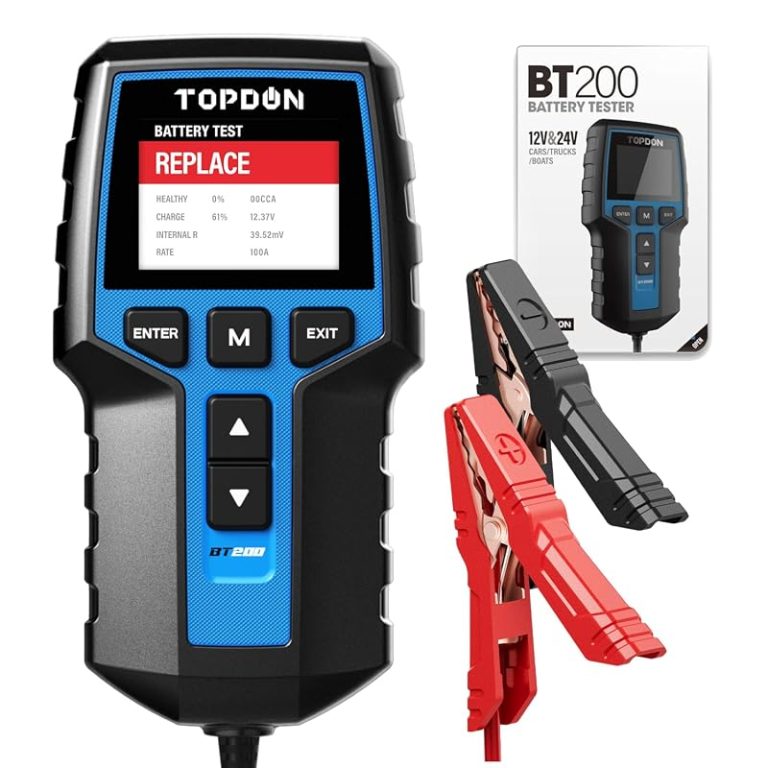
A modern battery tester is usually the better choice when your main concern is battery health. Most handheld testers use conductance-based analysis or a similar method to estimate cold cranking ability, state of charge, and overall battery condition without the old-style heavy load test many drivers picture.
That matters because a weak battery can still show decent voltage at rest. A tester goes beyond that simple number. It can help you spot a battery that is charged but worn out, or one that may recover after charging and retesting. If you want a deeper look at what these tools report, see what a battery tester tells you.
When a multimeter is the smarter tool for voltage and charging-system diagnosis
A multimeter becomes the smarter tool when the battery may not be the only problem. It can measure battery voltage, alternator charging voltage, continuity, and in some cases current draw. That makes it more flexible for tracing electrical faults, checking cable voltage drop, or confirming whether the charging system is doing its job.
It is also useful after a battery has been charged or replaced. You can verify whether the vehicle is charging normally and whether the battery voltage falls too low during cranking. But that flexibility comes with more room for user error, especially on current and fuse settings.
The short answer for daily drivers, DIY owners, and professional-level troubleshooting
For daily drivers and most DIY owners, the better first purchase is a battery tester. For broader troubleshooting, a multimeter is the better second tool. Professional-level diagnosis often uses both, plus a scan tool, service information, and sometimes more advanced load or current-testing equipment.
How Each Tool Works on a 12-Volt Vehicle Electrical System
What a battery tester measures: state of charge, cranking ability, and battery health
A battery tester typically asks for battery type and rating, such as CCA or another standard printed on the label. It then estimates how much starting power the battery can still deliver. Many also display state of charge, internal resistance or a similar indicator, and a recommendation such as good, recharge and retest, or replace.
This is why a tester is often more useful than guessing from symptoms alone. A battery can crank fine one morning and fail the next after temperature changes or a short-trip pattern that never fully recharges it.
What a multimeter measures: system voltage, parasitic draw, continuity, and alternator output
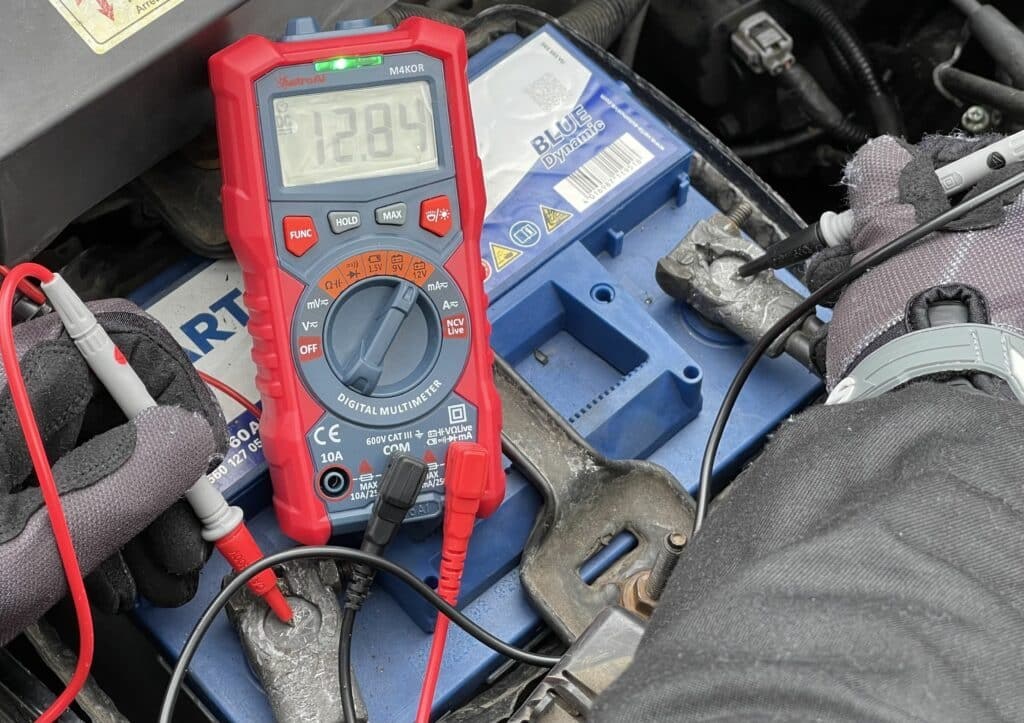
A multimeter directly measures electrical values. On a car, that usually means DC voltage first. You can check open-circuit battery voltage, watch voltage during cranking, and confirm charging voltage with the engine running. Some meters also let you test current draw and continuity, which helps with parasitic drain diagnosis and wiring checks.
If you are only asking whether a battery has some charge left, that may be enough. If you are trying to separate a weak battery from a charging problem or overnight drain, the meter becomes more important.
Why state of charge is not the same as battery health
This is where many owners get tripped up. State of charge tells you how full the battery is right now. Battery health tells you how much of its original performance remains. A worn battery can be fully charged and still fail under load. A healthy battery can be low on charge and recover well after proper charging.
That difference is the biggest reason a multimeter cannot fully replace a battery tester for battery decisions. If you want the voltage-only side explained in more detail, CarValleyNJ also covers whether you can test a battery with a multimeter.
Battery chemistry compatibility: flooded lead-acid, AGM, EFB, gel, lithium, and start-stop systems
Not every tester supports every chemistry. Many consumer units work with standard flooded lead-acid and AGM batteries. Some add EFB support for start-stop vehicles. Gel and 12-volt lithium starter batteries may require a tool that specifically lists support. A multimeter does not care about chemistry when reading voltage, but voltage interpretation can differ by battery type.
Check: Verify battery chemistry, battery rating standard, vehicle system voltage, and whether the battery is part of a start-stop system. Limitations: Some testers do not support every AGM, EFB, gel, or lithium application, and hybrids or EVs may have separate high-voltage rules.
Side-by-Side Comparison: Accuracy, Speed, Cost, Safety, and Driver Value
Which tool gives faster answers before a no-start leaves you stranded
For a quick go-or-no-go answer, the battery tester wins. It is usually faster because the workflow is guided: connect clamps, enter battery information, and read the result. That makes it more practical for families, commuters, and anyone maintaining more than one vehicle.
A multimeter can be quick too, but only if you already know what voltage ranges mean and understand their limits. Otherwise, it is easy to see 12.4 volts and assume the battery is fine when it may still be weak.
Which tool is easier and safer for beginners to use correctly
For beginners, a battery tester is usually easier and safer. The clamps are obvious, the menus are simpler, and there is less chance of selecting the wrong function. A multimeter is safe when used correctly, but mistakes like wrong jack placement, wrong range, or current testing in the wrong way can blow the meter fuse or create sparks.
Ownership cost, maintenance needs, firmware updates, and long-term usefulness
Ownership cost varies widely by brand and feature set, so it is smarter to compare categories than guess at exact prices. Basic multimeters are often inexpensive. Battery testers usually cost more, especially if they support more battery types, wider rating ranges, or printer and app features.
Long-term usefulness depends on your needs. A tester is more specialized, while a multimeter can help with many household and automotive tasks. Some digital testers and connected scan tools may also need firmware updates or app support over time.
Best fit by vehicle type: older gas cars, modern start-stop vehicles, trucks, hybrids, and EVs
Older gas vehicles are generally the easiest case. Either tool can be useful, and access is often straightforward. Modern start-stop vehicles benefit more from a tester that supports AGM or EFB batteries correctly. Trucks may need a tool that handles higher battery ratings or dual-battery setups, depending on the model.
Hybrids and EVs still have a 12-volt system in many cases, but they also have high-voltage components that change the safety picture. A battery tester or multimeter can help on the 12-volt side only when the tool and procedure fit the vehicle. Do not assume the same DIY approach applies across all electrified vehicles.
How to Test a Car Battery Safely With Either Tool
Correct connection order, ignition mode, and where to test under-hood versus trunk-mounted batteries
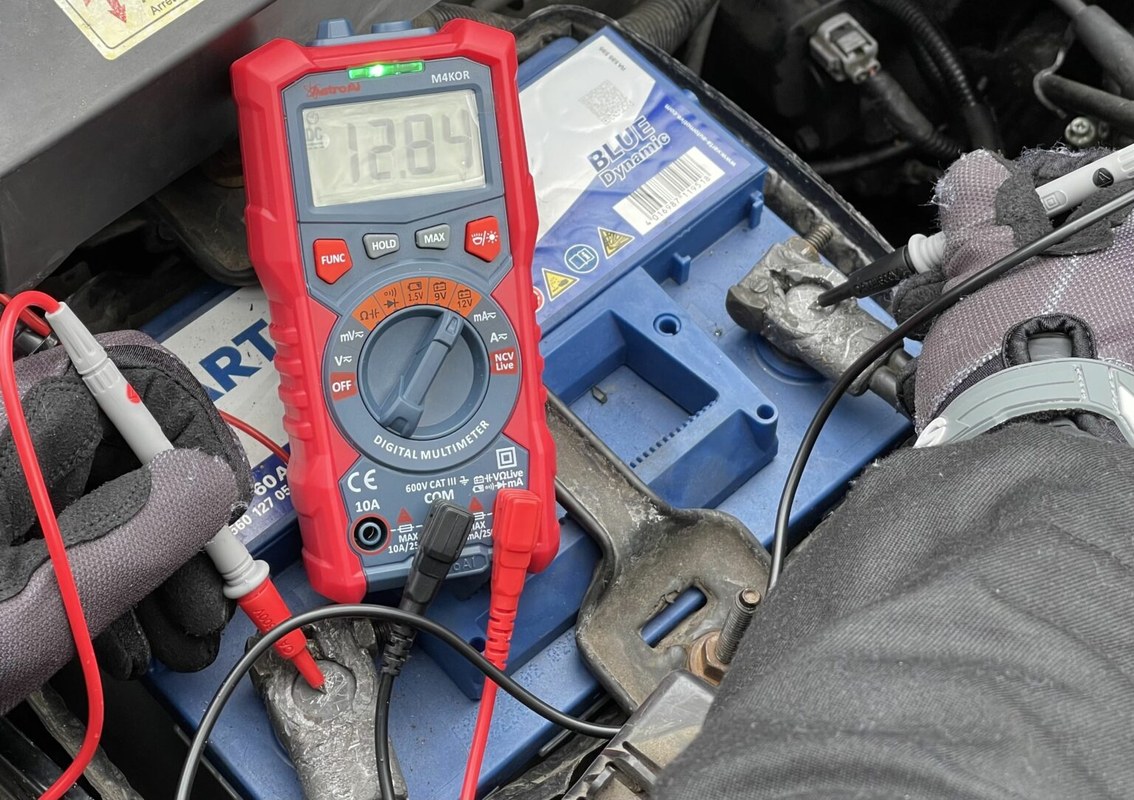
Start with the vehicle parked, in a safe location, with the ignition off unless your procedure specifically calls for key-on or engine-running checks. Connect the positive lead or clamp to the positive terminal first, then negative to negative or the approved ground point if the manufacturer specifies one.
Some vehicles have trunk-mounted batteries but under-hood jump posts or test points. In those cases, follow the vehicle manual. Testing at the wrong point can give confusing results or create access and safety problems.
Damaged-battery stop conditions: swelling, leaks, heat, cracked case, corrosion, and frozen batteries
Do not test or charge a visibly damaged battery the same way you would a normal one. Swelling, leaking electrolyte, a cracked case, severe corrosion, unusual heat, or signs of freezing are stop conditions. The safest next step is to follow the vehicle manual and seek professional service.
Hybrid and EV cautions, including high-voltage system boundaries and when not to DIY
Hybrid and EV owners should treat high-voltage components as off-limits unless the service procedure specifically allows owner access. The 12-volt battery may still be serviceable, but orange cables, high-voltage labels, and battery-pack areas are not a place to experiment with a meter.
If the vehicle will not enter ready mode, shows high-voltage warnings, or has multiple electrical faults after a low-voltage event, professional diagnosis is the safer path.
Safe location, traffic visibility, storage conditions, and post-use inspection for roadside emergencies
If you are checking a battery on the roadside, visibility matters as much as the reading. Move as far from traffic as possible, use hazard flashers, and avoid leaning into traffic-side engine bays. After use, inspect the clamps or probes, coil the leads neatly, and store the tool where heat and moisture will not ruin it.
- Confirm the battery type and the correct test points before connecting anything
- Record voltage and test results before charging, replacing, or clearing related fault information
- Recheck cable tightness and visible corrosion if the result does not match the symptom
- Probe damaged, leaking, swollen, or frozen batteries as if they are normal
- Use current mode on a multimeter unless you fully understand the circuit and meter limits
- Work in a traffic lane or near moving belts and fans with loose clothing or jewelry
Using a Battery Tester: The Best Method for Most Car Owners
Entering the right battery standard, rating, and chemistry for valid results
A battery tester is only as good as the information entered. You need the correct battery type and rating standard from the label. If the battery is AGM and the tool is set for flooded, or if the wrong rating is entered, the result may be misleading.
That is one reason guided instructions matter. If you need a step-by-step walkthrough, see this guide on how to test a battery with a battery tester.
How to read CCA, internal resistance, recharge-retest results, and replace recommendations
CCA is a starting-power rating, not a measure of charge level. If the tester says recharge and retest, the battery may not be bad yet. It may simply be too low for a valid health judgment. Internal resistance or related health indicators can help explain why a battery that shows fair voltage still struggles in real use.
A replace recommendation becomes more convincing when it matches the symptoms: slow cranking, repeated low voltage, age-related decline, or failure to hold charge after proper charging.
Limits of handheld testers and when a result still needs professional confirmation
Handheld testers are very useful, but they are not magic. A bad cable connection, a recently charged surface voltage, extreme temperatures, or a battery with unusual failure patterns can affect the result. If the reading conflicts with the vehicle’s behavior, confirm the basics and consider a second test after charging or a professional check.
That is also why it helps to understand how accurate a battery tester is before treating one screen result as final.
Using a Multimeter: When Voltage Readings Help and When They Mislead
Open-circuit voltage ranges for a 12-volt battery and what they mean
Open-circuit voltage can tell you a lot about state of charge after the car has been off long enough for the battery to settle. In general terms, around 12.6 volts suggests a full battery, around 12.4 volts suggests partial charge, and much lower readings point toward a discharged battery. Exact interpretation varies with temperature, battery chemistry, and recent charging history.
Useful does not mean complete. A battery can show a decent open-circuit number and still have poor cranking performance.
Checking cranking voltage drop and alternator charging voltage without overreaching the tool
A multimeter shines when you watch what happens during cranking and charging. If the voltage drops sharply during start-up, that can support a weak-battery suspicion. With the engine running, charging voltage that is too low or too high may point toward alternator or regulation issues.
Still, this should be treated as a screening step. Charging-system diagnosis can involve load conditions, cable condition, grounds, and vehicle control strategy that go beyond one number on a meter.
Why a multimeter cannot fully replace a conductance or load-style battery test
A multimeter measures voltage very well. It does not directly measure remaining cranking capacity the way a dedicated battery tester is designed to estimate. That is the key limitation. Voltage is one clue, not a full battery health report.
So if your question is “Can this battery still do its job?” the tester is better. If your question is “What is the electrical system doing right now?” the multimeter is better.
Common mistakes: wrong meter settings, blown fuses, reverse polarity, and inaccurate conclusions
Common errors include using the wrong DC range, leaving the leads in the current jack, touching the wrong points, or assuming a single reading proves the battery is good. Reverse polarity can also confuse results or damage some tools. The biggest mistake, though, is diagnostic overconfidence from one voltage check.
Compatibility and Diagnostic Limits on Modern Vehicles
Model-year and protocol coverage for OBD2-related battery and charging diagnosis
Battery testers and multimeters do not replace scan tools on modern vehicles. Many charging and battery-management systems are computer-controlled, and some faults only show up through codes or live data. OBD2 coverage varies by model year, protocol, and tool capability.
Port location, ignition mode, and what scan tools can add beyond a tester or multimeter
A scan tool can add charging-system data, battery-management faults, readiness status, and sometimes service functions after battery replacement. Port location is usually under the dash, but the ignition mode required for reading data can vary by vehicle. Some cars need key-on, while others use a push-button sequence.
Code and live-data limits, emissions readiness, and reset limitations after battery service
After battery replacement or a full discharge, some vehicles may lose adaptive settings or set low-voltage-related codes. Clearing codes too early can erase useful clues. It can also reset emissions readiness monitors, which may matter before inspection in some states.
App permissions, Bluetooth privacy concerns, firmware support, and when diagnosis requires a professional
Bluetooth scan tools and app-based diagnostic tools can collect VIN-related and usage data depending on the app and account setup. Review permissions and support policies before leaving a dongle plugged in all the time. If the car has network communication faults, repeated module warnings, or battery registration requirements, a professional-level tool or shop may be needed.
Troubleshooting Weak Starts, Charging Problems, and Battery Drain
How to tell whether the problem is the battery, alternator, starter, cables, or a parasitic draw
Start with the symptom pattern. Slow cranking after sitting can point to a weak battery or parasitic drain. A battery that keeps going low after driving may suggest charging problems. A single click with good voltage may involve the starter circuit, poor cable connections, or the starter itself.
If the battery repeatedly dies overnight, the issue may go far beyond battery age. CarValleyNJ has a separate guide on why a car battery dies after sitting overnight if that is your exact symptom.
Current limits, cable or jump-pack condition, and tool completeness for emergency starting
Neither a battery tester nor a multimeter starts the car. In a real emergency, cable condition, jump-pack condition, and safe connection order matter just as much. A weak or damaged battery may still refuse to recover enough for a safe restart, especially in cold weather or with larger engines.
When repeated low voltage affects TPMS, infotainment, driver-assist systems, and stored vehicle settings
Modern vehicles can act strangely after repeated low-voltage events. You may see warning lights, lost radio presets, disabled auto start-stop, window relearn issues, or temporary driver-assist warnings. That does not always mean those systems failed. Sometimes they are reacting to unstable system voltage.
Professional-repair thresholds for chronic drain, warning lights, and intermittent no-start conditions
If the battery tests good but the car still has intermittent no-start problems, recurring warning lights, or chronic drain, it is time to go beyond driveway diagnosis. Electrical faults that involve modules, network communication, hidden drains, or battery registration are often faster and safer to solve with service information and professional tools.
What to Buy and What to Do Next
Best choice for most owners: battery tester first, multimeter second
If you are buying one tool for car battery decisions, start with a battery tester. It answers the most common owner question better: should I charge, keep, or replace this battery? A multimeter is still worth adding later because it helps confirm charging voltage, voltage drop, and other electrical issues.
Who should buy both tools and who can skip one
Buy both if you maintain multiple vehicles, help family members with dead batteries, own an older vehicle with occasional electrical quirks, or do regular DIY work. You can skip the multimeter for now if you only want simple battery health checks. You can skip the battery tester only if you already understand the limits of voltage-based diagnosis and rarely need battery-specific answers.
What to check after replacement or charging: registration, resets, readiness monitors, and maintenance habits
After charging or replacement, verify terminal tightness, charging voltage, and any vehicle-specific battery registration requirement. Some vehicles may need window, clock, or infotainment resets. If inspection readiness matters in your state, remember that power loss or code clearing can affect monitor status.
Transparent verdict: the better tool depends on whether you need battery health answers or broader electrical diagnosis
The debate is not really about which tool is universally better. It is about which question you need answered. For battery health, the battery tester wins. For wider electrical troubleshooting, the multimeter wins.
- Best for: A dedicated battery tester is the best first tool for most owners who want fast, clearer battery health answers before a no-start becomes a bigger problem.
- Think twice if: You expect one tool to diagnose every charging, wiring, starter, and battery-management issue on a modern vehicle.
- Next step: Match the tool to your battery type and vehicle system, then confirm the safe testing procedure in the vehicle manual before you connect anything.
Frequently Asked Questions
For battery health, usually yes. A battery tester is built to estimate cranking ability and condition, while a multimeter mainly shows voltage. Voltage alone can miss a battery that is charged but worn out.
You can use a multimeter for voltage checks, cranking drop checks, and charging-system screening. It is useful, but it does not fully replace a dedicated battery test when you need a clear keep, charge, or replace answer.
Some do and some do not. Check the tool’s supported battery chemistries and rating standards before buying, especially if your vehicle uses AGM, EFB, or start-stop hardware.
Yes, if the battery is in normal condition and you follow the vehicle and tool instructions. Stop if the battery is swollen, leaking, cracked, unusually hot, or frozen, and use extra caution with hybrids and EVs.
Sometimes. Some modern vehicles may need battery registration, code checks, or system resets after replacement, while others do not. The requirement depends on the make, model, year, and electrical system design.
Check battery chemistry support, system voltage, lead quality, display clarity, and update policy. Also confirm whether you need current testing, app features, or simple battery health checks only.