How Long Should You Run a Car After Using a Jump Starter? 15 Minutes
Run your car for about 15 minutes after a jump start, preferably while driving, so the alternator can restore enough charge for the next start. If the battery is old or damaged, no amount of driving will fix it.
Knowing how long should you run a car after using a jump starter is the difference between a reliable restart and a second dead battery in the same morning. The short answer is about 15 minutes of driving for most modern vehicles. That window gives the alternator time to replace the energy the starter pulled from the battery and leaves enough reserve for the next start.
- 15-minute rule: Drive about 15 minutes after a jump start so the alternator can restore enough.
- Drive, don’t idle: Driving at normal speeds spins the alternator faster than idling, which recharges the battery.
- Safety first: Connect positive first and ground last, and never jump a cracked, swollen, or leaking.
- Know your battery: A healthy battery recovers in 15 minutes; an old or failing battery needs a.
- Check the charging system: If the car dies again, test the battery, alternator, and parasitic drain before buying.
The 15-Minute Rule: How Long to Run Your Car After a Jump Start
Most vehicle manufacturers and battery specialists point to 15 minutes as the practical minimum recharge window after a jump start. It is not a random number. It reflects the balance between alternator output, battery capacity, and the energy needed for the next cold start.
Why 15 Minutes Is the Practical Recharge Window for Most Vehicles
A typical passenger car battery stores around 48 amp-hours of usable energy. A single start draws only a small fraction of that, but a deeply discharged battery needs far more than the few minutes it took to connect the cables. Fifteen minutes of driving at moderate RPM lets the charging system replace enough energy to support the next start without relying on a second jump.
Shorter drives of five minutes or less may leave the battery in a borderline state. If you only run the engine briefly and shut it off, you may be right back where you started. The 15-minute rule gives you a buffer that short trips cannot provide.
What the Alternator Actually Restores in That Time
The alternator does not work at full output the moment the engine fires. It needs the engine to spin at a reasonable speed, usually above idle, to produce meaningful current. At idle, many alternators produce only a fraction of their rated output because the pulley ratio limits how fast the rotor spins.
During 15 minutes of driving, the alternator can put back a meaningful portion of the charge the battery lost. It will not fully recharge a deeply discharged battery. That takes hours on a proper charger. But it will restore enough capacity to restart the engine and keep the electrical system stable.
The Battery Science: Why a Jump Start Only Begins the Recharge
A jump start delivers a burst of current that cranks the starter motor and wakes up the engine. Once the engine runs, the alternator takes over. But the battery chemistry does not instantly accept all the energy the alternator can produce. The recharge process has limits built into the battery itself.
System Voltage and the 13.5–14.7V Alternator Sweet Spot
Most modern vehicles run a 12-volt electrical system, but the alternator charges at a higher voltage. The typical charging range sits between 13.5 and 14.7 volts depending on the vehicle, temperature, and electrical load. That elevated voltage is what pushes current back into the battery.
If you measure battery voltage with the engine running and see something below 13.5 volts, the charging system may not be working properly. A reading above 14.7 volts can indicate an overcharging condition. Both situations deserve attention before you trust the 15-minute rule. For more detail on the lower limit, check our guide on what battery voltage is too low to start a car.
State of Charge vs. State of Health: A Dead Battery Isn’t Always a Bad One
State of charge tells you how full the battery is right now. State of health tells you how much life the battery has left. A battery can be deeply discharged but perfectly healthy, or fully charged but weak and near the end of its service life.
This distinction matters after a jump start. If the battery is healthy and simply drained by a left-on dome light, 15 minutes of driving may be enough to get you going again. If the battery is old, sulfated, or has a damaged cell, no amount of driving will restore it. The 15-minute rule assumes a battery that can still hold a charge.
Flooded, AGM, and EFB Chemistry: How Battery Type Changes the Recharge Math
Flooded lead-acid batteries are the traditional choice in many vehicles. They accept charge at a moderate rate and tolerate the occasional deep discharge, though repeated deep discharges shorten their life.
AGM (absorbent glass mat) batteries are common in newer vehicles with start-stop systems. They accept charge faster and handle cycling better than flooded batteries, but they also require controlled charging voltages. EFB (enhanced flooded battery) technology sits between the two, offering better cycling life than standard flooded batteries.
The battery type affects how quickly the battery accepts the alternator’s current, but it does not change the basic 15-minute guideline. It mainly changes how well the battery recovers over the following hours and days.
Before You Connect: Jump-Start Safety and Correct Connection Order
The 15-minute rule only matters if the jump start itself goes safely. Connecting cables in the wrong order can create sparks near the battery, which is risky because batteries can emit hydrogen gas.
The Right Order: Dead Positive First, Ground Last
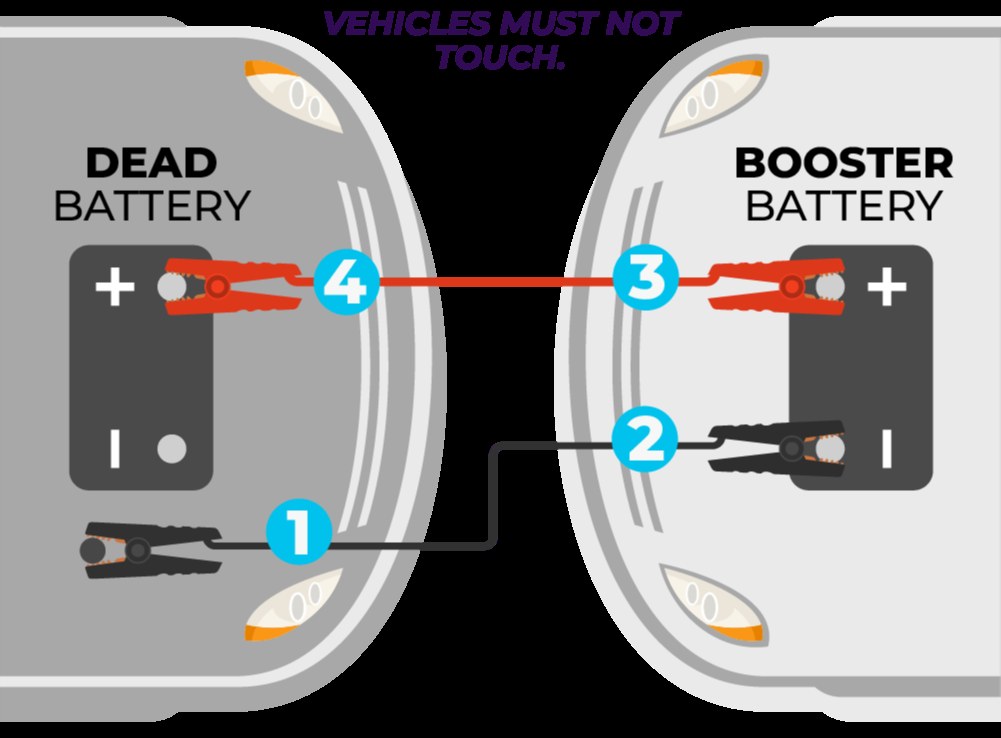
The standard sequence for jumper cables is straightforward. Connect the positive clamp to the dead battery’s positive terminal first. Then connect the other positive clamp to the good battery’s positive terminal. Connect the negative clamp to the good battery’s negative terminal. Finally, connect the last negative clamp to a metal ground point on the dead car’s engine block or chassis, not to the dead battery’s negative terminal.
That final connection away from the battery reduces the chance of sparks near the battery. When disconnecting, reverse the order. Remove the ground clamp first and the positive clamp last.
Damaged-Battery Stop Conditions: Cracks, Swelling, Leaks, and Smells
Before you connect anything, inspect the battery. Look for cracks in the case, swelling or bulging sides, leaking fluid, or a rotten-egg sulfur smell. Any of these signs means the battery may be damaged internally or externally.
If you see any of these conditions, do not jump start the vehicle. A damaged battery can short circuit, leak acid, or in rare cases rupture during a jump start. Call a professional tow service or replace the battery first. This applies whether you are using jumper cables or a portable jump starter.
Safe Location and Traffic Visibility: Never Jump-Start on a Curve
Where you park matters as much as how you connect the cables. A dead battery often means a dead car in a driveway, parking lot, or roadside. If you are on the road, pull as far off the travel lane as possible. Avoid curves, hills, and blind corners where other drivers cannot see you.
Turn on your hazard lights, set the parking brake, and place a warning triangle or reflective flares behind the vehicle if you have them. Wear a reflective vest if you are working near traffic. Your safety matters more than getting the car running quickly.
How to Spend the 15 Minutes: Idle vs. Driving
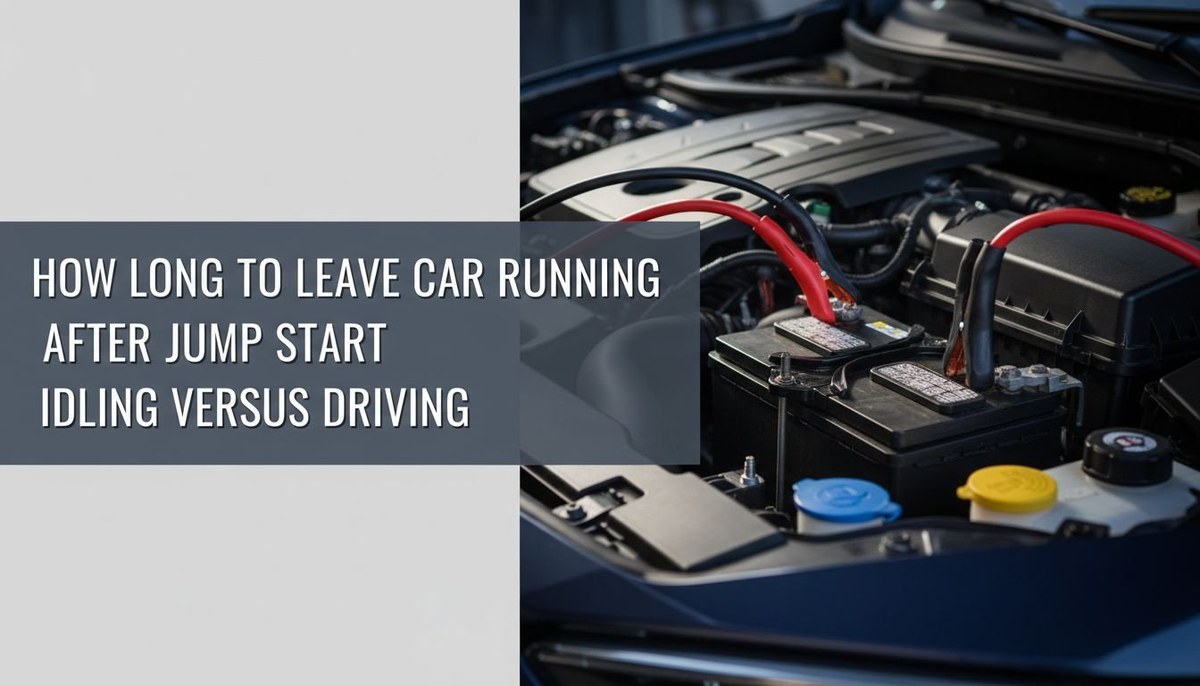
Once the engine is running, you have two choices: let it idle in the driveway or drive for 15 minutes. The better choice for most drivers is to drive.
Driving Beats Idling: Why Raising RPM to 2,000 Helps
At idle, most engines spin around 700 to 900 RPM. At that speed, the alternator produces less current than it does at cruising RPM. When you drive, the engine runs faster, typically above 1,500 to 2,000 RPM, and the alternator spins faster too. Faster spinning means more output and a quicker recharge.
Driving also gives the battery the benefit of the vehicle’s normal electrical load. The battery receives more current than it would at idle, and the trip itself gets you to your destination. If you must idle, raise the engine speed slightly with light throttle, but do not hold the gas pedal in a way that feels unsafe.
Turn Off Headlights, HVAC, and Audio to Maximize Alternator Output
Every electrical load in the car draws current from the charging system. Headlights, the blower fan, the rear defroster, heated seats, and the audio system all compete with the battery for alternator output. Turning off unnecessary loads leaves more current available to recharge the battery.
You do not need to drive in the dark without headlights. Use common sense. If it is daytime, turn off the lights. Set the climate fan to low or off. Mute the radio. The fewer loads you run during the 15-minute window, the faster the battery recovers.
- Drive for at least 15 minutes after a successful jump start
- Turn off headlights, HVAC, rear defroster, and audio when safe
- Inspect the battery for cracks, swelling, leaks, or smells before connecting
- Connect the final ground clamp to a metal engine bracket, not the battery
- Shut the engine off after a short five-minute idle and expect a reliable restart
- Jump start a battery that is cracked, swollen, leaking, or smells like sulfur
- Connect the negative clamp to the dead battery’s negative post
- Work on a curve, hill, or blind corner without hazard lights and warning devices
When 15 Minutes Isn’t Enough: Signs Your Battery Is Failing
The 15-minute rule works when the battery is fundamentally sound. When it is not, the car may start again right after the drive but fail again the next morning. Knowing the warning signs helps you decide whether to keep driving or replace the battery.
Slow Cranks, Dimming Lights, and the Multimeter Test
A slow crank sounds like the engine is turning over reluctantly. The dash lights may dim while the starter engages. If the headlights look noticeably dimmer at idle and brighten when you rev the engine, the battery or charging system is struggling.
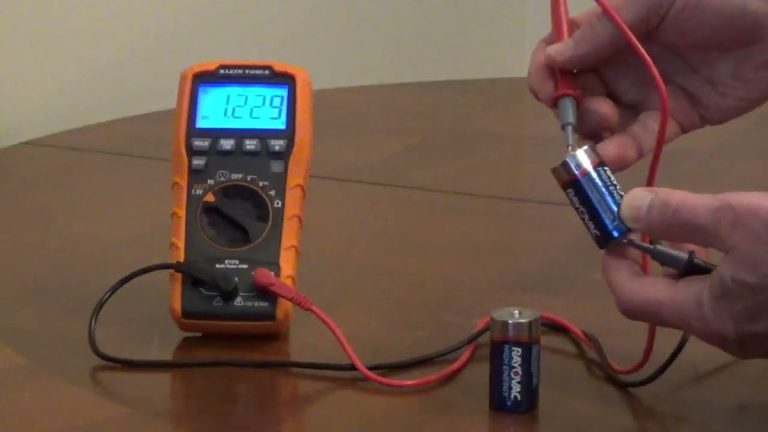
A digital multimeter gives you a quick voltage check. With the engine off, a healthy battery should read around 12.4 to 12.6 volts or higher. With the engine running, you should see roughly 13.5 to 14.7 volts. If the resting voltage drops below 12.4 volts shortly after a 15-minute drive, the battery is not holding its charge well. Our guide on whether a portable jump starter can damage a car battery covers related charging concerns.
When to Hand It to a Professional for a Load Test
A multimeter measures voltage, but it does not measure the battery’s ability to deliver current under load. That requires a load test. Many auto parts stores offer this service free, and a professional technician can perform a more detailed test in the shop.
If the battery fails a load test, the 15-minute rule will not save it. Replace the battery before it strands you again. If the battery passes but the car still dies, the alternator, starter, or a parasitic drain may be the culprit. A professional diagnosis is the safest next step.
Jump Starter vs. Jumper Cables: Which Tool Fits Your Driving Profile?
Both jumper cables and portable jump starters can get a dead car running. The right choice depends on your vehicle, your driving habits, and whether you usually have a second car nearby.
Peak Amps and Current Limits: Matching the Pack to Your Engine Size
Portable jump starters list peak amps, which is the maximum current the unit can deliver in a short burst. A small four-cylinder engine may start with a pack rated around 400 to 600 peak amps. A large V8 or diesel engine needs more current, sometimes 1,000 peak amps or higher. Matching the pack to your engine size matters because an undersized pack may struggle or fail to crank the engine. Our guide on how many amps you need to jump start a car explains the numbers in more detail.
Cable Condition, Pack Charge, and Tool Completeness Checks
Jumper cables are simple, but they fail in specific ways. Corroded clamps, cracked insulation, and frayed wires reduce current flow and create safety risks. Check the full length of the cables before you rely on them.
Portable jump starters need attention too. A jump pack with a dead internal battery cannot help anyone. Check the pack’s charge level before you store it and again before a long trip. Confirm that the clamps are clean, the cables are not frayed, and the unit powers on. If you are choosing a new unit, our guide on how to choose a jump starter for your car covers the key decision points.
Storing Your Jump Pack: Temperature Limits and Maintenance
Most portable jump starters use lithium-ion batteries, which prefer moderate temperatures. Extreme heat in a closed car during summer and freezing cold in winter both reduce performance and shorten pack life. Store the pack in a climate-controlled space when possible, such as a garage or cabin, rather than leaving it in the trunk year-round.
Recharge the pack every few months even if you never use it. Lithium cells self-discharge slowly, and a pack left at a very low charge for months may lose capacity permanently.
Hybrid and EV Cautions: The Rules Change for Electrified Vehicles
Hybrids and electric vehicles do not behave like conventional gas cars when the battery dies. The rules for jumping them are different, and the consequences of a mistake are more serious.
Why Hybrids Jump the 12V Battery, Not the High-Voltage Pack
Most hybrids have a small 12-volt battery that runs the computer, lights, and accessories. When a hybrid “won’t start,” the 12V battery is usually the problem, not the high-voltage traction battery. You jump the 12V battery just like a conventional car, but the jump points may be under the hood, in the trunk, or behind a labeled access panel.
Never connect jumper cables to the orange high-voltage cables or components. The high-voltage system can deliver a lethal shock. Always consult the owner’s manual for the exact jump-start procedure and location.
EV-Specific Procedures and Manufacturer Warnings
Most pure EVs do not need a jump start in the traditional sense because they do not have a starter motor. But they do have a 12V battery that powers the computers and contactors. If that 12V battery dies, the EV may not wake up or shift into drive.
Some EVs include a special access point or require the use of a specific terminal under a cover. Others warn against using a traditional jump starter at all. Follow the manufacturer’s instructions exactly. When in doubt, call roadside assistance or a qualified technician.
Post-Jump Inspection and Next Steps
The 15-minute drive is only part of the job. After you arrive, a quick inspection helps you decide whether the car is truly back to normal or just temporarily running.
The 5-Minute Post-Use Inspection Checklist
Once the engine is off, take five minutes to check a few things. Look at the battery terminals for corrosion, which appears as white or blue-green crust. Make sure the cable clamps are tight and the battery hold-down bracket is secure. Check the alternator belt for cracks or looseness if you can see it.
Then restart the car. If it cranks quickly and starts on the first try, the 15-minute drive did its job. If it cranks slowly or hesitates, the battery or charging system still needs attention.
If It Dies Again: Battery Replacement vs. Alternator Diagnosis
A battery that dies again after a successful jump start and 15-minute drive points to one of three problems. The battery may be too old to hold a charge. The alternator may not be charging properly. Or something in the car may be draining the battery while it sits.
Start with a battery test. Many parts stores test batteries and alternators free. If the battery fails, replace it. If the battery passes, ask for an alternator output test and a parasitic draw check. A professional diagnosis costs a little time but prevents buying parts you do not need.
If the battery is simply old and weak, the safest move is replacement before the next failure strands you. The 15-minute rule is a helpful guideline, but it cannot fix a battery that has reached the end of its service life.
- Best for: Drivers with a reasonably healthy battery who need a quick, reliable restart after a one-time drain.
- Think twice if: The battery is old, damaged, or fails a load test. No driving time will fix a battery that cannot hold a charge.
- Next step: After your 15-minute drive, test the battery with a multimeter or a professional load test to confirm it is truly recovered.
Frequently Asked Questions
Idling works, but driving is better. At idle, most alternators produce less current because the engine spins slowly. Driving at normal speeds raises engine RPM and lets the alternator deliver more charge in the same 15-minute window.
No. Fifteen minutes of driving restores enough charge for a reliable restart, but it does not fully recharge a deeply discharged battery. A complete recharge takes several hours with a dedicated battery charger.
If the engine cranks slowly, the headlights dim at idle, or the resting voltage drops below 12.4 volts shortly after a 15-minute drive, the battery may be failing. A professional load test gives a clearer answer.
Test the battery first. Many auto parts stores offer free battery and alternator testing. If the battery passes, ask for an alternator output test and a parasitic draw check before replacing parts.
Only if the manufacturer allows it and you follow the owner’s manual exactly. Hybrids and EVs use a 12V battery for starting the computers, but the high-voltage system is dangerous. Never touch orange cables or components.
Most lithium-ion jump packs lose charge slowly over time. Check the charge indicator monthly and recharge the pack every three months or so, even if you have not used it. Store it in a temperature-controlled area.