How to Reset TPMS Light After Tire Rotation Without a Scan Tool
Set your tires to the placard pressure, then use the drive-out method, the reset button, or the infotainment menu to clear the TPMS light. If the light flashes or returns, a sensor or leak needs professional attention.
Learning how to reset tpms light after tire rotation is one of the most common follow-ups after a DIY tire rotation. The good news: most cars let you clear the warning without a scan tool using a drive cycle, a reset button, or the infotainment menu. The tricky part is knowing which method fits your vehicle. This guide covers all three, explains how direct and indirect TPMS differ, and tells you when to stop and call a shop.
- Know your system: Direct TPMS needs a relearn; indirect TPMS often self-calibrates while driving.
- Set cold pressure first: Use the door-jamb placard and check in the morning for accuracy.
- Try free methods first: Drive-out, reset button, or infotainment menu clear most lights without a scan tool.
- Watch for flashing: A flashing TPMS light means a sensor fault, not low pressure.
- Keep records: Log rotations and resets for warranty claims and state inspections.
Why the TPMS Light Comes On After a Tire Rotation (and What It Is Not Telling You)
That glowing tire-pressure light after a rotation is usually not a flat tire. It’s the system telling you it lost track of which sensor sits at which corner. Understanding that difference saves time and prevents unnecessary worry.
The Difference Between a Low-Pressure Warning and a Sensor-Identification Warning
A low-pressure warning means one or more tires dropped below the threshold, usually 25% below the pressure on your door placard. The light often comes with a message like “Tire Pressure Low” and may show which tire is affected.
A sensor-identification warning happens when the system can’t match sensor IDs to wheel positions. After a rotation, the sensors moved with the wheels, but the computer still thinks they’re in the old corners. The result is a solid TPMS light even though all four tires are full.
Why Rotating Tires Confuses Direct and Indirect TPMS Systems
Direct TPMS uses a sensor inside each wheel with a unique ID. The computer maps each ID to a position. Rotate the tires, and those IDs physically move. Without a relearn, the car shows pressures for the wrong corners, and some vehicles trigger a warning.
Indirect TPMS uses the anti-lock brake system’s wheel-speed sensors to compare rotation speeds. A rotation changes which wheel is where, so the system needs time to relearn the new pattern. Many indirect systems do this automatically while you drive.
| System type | How it measures | After a rotation | Typical reset |
|---|---|---|---|
| Direct TPMS | Pressure sensor in each wheel with a unique ID | Sensor IDs no longer match wheel positions | Relearn via button, menu, or scan tool |
| Indirect TPMS | Wheel-speed sensors compare rotation rates | System must relearn the new pattern | Drive at speed, or press reset button |
Know Your System First: Direct vs. Indirect TPMS and How Each One Resets
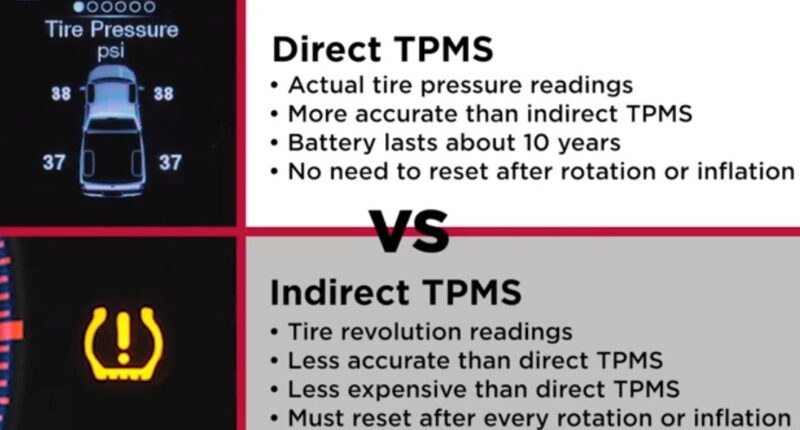
Before you press anything, find out which system your car has. The owner’s manual is the fastest source. The door placard also helps: if it lists only tire pressures, you likely have indirect TPMS. If it mentions sensor IDs or battery life, it’s direct.
Direct TPMS: Sensor IDs, Wheel Positions, and Relearn Modes
Direct systems store each sensor’s ID in the body control module. After a rotation, the module needs a “relearn” to match the new positions. Some cars do this automatically when you drive. Others need a manual relearn through a button, the infotainment menu, or a TPMS tool.
If your vehicle requires a manual relearn, follow the owner’s manual procedure exactly. Skipping a step, like starting the car before pressing the button, can fail the relearn.
Indirect TPMS: Wheel-Speed Sensors and Automatic Self-Calibration
Indirect systems don’t have sensors inside the wheels. They use ABS wheel-speed sensors to detect a tire spinning faster because it’s underinflated. After a rotation, the system has to learn a new baseline.
Most indirect systems self-calibrate after you drive above 15 to 25 mph for 10 to 20 minutes. Some, like many Honda and Toyota models, have a reset button that starts the calibration process.
For a deeper breakdown of the terms, see our guide on TPMS relearn vs. TPMS reset.
The Fastest Way to Reset the TPMS Light Without a Scan Tool
Once you know your system, pick the method below. In most cases, you can reset the light in under 15 minutes without leaving your driveway.
Method 1: The “Drive It Out” Relearn for Indirect Systems
This is the simplest method for most indirect systems. First, set all four tires to the cold pressure listed on the door placard. Then drive at highway speed, around 50 mph or higher, for 10 to 20 minutes.
The system compares wheel speeds and recalibrates during the drive. The TPMS light should turn off before you reach your destination. If it stays on, move to Method 2 or check your owner’s manual for a manual reset procedure.
Method 2: The TPMS Reset Button Under the Dash or Glovebox
Many vehicles have a physical TPMS reset button. It’s often under the dash, to the left of the steering wheel, or inside the glovebox. It may be labeled “SET” or show a tire-pressure icon.
Fill all tires to the placard pressure while the tires are cold.
Do not start the engine. The instrument cluster should light up.
Hold it until the TPMS light blinks three times, then release.
Drive for about 10 minutes. The light should go out on its own.
Method 3: The Infotainment Menu Path for 2015-and-Newer Vehicles
Many newer cars handle TPMS resets through the touchscreen. The exact path varies, but it usually looks like: Settings → Vehicle → Tire Pressure Monitoring → Reset or Calibrate.
Select the reset option, confirm the message, and drive. Some systems need a few minutes of driving to complete the calibration.
Set the Correct Cold Tire Pressure Before You Reset Anything
Resetting the TPMS light without fixing the actual pressure is a waste of time. The system will simply turn the light back on. Always set the correct cold pressure first.
Reading the Door-Jamb Placard and Matching the Season’s Cold-Pressure Baseline
The placard on the driver’s door jamb lists the cold tire pressure for your vehicle’s factory tire size. “Cold” means the car hasn’t been driven for at least three hours, or less than a mile at low speed. Morning is the best time to check.
Seasonal temperature swings change tire pressure by about 1 PSI for every 10°F change. If you set pressure on a warm afternoon, it will read low on a cold morning.
Gauge Accuracy, Inflator Duty Cycle, and the 10-PSI Overfill Trap
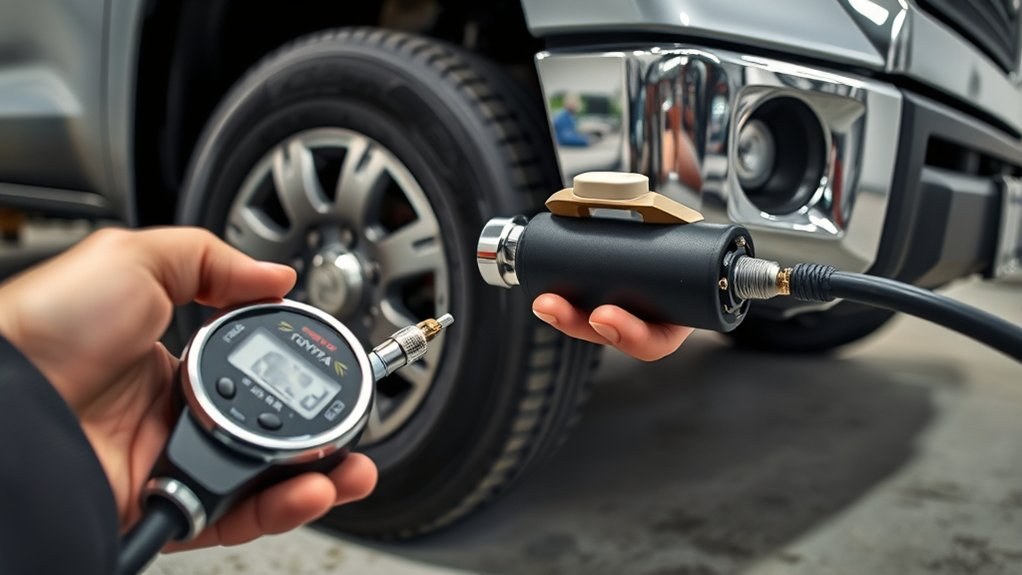
A cheap pencil gauge can be off by 2 to 3 PSI. A digital gauge is more consistent. If you’re using a portable inflator, run it in short bursts and double-check with a separate gauge, because the inflator’s built-in gauge may not be accurate.
Overfilling by 10 PSI or more can make the ride harsh and increase wear in the center of the tread. Fill to the placard number, not above it.
For a step-by-step routine, read our guide on how to check tire pressure at home.
When “Without a Scan Tool” Stops Working: TPMS Relearn Limits and Failure Signs
Sometimes the light won’t reset no matter what you try. That’s a clue the problem is not a simple relearn.
How Many Relearn Attempts You Get Before the System Locks Out
Some vehicles limit the number of relearn attempts, often two or three, before the system locks out and requires a scan tool to recover. If the light doesn’t clear after two attempts, stop. Read the owner’s manual to check whether your car has this limit.
Repeated failed attempts can leave the system in a state that only a professional TPMS tool can fix. Pressing the button over and over won’t help.
Why a Tire Rotation Can Expose a Failing Sensor or a Dead Sensor Battery
TPMS sensor batteries usually last 5 to 10 years. A rotation can move a weak sensor to a new position, and the system may now flag it. A flashing TPMS light at startup, usually for 60 to 90 seconds, means a sensor fault, not low pressure.
If your light flashes and then stays on, see our guide on why the TPMS light flashes then stays on.
OBD2 and TPMS: What a Scan Tool Can and Cannot Do for a Relearn
Many drivers assume any OBD2 scanner can reset the TPMS light. That’s not true. Understanding the limits saves money and frustration.
Model-Year and Protocol Coverage: OBD2 Port Location, Ignition Mode, and TPMS-Specific Functions
Every US passenger vehicle since 1996 has an OBD2 port, usually under the driver’s side dash. But a basic code reader can only read and clear engine codes. TPMS relearn requires a bidirectional tool or a dedicated TPMS tool that can send commands to the tire pressure module.
The ignition must be in the correct mode, usually key on, engine off, for a TPMS relearn. Some vehicles also require a specific sequence, like pressing the brake pedal or cycling the headlights.
Code Reading, Live Data, and Emissions Readiness: The Limits of App-Based OBD2 Adapters
Bluetooth OBD2 adapters paired with a phone app can read codes, show live data, and check emissions readiness. But most cannot perform a TPMS relearn because that requires bidirectional control. They also can’t read sensor IDs or battery status from inside the tire.
For that, you need a TPMS-specific tool that communicates with the sensor directly. We explain how to use one in our guide on how to use a TPMS reset tool.
App Permissions, Firmware Updates, and When TPMS Diagnosis Requires a Professional
App-based diagnostic tools ask for permissions like location, Bluetooth, and sometimes vehicle identification. Check the app’s privacy policy before you install it. Firmware updates can add features, but they can’t turn a basic code reader into a TPMS tool.
If your car needs a sensor replacement, a professional shop with a TPMS tool is the reliable route. Sensor replacement also requires proper programming and, in some cases, a relearn.
Safety and Driving After the Reset: What to Watch For in the First 100 Miles
The reset worked, and the light is off. The first 100 miles after a rotation and reset are a good time to verify everything is actually fine.
Puncture Location, Temporary-Repair Limits, and the Threshold for Professional Tire Repair
If the TPMS light comes back on after a reset, don’t assume it’s a glitch. Check each tire for nails, screws, or cuts. A puncture in the tread can often be repaired if it’s within the repairable area and smaller than about 1/4 inch. Sidewall damage, shoulder damage, or a puncture near the edge means the tire should be replaced.
Temporary plug kits are meant for emergency use, not permanent repairs. A professional patch-plug repair from the inside is the safer choice.
How to Verify the Reset Worked Without Relying on the Dashboard Light Alone
Use a tire pressure gauge to confirm all four tires match the placard. Then drive for 10 to 15 minutes and recheck. If the light stays off and pressures hold, the reset worked.
If the light returns, there’s a leak, a sensor issue, or the relearn didn’t take. Don’t ignore it. A tire that loses pressure slowly can still fail on the highway.
Next Steps: When to Stop DIY and Visit a Professional (and What It Should Cost)
Most TPMS resets after a rotation are simple. But there are times when a professional is the smarter move.
Ownership Cost Comparison: Scan Tool Purchase vs. One-Time Shop Relearn Fee
A dedicated TPMS reset tool can cost anywhere from about $20 to over $100 depending on the brand and features. A shop relearn fee varies by region and dealer, and some tire shops include it free with a rotation. If you rotate your own tires regularly, a tool can pay for itself quickly.
If you only need one reset and don’t plan to rotate tires yourself again, a shop visit may be the cheaper route.
Legal Variation, State Inspection Rules, and Keeping a Paper Trail for Warranty Coverage
Some states include TPMS operation in their safety inspection. A car with a TPMS light on can fail inspection in those states. Check your state’s rules before your next inspection.
Keep a simple log of tire rotations, pressure checks, and TPMS resets. A paper trail helps if you need to prove maintenance for a warranty claim or a sensor replacement dispute.
- Best for: Drivers who rotate their own tires and want a free, no-tool reset using the drive-out method, reset button, or infotainment menu.
- Think twice if: The light flashes at startup or returns after two reset attempts, which points to a sensor fault or leak that needs a professional.
- Next step: Set cold tire pressure from the door placard, try the correct reset method for your system, and verify with a gauge before your next drive.
Frequently Asked Questions
Most indirect systems clear the light after 10 to 20 minutes of driving above 15 to 25 mph. Button and menu resets usually show results within the same drive. If the light stays on after two attempts, stop and check the owner’s manual.
Most cars allow a no-tool reset through the drive-out method, a reset button, or the infotainment menu. Some vehicles, especially certain European and Asian models, require a dedicated TPMS tool for a relearn. Check your owner’s manual first.
The light comes on because the system lost track of which sensor is at which wheel position. Direct TPMS systems need a relearn to match sensor IDs to corners. Indirect systems need time to recalibrate to the new rotation pattern.
Yes. Set all four tires to the cold pressure listed on the driver’s door placard before any reset attempt. If you reset with low pressure, the light will simply come back on once the system recalibrates.
A flashing TPMS light at startup, usually for 60 to 90 seconds, means the system detected a sensor fault. It is not a low-pressure warning. Have the sensors inspected, because the system cannot monitor tire pressure while the fault exists.
Take the car to a shop if the light won’t clear after two reset attempts, if it flashes at startup, or if your owner’s manual says a TPMS tool is required. A shop relearn fee varies by region and dealer, and some tire shops include it free with a rotation.