How Accurate Are Portable Tire Inflator Gauges? Know the Margin
Most portable tire inflator gauges read within a few PSI of true pressure, but the margin varies by design, battery, and calibration. For everyday topping off that is enough; for exact tire maintenance, verify with a separate gauge.
The question of how accurate are portable tire inflator gauges matters more than most drivers realize, because a few PSI can change ride quality, tire wear, and safety. This guide explains the real-world accuracy margin, what changes the reading, and when a portable inflator’s built-in gauge is good enough for your vehicle.
- Accuracy margin: Most portable inflators claim ±1 to ±2 PSI, but real-world readings can drift to.
- Cold pressure rule: Set pressure when tires are cold; heat raises readings and causes underinflation once tires.
- Digital vs analog: Digital inflator gauges are usually more consistent, but weak batteries and loose connections cause.
- TPMS limits: TPMS warns at about 25% below placard pressure, so a slightly off gauge can.
- Verify before you trust: Compare your inflator’s reading against a known-good gauge at least once.
The Short Answer: How Accurate Are Portable Tire Inflator Gauges?
Most portable tire inflators use built-in digital gauges with manufacturer accuracy claims around ±1 to ±2 PSI. In real-world use, that margin often stretches to ±3 PSI or more depending on battery voltage, hose connection, temperature, and calibration.
For topping off tires between service visits, that level of accuracy is usually fine. For setting exact cold pressure, verify with a separate quality gauge. The inflator gets you close; a standalone gauge confirms the number.
Gauge Accuracy vs. Real-World Pressure: What Moves the Reading
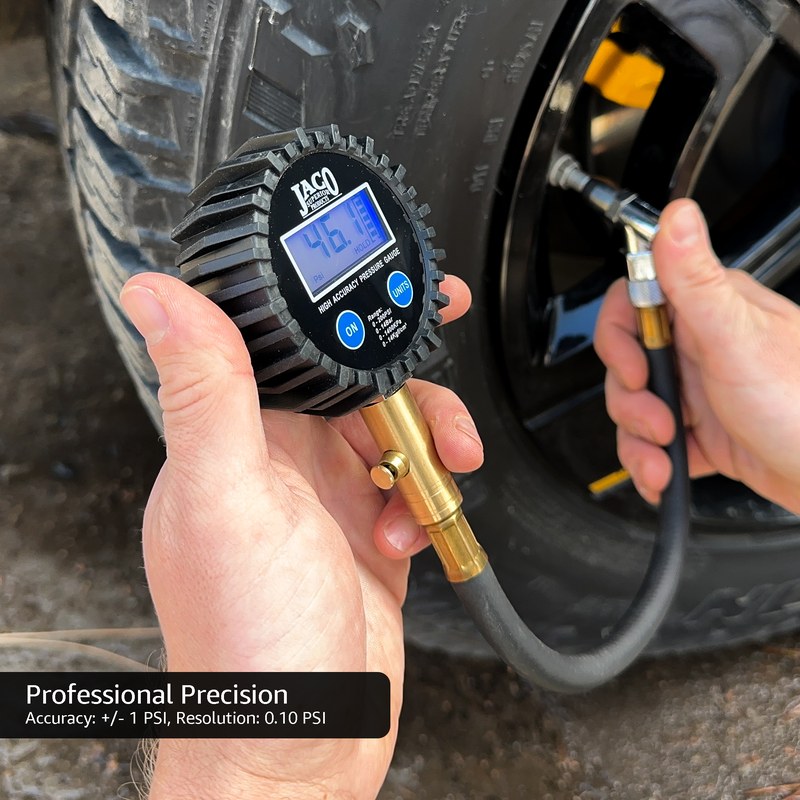
Analog vs. Digital Gauge Accuracy
Digital gauges are generally more consistent than analog because they rely on electronic pressure sensors rather than moving parts. Analog gauges can stick, drift, or lose calibration as they age. That does not mean every digital gauge is accurate; low-cost sensors and weak batteries can produce misleading readings.
If you want to compare the two styles directly, our breakdown of digital vs analog tire pressure gauges covers the practical differences for daily drivers.
Cold Pressure, Temperature, and the Door-Jamb Placard
The pressure number on your door-jamb placard is a cold-tire spec. As tires roll, friction builds heat and pressure rises roughly 1 PSI for every 10°F change in temperature. If you fill a hot tire to the placard number, it will read low once it cools.
Set pressure when tires have been parked for at least a few hours, ideally overnight. For the full routine, see how to check tire pressure at home.
Calibration and Repeatability: Why Two Inflators Disagree
Two inflators can read the same tire differently because each has its own sensor tolerance and calibration drift. A unit stored in a hot trunk or dropped on pavement can lose accuracy faster than one kept in a climate-controlled garage.
Repeatability matters as much as raw accuracy. If your inflator gives different numbers on the same tire minutes apart, treat its gauge with suspicion and confirm with another gauge.
Why Accuracy Matters for TPMS, Tire Wear, and Safety
TPMS Relearn Limits and Warning Thresholds
Most TPMS systems warn when pressure drops about 25% below the placard value, not when you are a couple of PSI off. That means an inflator gauge reading 2 PSI high can leave a tire underinflated without triggering any warning light.
After inflating, some vehicles need a TPMS relearn procedure before the system accepts the new pressure. If your light stays on after a proper fill, our guide to why does my tire pressure light come on when tires are fine walks through the common causes.
Driver Impact: Ride Quality, Fuel Economy, and Tire Life
Underinflation increases rolling resistance, which hurts fuel economy and makes tires run hotter. Overinflation shrinks the contact patch, which can make the ride harsh and reduce grip in wet conditions.
A few PSI either way will not ruin a tire overnight, but consistent errors add up over thousands of miles. Uneven wear, vibration, and poor braking can all trace back to pressure habits.
Legal Variation: State Inspections and TPMS Rules
Some states include TPMS operation in their safety inspection programs, and the rules vary by state. A tire worn from chronic underinflation or a TPMS light that stays on can fail an inspection in some places.
Check your state’s inspection requirements before relying on a portable inflator gauge as your only pressure check.
Portable Inflator vs. Professional Gauge: Side-by-Side Comparison
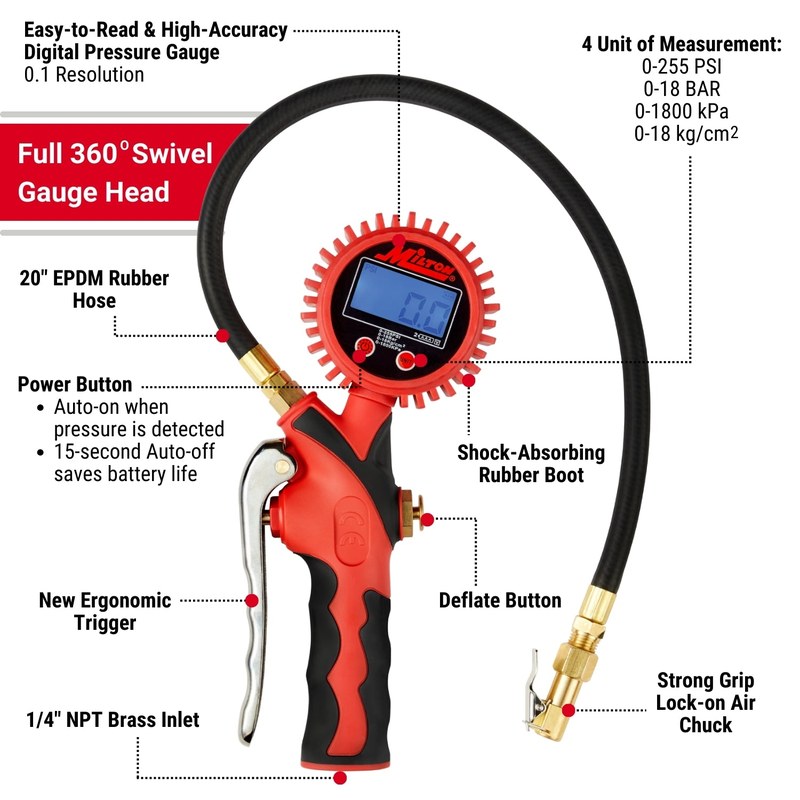
Same Criteria: Accuracy, Repeatability, Power, and Cost
Compare both tools on the same four criteria: accuracy, repeatability, power, and cost. A portable inflator adds inflation ability but brings a bulkier package and a battery or 12V cable. A professional gauge is smaller, cheaper, and usually more accurate, but it only reads pressure.
| Option | Best for | Owner consideration | Driver consideration |
|---|---|---|---|
| Portable inflator | Topping off tires and roadside emergencies | Needs power source, storage space, and occasional battery care | Built-in gauge is convenient but may drift from true pressure |
| Professional gauge | Setting exact cold pressure and verifying inflator readings | Low cost, small size, no power needed | Requires a separate inflation step but gives more reliable numbers |
Which Option Fits Different Drivers and Vehicles
If you commute daily and check pressure monthly, a portable inflator with a decent gauge is convenient. If you track pressure precisely or drive a vehicle with sensitive TPMS, keep a separate gauge in the glovebox.
Many drivers do both: inflate with the portable unit, then verify with a standalone gauge. That two-step habit costs little and removes most of the accuracy worry.
Buying Guide: Matching an Inflator to Your Vehicle and Driving Habits
Power Source and System Voltage: 12V, Cordless, and USB-C
12V inflators plug into the accessory socket and work with most cars, but a weak socket can blow a fuse under load. Cordless units run on internal batteries and suit roadside use, but they need regular charging. USB-C models are fine for bikes and small tires but often lack the airflow for full-size trucks.
Match the power source to your vehicle and typical use. A commuter sedan and a work truck have very different inflation needs.
Inflator Duty Cycle and Overheating Limits
Duty cycle is how long an inflator can run before it needs to cool down. Many portable units run for 10 to 15 minutes before overheating, which is enough for one or two tires but tight for a full set on a large vehicle.
If your unit keeps shutting off mid-fill, our guide to why does my portable tire inflator keep shutting off explains the common causes and fixes.
EV and Hybrid Cautions: Battery Chemistry and 12V Systems
EVs and hybrids still use a 12V battery for accessories, and some inflators draw more current than that system can safely provide. Check the vehicle manual before using a high-draw inflator on an EV or hybrid.
Never connect an inflator to the high-voltage traction battery. That connection is for trained technicians only.
Smart Inflators: App Permissions, Firmware, and Privacy
Smart inflators connect to phone apps for preset pressures, logging, and firmware updates. Before buying, check what data the app collects and whether updates are actually available for the model.
Some apps require accounts, location access, or Bluetooth permissions that have nothing to do with inflating tires. Read the app’s privacy policy before you connect it to your phone.
What We Can and Can’t Verify Without First-Hand Testing
CarValleyNJ has not independently tested portable inflator gauges in a lab. Accuracy claims come from manufacturer documentation and owner-reported patterns, not from our own measurements.
Treat any advertised accuracy figure as a best-case number until you verify it against a known-good gauge. That single check tells you more than any spec sheet.
Using Your Inflator Correctly: Connection, Maintenance, and Storage
Correct Connection Order and Damaged-Battery Stop Conditions
For 12V inflators, connect the air hose to the tire valve first, then plug into the power source. If your inflator uses alligator clips for direct battery connection, attach positive first, then negative, and reverse the order when disconnecting.
If the vehicle battery is damaged, swollen, or leaking, stop immediately and get professional help. Do not use an inflator near a damaged battery.
Roadside Inflation: Safe Location and Traffic Visibility
Pull fully off the road onto a flat, stable surface before inflating. Turn on hazard lights and, if you have them, set out reflective triangles or flares.
Never kneel next to a tire in a lane of traffic. If the location feels unsafe, drive slowly to a better spot or call for help.
Cable and Pack Condition Checks
Before each use, inspect the power cable for cuts, exposed wires, or melted insulation. Check the air hose for cracks and make sure the valve connector seats tightly on the stem.
A damaged cable can short out the accessory socket or create a fire risk. A loose valve connection produces a false reading and wastes air.
Post-Use Inspection and Storage Conditions
After inflating, disconnect the hose, let the unit cool, and wipe off dirt or moisture. Store it in a dry place away from extreme heat or cold.
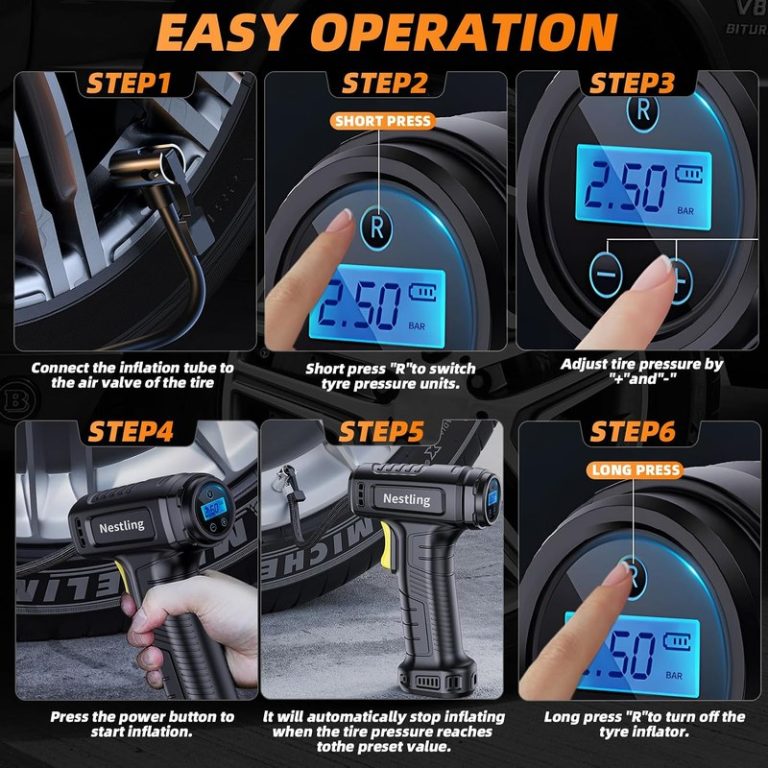
If it is a cordless model, check the manual for battery maintenance and charging intervals. For the complete step-by-step routine, our guide on how to use portable tire inflator covers the details.
Limitations: When a Portable Inflator Isn’t the Right Tool
Puncture Location and Temporary-Repair Limits
A portable inflator can top off a slow leak, but it cannot fix a puncture in the sidewall or shoulder. Temporary repair kits are for the tread area only and are meant to get you to a shop, not to serve as a permanent fix.
If a tire is losing air fast, do not keep inflating and driving. That turns a manageable problem into a blowout risk.
Professional-Repair Thresholds and When to Call a Shop
If a tire loses more than a few PSI overnight, shows visible damage, or exposes cords, it needs professional inspection. A plugged tire may not be repairable depending on puncture size and location.
When in doubt, a tire shop is safer than a portable inflator. The tool is for convenience, not for replacing proper tire service.
Next Steps: Know Your Margin, Set Cold Pressure, Drive Confident
Start by checking your door-jamb placard for the cold pressure spec. Use your portable inflator to reach that number, then verify with a separate gauge when you want more confidence.
Check pressure monthly and before long trips. Knowing your inflator’s accuracy margin turns a convenient tool into a reliable one.
- Best for: Daily drivers who want a convenient way to top off tires and handle slow leaks without a trip to the gas station.
- Think twice if: You need laboratory-grade pressure accuracy or drive a vehicle with a sensitive TPMS that demands exact readings.
- Next step: Compare your inflator’s reading against a known-good gauge, then set cold pressure from the door-jamb placard.
Frequently Asked Questions
Most portable inflator gauges claim accuracy within ±1 to ±2 PSI, similar to a well-maintained gas station gauge. In practice, both can drift, so verify against a known-good gauge when exact pressure matters.
TPMS sensors report pressure to the vehicle’s system and may round or update slowly, while the inflator reads the valve directly. Differences of 1 to 2 PSI are common. Set pressure from the door-jamb placard and use the TPMS as a warning system, not a precision tool.
Check the reading against a known-good gauge at least once a season or after the unit is dropped or stored in extreme heat. If the inflator reads more than 2 PSI off, replace it or use a separate gauge for final pressure setting.
Yes, but only on the 12V accessory system, not the high-voltage traction battery. Check the vehicle manual for accessory socket limits, and avoid high-draw inflators if the manual warns against them.
Duty cycle is the maximum continuous run time before the unit needs to cool. Many portable inflators run 10 to 15 minutes before overheating. Check the manual and let the unit cool between tires on larger vehicles.
Stop if the tire loses more than a few PSI overnight, shows sidewall damage, exposes cords, or has a puncture outside the repairable tread area. A portable inflator is for convenience, not a substitute for professional tire service.