TOPDON BT100 vs BT200 Battery Tester: Key Differences
Nothing turns a normal morning into a headache faster than a car that suddenly cranks slowly—or does not start at all. A battery tester will not fix the problem for you, but it can give you useful information before you replace a battery unnecessarily or head to a shop without knowing what is wrong.
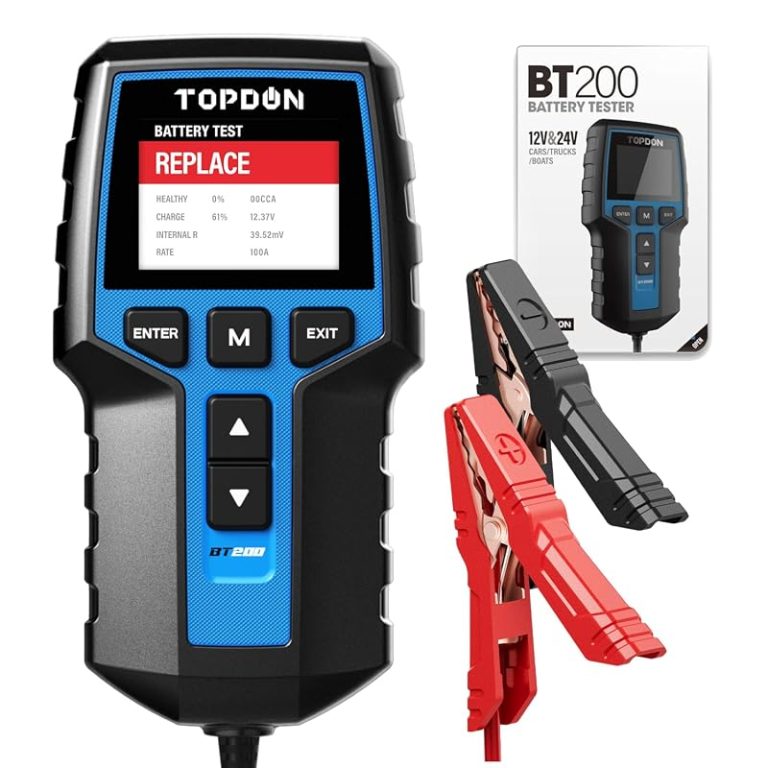
So, what is the difference between the TOPDON BT100 and BT200 battery tester? The BT100 is the simpler choice for standard 12V vehicles, while the BT200 adds 12V and 24V cranking and charging tests, a larger color display, and broader language support. Both cover the main 12V lead-acid battery types and rating standards listed by TOPDON.
Buy the BT100 if you mainly maintain ordinary 12V cars, SUVs, motorcycles, boats, or light trucks and want the core battery, cranking, and charging checks without paying for features you may never use.
Buy the BT200 if you work with 24V starting or charging systems, maintain mixed vehicle types, or simply value its larger 2.4-inch color screen.
The important part: do not let the higher model number make the decision for you. The better tester is the one that matches the vehicles sitting in your driveway or workshop.
Mostly 12V vehicles? Save the money and choose the BT100.
Need 24V cranking or charging checks? Choose the BT200.
Want broader professional diagnostics beyond battery testing? See the premium alternatives later in this guide.
These two handheld testers perform many of the same core jobs. Each can help you assess battery condition, starting performance, and charging-system behavior. The real buying question is whether you need the BT200’s additional 24V system capability and larger display.
This comparison uses TOPDON’s current US product pages, global product details, and support information checked on July 28, 2026. It does not claim personal laboratory testing. For more related guides, visit our battery and electrical tester guides.
What Is the Difference Between TOPDON BT100 and BT200?
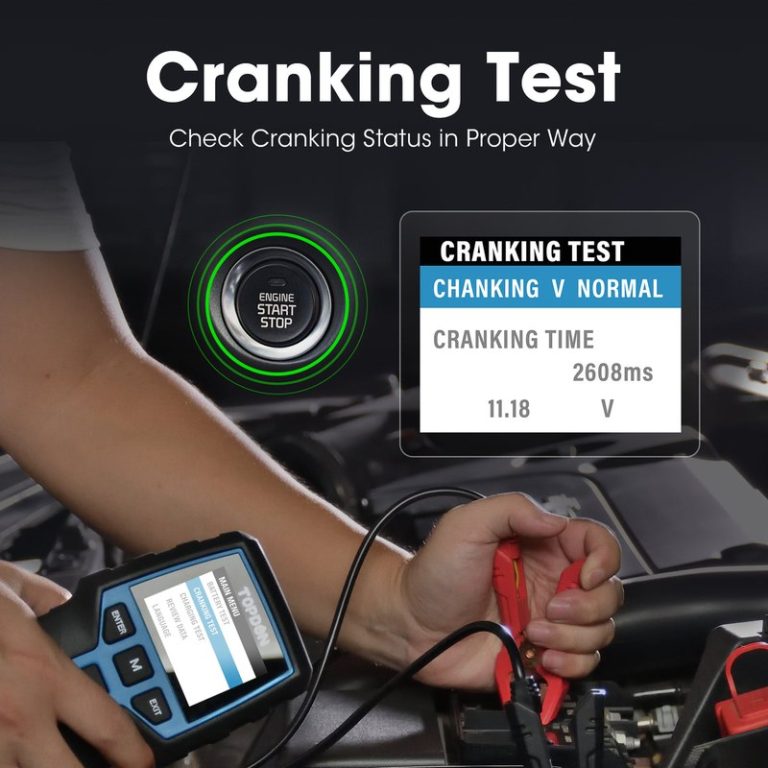
The biggest functional difference is voltage coverage. TOPDON lists the BT100 as a 12V battery and system tester. Its main functions include a 12V battery test, 12V cranking test, and 12V charging test.
The BT200 also performs a 12V battery test, but it extends cranking and charging checks to 24V systems. That can matter if you maintain commercial trucks, equipment, larger boats, or other vehicles using 24V starting and charging systems.
TOPDON BT100 vs BT200 Specifications
The table below focuses on the differences that affect everyday use and the buying decision.
| Feature | TOPDON BT100 | TOPDON BT200 |
|---|---|---|
| Battery health test | 12V | 12V |
| Cranking test | 12V | 12V and 24V |
| Charging test | 12V | 12V and 24V |
| Display | 2-inch backlit LCD | 2.4-inch color LCD |
| Listed languages | Six | Eight |
| US warranty listed | Two years | One year |
The warranty row reflects TOPDON’s US pages checked on July 28, 2026. Warranty terms can change by seller, region, and purchase date, so confirm current coverage before ordering.
You can also review the manufacturer’s current TOPDON BT100 product details and TOPDON BT200 product details.
Which One Would We Buy?
If we owned one or two ordinary 12V vehicles and wanted a tester primarily for checking whether a battery was healthy, whether the starter was cranking normally, and whether the charging system was doing its job, we would lean toward the BT100.
Why? Because buying diagnostic tools should reduce uncertainty—not create a drawer full of features we never use.
But if our garage included 24V equipment, commercial vehicles, or mixed electrical systems, we would choose the BT200. In that situation, the additional voltage coverage becomes a practical tool rather than an unused specification.
What Both Battery Testers Can Do
Both models provide more information than checking battery voltage alone. TOPDON lists battery, cranking, charging, and ripple-related testing for the BT100 and BT200.
Both official US specification tables list a testing range of 100 to 2,000 cold cranking amps and 30 to 220 amp-hours under the listed GB capacity option.
They also list common rating standards including CCA, CA, BCI, MCA, DIN, IEC, EN, SAE, JIS, and GB.
Supported lead-acid battery categories include flooded, absorbed glass mat, gel, enhanced flooded, and valve-regulated lead-acid batteries.
Check: Read the battery label for voltage, battery type, rating standard, and rating value. Match those details in the tester menu.
Limitation: These testers are designed around supported lead-acid batteries and vehicle starting and charging checks. Do not assume they support lithium batteries or high-voltage hybrid and EV traction batteries.
TOPDON’s support guidance also notes that clean terminals and firm clamp contact matter. Entering the wrong battery standard or rating can make the result less useful. See TOPDON’s battery tester support guidance for current setup information.
Where the BT200 Is Better
24V Cranking and Charging Support
This is the strongest reason to pay more for the BT200. A 24V starting or charging system sits outside the BT100’s listed system-test coverage.
The BT200 can assess cranking voltage and time and evaluate charging-system behavior on supported 24V systems.
However, TOPDON’s detailed feature table separates these functions: the battery test is listed for 12V, while cranking and charging tests are listed for 12V and 24V. Confirm the current manual before assuming the BT200 performs a complete 24V battery-bank health test.
Larger Color Screen
The BT200 uses a 2.4-inch color LCD, while the BT100 uses a 2-inch backlit display.
If you regularly use diagnostic tools in a workshop, a clearer interface can make menus and results more pleasant to scan. But the larger screen does not make a weak battery stronger or automatically make a diagnosis more accurate.
More Interface Languages
TOPDON’s US page lists eight languages for the BT200 and six for the BT100. The BT200 adds Portuguese and Japanese to the BT100’s listed English, Spanish, French, German, Italian, and Russian options.
Where the BT100 Makes More Sense
The BT100 covers the main battery-testing tasks most drivers with standard 12V passenger vehicles are likely to use.
It can test the battery, monitor cranking voltage and time, and check the charging system after the engine starts.
It also uses the same listed battery-rating range and broad group of supported lead-acid battery types as the BT200.
The BT100 may also suit owners who prefer a straightforward monochrome interface. For broader electrical and diagnostic topics, browse our car diagnostics guides.
Which Model Fits Your Vehicle?
| Your situation | Better fit | Reason |
|---|---|---|
| One or more 12V cars | BT100 | Core testing functions are covered |
| Motorcycle or ATV battery | BT100 | 12V testing is generally sufficient |
| 24V truck charging system | BT200 | Supports listed 24V system checks |
| Prefer a color display | BT200 | Larger visual interface |
| Want only necessary features | BT100 | Avoid paying for unused 24V capability |
| Mixed 12V and 24V work | BT200 | Broader system coverage |
For most everyday drivers with one or two standard 12V vehicles, the BT100 is the practical choice. The BT200 becomes more compelling for mixed fleets, 24V equipment, or users who value the larger color interface.
Want More Than a Basic Battery Tester?
The BT100 and BT200 make sense when your primary question is, “What is happening with my battery, starter, or charging system?”
But some owners eventually want more. Maybe the battery tests fine and the warning light is still on. Maybe you maintain several vehicles. Or maybe you simply prefer buying one more capable diagnostic tool instead of adding another single-purpose device later.
If that sounds familiar, these three higher-level options are worth comparing.
TOPDON BT600
Best for: Owners or technicians who want to step beyond a basic handheld battery tester and prefer a more professional battery-testing workflow.
If the BT100 feels too basic but you do not necessarily need a full vehicle scan tool, the BT600 is a logical product to compare before buying.
Innova 5610
Best for: Drivers who want to move beyond battery-only testing and investigate a broader range of vehicle diagnostic issues.
A battery tester can help answer battery and charging questions. A broader diagnostic scanner can make more sense when the problem continues after the battery checks out.
OBDLink MX+
Best for: Owners who prefer a compact Bluetooth OBD-II tool and phone-based vehicle diagnostics rather than another handheld screen.
This is not a replacement for a dedicated battery tester when your priority is battery-health analysis, but it can be a useful companion for owners who also want broader vehicle data.
Accuracy and Result Quality
TOPDON markets the BT200 with a 99.5% accuracy figure. The current BT100 US product page does not show a directly comparable accuracy percentage, so available official information does not prove that one model is more accurate under identical conditions.
More importantly, either tester can produce a poor result when the setup is wrong.
Dirty battery posts, weak clamp contact, the wrong battery type, or an incorrect rating value can all reduce the usefulness of the reading.
State of health and state of charge are diagnostic estimates. They can help you judge battery condition, but they do not identify every possible electrical fault.
A weak starter, damaged cable, poor ground, alternator issue, or parasitic drain may require additional testing.
What to Check Before Buying
- Confirm whether every vehicle you plan to test uses a 12V or 24V system.
- Check that your battery chemistry appears in the supported list.
- Read the battery’s rating standard and rating value.
- Decide whether the BT200’s color display matters to you.
- Review the current US warranty and Amazon return terms.
- Confirm the latest manual covers your intended test procedure.
- Do not buy either unit for testing a high-voltage lithium EV traction battery.
The decision becomes much easier once you stop comparing model numbers and start comparing them with your actual vehicles.
Find the highest system voltage you need to test first. Then compare screen preference, warranty, seller support, and current price.
- Best value for typical 12V owners: TOPDON BT100.
- Best for mixed 12V and 24V system work: TOPDON BT200.
- Best reason to spend more: You genuinely need 24V cranking/charging capability or prefer the larger color interface.
- Do not overbuy: If every vehicle you maintain is 12V, the BT100 already covers the core jobs.
Frequently Asked Questions
TOPDON markets the BT200 with a 99.5% accuracy claim, but its current US product information does not provide a directly matched accuracy figure for the BT100. The available official information therefore does not support a clean like-for-like claim that the BT200 is more accurate.
No. TOPDON lists the BT100 as a 12V battery and system tester. It can check a 12V battery, cranking performance, and charging performance, but it is not the model to choose for a 24V cranking or charging system.
TOPDON’s detailed feature information lists a 12V battery test plus 12V and 24V cranking and charging tests. For a 24V vehicle, confirm the exact procedure in the current BT200 manual before assuming it evaluates a complete 24V battery bank as one battery.
Yes. TOPDON lists flooded, AGM, gel, EFB, and VRLA lead-acid battery categories for both models. You still need to select the correct battery type, rating standard, and rating value from the battery label.
The BT100 is usually enough when you want battery, cranking, and charging tests on a normal 12V car. Choose the BT200 if you also need its listed 24V cranking and charging support or strongly prefer the larger color display.
No app is listed as part of normal operation for either model. Both use built-in screens and physical controls. They differ from TOPDON’s Bluetooth battery testers, which use a phone or tablet for app-based functions.
Only if you need broader vehicle diagnostics. If your main goal is evaluating battery condition plus cranking and charging performance, a dedicated battery tester such as the BT100 or BT200 is usually the more focused purchase.
Conclusion
The difference between the TOPDON BT100 and BT200 is easier to understand when you ignore the model numbers and focus on what is parked in front of you.
The BT100 handles the core 12V battery and system checks that most everyday vehicle owners need.
The BT200 adds 24V cranking and charging support, a larger color display, and two additional listed interface languages.
If your garage contains ordinary 12V vehicles, the BT100 is the sensible choice. If your work crosses into 24V systems, the BT200 is the stronger fit.
Either way, buying the right tester now can give you more useful information the next time a vehicle cranks slowly, a battery warning makes you uncertain, or you simply want to check battery condition before replacing parts unnecessarily.


3 Comments