Which TOPDON Battery Tester Is Best? 6 Models Compared
Which Topdon battery tester is best? For most car owners and DIY users, the TOPDON BT200 offers the best balance of price, clear results, and 12V battery plus 12V/24V system testing. The BT600 Plus is the most capable choice for professional shops, while the BT50 is the strongest budget option.
Choose the BT200 for general home-garage use, the BT100W for app-based reports, the BT300P when printed results matter, the BT600 for regular 24V system work, and the BT600 Plus for professional or fleet testing. Match the tester to the battery voltage and work you actually perform.
TOPDON currently sells several testers that look similar but serve different users. Some focus on simple 12V checks, while others add color screens, phone connectivity, printers, 24V system tests, or professional resistance testing.
This comparison uses TOPDON’s official US product information and listed prices checked on July 28, 2026. Prices, bundles, and specifications can change, so confirm the current listing before ordering. You can review the brand’s official battery tester lineup.
Which Topdon Battery Tester Is Best?
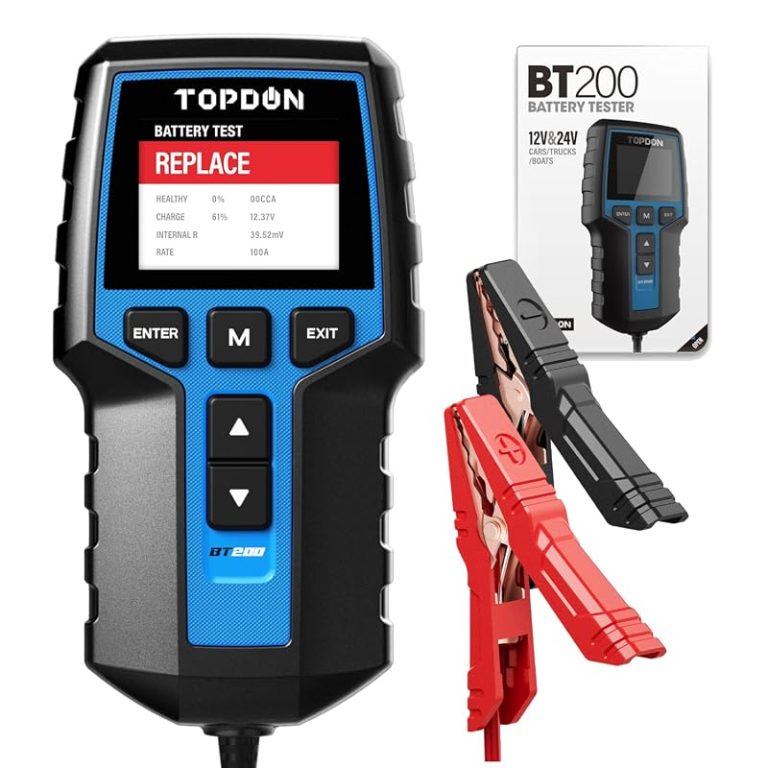
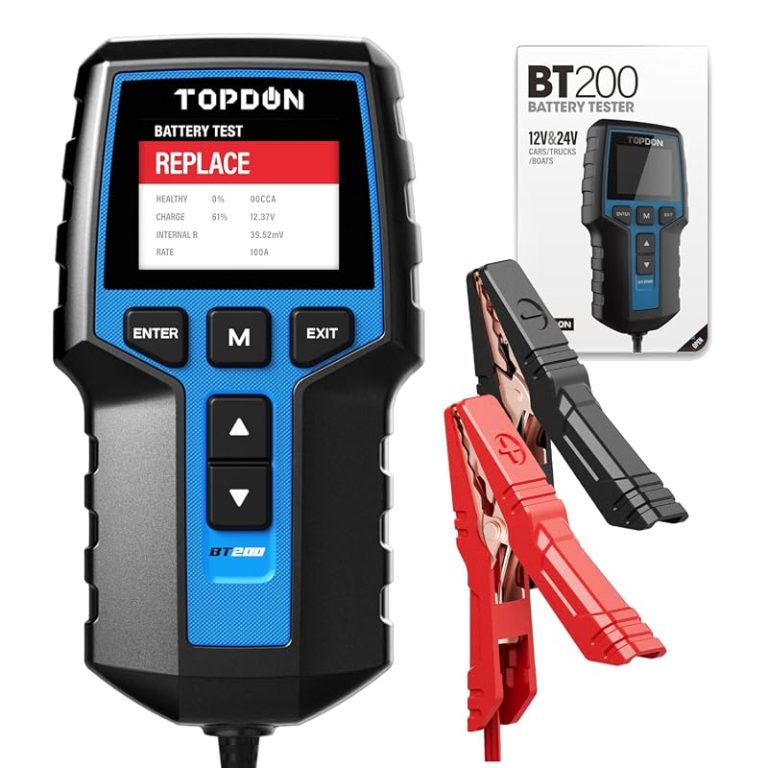
The BT200 is the best overall choice for most everyday drivers because it covers the tasks most owners need without adding a printer, smartphone requirement, or professional-shop features. It tests supported lead-acid batteries and checks starting and charging performance through a 2.4-inch color display.
TOPDON markets the BT200 as a 12V battery and 12V/24V system tester. Its official specifications list a 100–2000 CCA test range and support for flooded, AGM, GEL, EFB, and VRLA battery types. See the official TOPDON BT200 specifications.
TOPDON BT200: The best-balanced model for most US car owners. It has a color screen, handles common lead-acid battery types, and adds 24V starting and charging system coverage. Its main trade-off is the lack of a built-in printer or phone reporting.
TOPDON Battery Tester Comparison
The table below compares six current models by their strongest use case. Prices are official US list prices observed on July 28, 2026 and may change.
| Model | Best For | Key Capability | Listed Price |
|---|---|---|---|
| BT50 | Budget DIY testing | 12V battery and system checks | $32.99 |
| BT100W | Phone-based reports | Standalone and app operation | $65.99 |
| BT200 | Best overall value | 12V battery, 12V/24V systems | $71.99 |
| BT300P | Printed 12V reports | Built-in thermal printer | $99.99 |
| BT600 | Shops testing 24V systems | Color display and printer | $179.99 |
| BT600 Plus | Professional and fleet work | 6V/12V/24V and resistance tests | $399.99 |
Best Budget Choice: TOPDON BT50
The BT50 is the practical entry point for drivers who mainly test 12V passenger-vehicle batteries. It performs battery, cranking, and charging checks and supports common flooded, AGM, GEL, EFB, and VRLA lead-acid batteries.
Its 2-inch backlit screen is simpler than the larger color displays on the BT200 and BT600. It also lacks phone connectivity and a printer. Those limits are reasonable when the goal is an affordable tester for occasional checks.
Best App-Connected Choice: TOPDON BT100W
The BT100W suits owners who want a physical tester and smartphone reporting in one tool. It can operate by itself, then connect to TOPDON’s app for deeper data display, stored reports, and battery-library features.
It remains a 12V-focused tester, so it is not the right choice for regular 24V truck or equipment work. App users should also confirm current iOS or Android requirements, permissions, and support before purchase.
Best Tester With a Printer: TOPDON BT300P
The BT300P is a useful middle choice when you need printed battery reports but do not need the BT600 Plus. Its built-in thermal printer can produce a physical record for customer files, fleet logs, resale checks, or repeat testing.
For a home user, the printer adds paper cost and bulk without improving the actual diagnosis. The BT200 usually offers better value when a screen result or handwritten note is enough.
Best for 24V System Work: TOPDON BT600
The BT600 is designed for users who work with passenger vehicles and larger 24V starting or charging systems. It combines a 3.5-inch color display with a thermal printer and supports 12V battery tests plus 12V/24V cranking and charging checks.
This makes it more suitable for repair shops, mobile technicians, fleets, and owners of heavier equipment. It costs much more than the BT200, so occasional passenger-car users may not receive enough extra value.
Most Capable: TOPDON BT600 Plus
The BT600 Plus is the strongest overall model by capability. TOPDON describes it as a professional 2-in-1 battery and resistance tester for workshops, dealerships, mobile technicians, and battery operations.
It supports 6V, 12V, and 24V lead-acid battery testing, along with 12V/24V cranking, charging, and system tests. Its built-in 5200mAh battery allows testing at low voltage, reviewing saved results away from the vehicle, and using the device without depending only on the tested battery for power.
The BT600 Plus also adds a thermal printer, resistance testing for additional battery chemistries, and sequence testing for groups of batteries. Review the official BT600 Plus feature list for its current supported functions and limitations.
- Tests 6V, 12V, and 24V lead-acid batteries
- Has onboard power and saved data
- Includes resistance and sequence testing
- Prints reports without another device
- Costs far more than DIY models
- Adds features many owners will not use
- Requires more setup and learning
- Still does not replace full diagnosis
How to Choose the Right Model
Start with the battery and electrical systems you will test. Most passenger cars use a 12V auxiliary battery, while some trucks, commercial vehicles, and equipment use 24V starting or charging systems.
Choose BT50 When
- You want the lowest-cost basic tester.
- You work only with common 12V batteries.
- You do not need printed or digital reports.
Choose BT100W When
- You prefer phone-based reports and saved data.
- You want standalone use plus an app.
- Your testing needs stay within supported 12V systems.
Choose BT200 When
- You want the best balance for home use.
- You value a larger color screen.
- You may check 24V starting or charging systems.
Choose BT300P or BT600 When
- You need printed reports.
- You test customer or fleet vehicles.
- You need the BT600’s broader 24V system workflow.
Choose BT600 Plus When
- You run a shop, fleet, or battery operation.
- You test deeply discharged or varied-voltage batteries.
- You need resistance, sequence, and stored-data functions.
Check: Confirm battery voltage, chemistry, Cold Cranking Amps range, test standard, and whether you need battery, cranking, charging, or resistance testing. Limitations: These automotive testers are not a universal tool for high-voltage EV traction batteries or every lithium battery system.
What the Test Results Mean
Battery testers usually report values such as voltage, measured Cold Cranking Amps, state of charge, state of health, and internal resistance. A cranking test checks voltage behavior while the engine starts. A charging test checks alternator or charging-system output.
These readings narrow the problem, but they do not always identify the failed part. Corroded terminals, loose cables, parasitic drain, starter problems, charging faults, temperature, and an incorrect battery profile can affect the result.
For related testing advice, visit our battery and electrical tester guides and vehicle maintenance tool guides.
Battery Testing Safety
Park the vehicle, switch off unnecessary electrical loads, and follow the tester and vehicle instructions. Connect the clamps to the correct terminals and keep metal tools away from both battery posts.
OSHA battery rules recognize risks involving electrolyte, ventilation, fire protection, and electrical hazards. Home users should follow the vehicle manual, battery label, and tester instructions even though workplace regulations may not directly apply. Review the OSHA battery safety requirements.
- Confirm whether you need 12V, 24V, or 6V testing.
- Match the tester to the battery chemistry.
- Check the supported CCA range and standards.
- Decide whether you need an app or printer.
- Review warranty, return, and support terms.
- Compare official prices and included accessories.
- Avoid paying for shop features you will not use.
- Best for most owners: TOPDON BT200 for its balanced price, color display, and useful system coverage.
- Best professional model: TOPDON BT600 Plus for multi-voltage testing, onboard power, resistance checks, sequence testing, and printing.
- Best budget model: TOPDON BT50 for straightforward 12V battery, cranking, and charging checks.
- Next step: Confirm your battery voltage, chemistry, reporting needs, and test range before choosing a model.
Frequently Asked Questions
The BT200 is the better choice when you want a larger color display and 12V/24V system coverage. The BT100 costs less and remains suitable for basic 12V battery, cranking, and charging checks.
The BT300P, BT600, and BT600 Plus include built-in thermal printers. The BT300P suits printed 12V reports, while the BT600 and BT600 Plus support broader professional workflows.
The BT100W is designed for standalone testing and app-based use. Its app can add saved reports and battery data. Confirm the current phone operating-system requirements before buying.
Some models support 24V functions, but the exact capability differs. The BT600 handles 12V battery tests and 12V/24V system tests, while the BT600 Plus supports broader 6V, 12V, and 24V battery testing.
They may test a supported low-voltage auxiliary battery, but they are not general tools for an EV’s high-voltage traction battery. Follow the vehicle manual and use trained professional service for high-voltage systems.
No. A tester provides useful data under the test conditions, but intermittent faults, poor connections, temperature, parasitic drain, starter load, and charging problems can still affect vehicle performance.
Conclusion
Which Topdon battery tester is best? The BT200 is the strongest all-around recommendation for most owners, while the BT600 Plus is the better professional choice and the BT50 is the best budget entry point.
The right model can help you check battery health and separate a weak battery from a possible starting or charging problem. The main limitation is that model coverage, voltage support, and reporting features differ.
Confirm the battery label, vehicle manual, official tester specifications, and current price before ordering. Use the tool while parked, connect it correctly, and treat every reading as one part of a complete diagnosis.


7 Comments