Is the Topdon Battery Tester Any Good? Buyer Guide
Is the Topdon battery tester any good? Yes, many TOPDON models are useful for routine battery, cranking, and charging-system checks. They suit car owners who want clearer information than a basic voltmeter provides. The main limits are model-specific compatibility, correct test setup, and the fact that one result cannot guarantee future battery life.
TOPDON battery testers are a sensible choice for home garages when the selected model matches the battery voltage, chemistry, and rated cold-cranking amps. The BT100 is a practical basic option, while app, 24V, and printer models serve different needs. Confirm weak or conflicting results before replacing an expensive battery or charging component.
TOPDON sells several battery testers rather than one universal device. Some are simple handheld tools, some connect to a phone, and others add 24V system testing or a built-in printer.
That means the brand can be good while one particular model may still be wrong for your vehicle or task. This guide explains what the testers can do, where they fall short, and how to choose the right level.
Why TOPDON Battery Testers Can Be Good
The strongest reason to consider one is function coverage. A typical TOPDON battery tester can check more than open-circuit voltage. Depending on the model, it may report state of health, state of charge, measured cold-cranking amps, internal resistance, cranking voltage, cranking time, and charging-system behavior.
TOPDON’s official BT100 specifications list battery, cranking, charging, and ripple tests for 12V lead-acid batteries. The tool supports a stated 100–2000 CCA testing range and common battery types, including flooded, AGM, GEL, EFB, and VRLA. Review the official TOPDON BT100 specifications.
Is the Topdon Battery Tester Any Good for Accuracy?
It can provide useful diagnostic results, but accuracy depends on the model and setup. Battery type, rated CCA, state of charge, temperature, terminal condition, and clamp contact can all affect the reading.
TOPDON states that the BT100 uses conductance testing and reports voltage, state of health, state of charge, internal resistance, and measured CCA. Its support guidance also tells users to select the battery information shown on the label before testing. Read the TOPDON battery-tester support guidance.
A conductance result is still an estimate of current battery condition. It cannot promise that a battery will start the vehicle tomorrow or identify every intermittent electrical fault.
| Test Result | What It Helps Show | Main Limitation |
|---|---|---|
| Battery voltage | Present electrical level | Not a full health test |
| Measured CCA | Estimated starting ability | Setup affects results |
| State of health | General battery condition | Not remaining-life certainty |
| Cranking test | Voltage during starting | Other faults can affect it |
| Charging test | Charging voltage behavior | Does not isolate every cause |
Which TOPDON Model Fits Your Needs?
The best model depends on the battery voltage and how you want to view or document results. Do not pay for a printer or app if you only need occasional 12V checks.
| Model | Best Use | Key Difference |
|---|---|---|
| BT50 | Basic home checks | Simple 12V testing |
| BT100 | Most DIY owners | Handheld 12V system tests |
| BT100W | Saved digital reports | Device plus phone app |
| BT200 | Larger vehicle systems | 12V battery, 12V/24V systems |
| BT600 | Shop documentation | Color screen and printer |
BT100 for Basic DIY Testing
The BT100 is suitable for owners who want a dedicated handheld tester without an app. TOPDON lists a backlit screen, common lead-acid battery support, battery testing, cranking testing, charging testing, and ripple testing.
Its main limitation is voltage coverage. It is designed around 12V battery testing, so buyers working with 6V batteries, lithium batteries, or specialized systems should choose another tool that explicitly supports them.
BT100W for App-Based Reports
The BT100W can work from its own interface and connect to a phone for reports and additional data handling. TOPDON lists battery, cranking, charging, and system tests, along with report generation and a battery library. See the official BT100W product details.
This model is useful when you want to save or share results. The trade-off is greater dependence on an app, phone compatibility, permissions, and current software support.
BT200 or BT600 for Broader Work
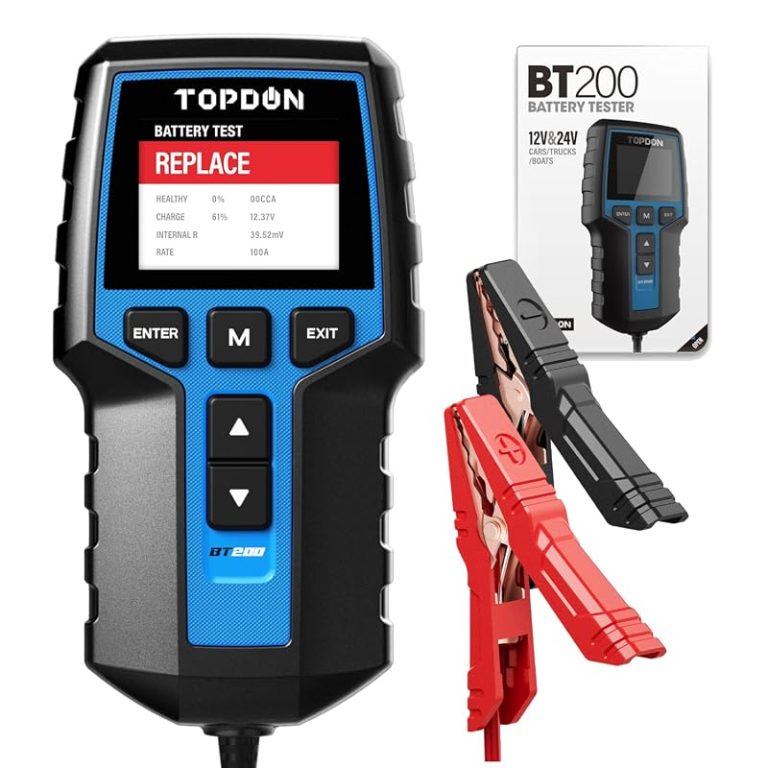
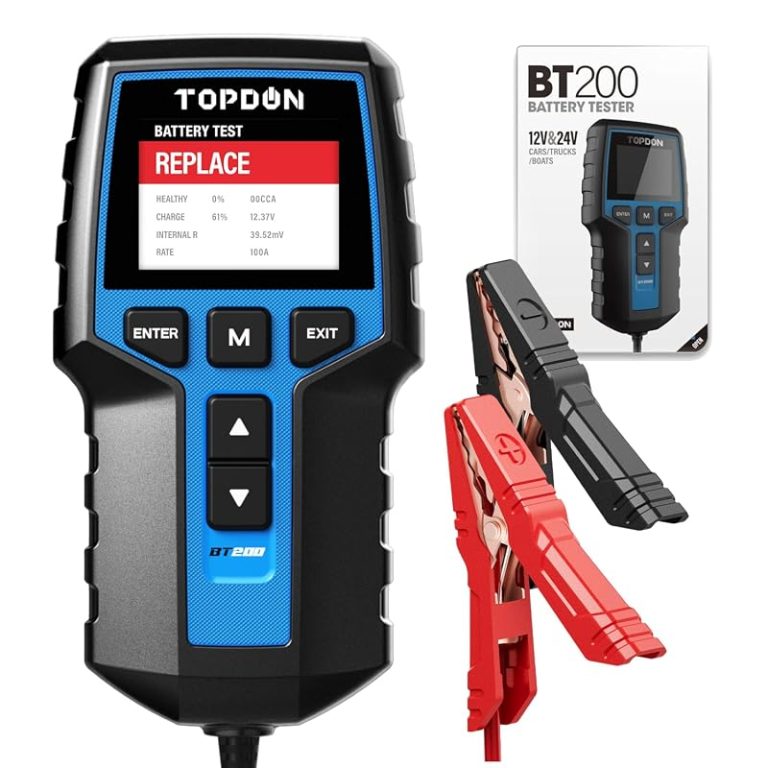
TOPDON states that the BT200 performs 12V battery tests and supports cranking and charging checks on 12V and 24V systems. The BT600 adds a color screen and a thermal printer for immediate reports. Review the official BT200 specifications and official BT600 details.
These models make more sense for owners with larger vehicles, mixed-voltage work, multiple batteries, or a need to document test results.
Check: Confirm battery voltage, chemistry, capacity, printed rating standard, vehicle system voltage, and the tests supported by the exact TOPDON model. Limitations: Do not assume support for lithium, high-voltage hybrid, electric-vehicle traction, or specialty batteries unless the product documentation states it.
Our battery and electrical tester guides cover more tools for checking battery and charging problems. For general purchase comparisons, visit our automotive buying guides.
What a TOPDON Tester Cannot Diagnose
A battery tester can narrow a problem, but it does not replace a complete electrical diagnosis. A weak cranking result may involve the battery, poor terminal contact, a damaged cable, the starter, temperature, or another mechanical load.
A charging warning may involve the alternator, regulator, drive belt, fuse, wiring, battery connection, or control strategy. The tester can show abnormal behavior without proving which component caused it.
It also will not measure every parasitic drain. Finding key-off current draw normally requires a suitable current-measurement method and a vehicle-specific diagnostic process.
- Quick battery health screening
- Cranking and charging checks
- Clearer data than voltage alone
- Models for different skill levels
- Portable home-garage use
- Results depend on correct setup
- Model coverage varies
- Not a future-failure guarantee
- Cannot isolate every electrical fault
- Some features require an app
How to Get a More Reliable Result
Correct setup matters as much as the tester. A wrong battery rating or poor clamp contact can make a useful tool look unreliable.
- Read the vehicle and tester manuals.
- Confirm battery voltage and chemistry.
- Enter the rating printed on the battery.
- Clean heavy corrosion before testing safely.
- Attach clamps firmly to correct terminals.
- Charge a deeply discharged battery when directed.
- Repeat a surprising result after checking setup.
- Compare conflicting results with further testing.
State of charge can affect the decision. A battery may be healthy but discharged, which can produce a charge-first result. Follow the tester’s instruction rather than immediately replacing the battery.
Battery Testing Safety
Battery testing is simple, but a damaged battery or running engine adds risk. Follow the battery, vehicle, and tester instructions.
The official BT100W manual tells users to work in a ventilated area, wear approved eye protection, and stay aware of moving belts, pulleys, and fans when the engine runs. Read the TOPDON BT100W safety instructions.
Who Should Buy One?
A TOPDON battery tester makes sense for drivers who maintain more than one vehicle, store a seasonal vehicle, experience occasional slow starts, or want to check a battery before winter or a long trip.
The BT100 or BT50 can suit occasional home use. The BT100W may help owners who want digital records. A BT200 or BT600 is more suitable when 24V system checks or printed documentation matter.
You may not need one when you rarely perform maintenance and already receive a trusted battery and charging-system test from a repair shop or parts store. A multimeter may also be enough for basic voltage checks, although it does not provide the same battery-health estimate.
See our vehicle maintenance tool guides for other practical home-garage equipment.
- Best for: Car owners and DIY users who want quick 12V lead-acid battery, cranking, and charging checks.
- Think twice if: You need lithium support, high-voltage diagnosis, parasitic-draw testing, or proof that one component has failed.
- Next step: Match the TOPDON model to the battery voltage and type, then confirm surprising results before replacing parts.
Frequently Asked Questions
It can be useful for home checks when you select the correct battery type and rating, connect the clamps securely, and follow the instructions. Treat the result as diagnostic evidence, not a guarantee of remaining battery life.
The BT100 is a practical starting point for many owners with 12V lead-acid batteries. The BT100W adds app-based reports, while the BT200 or BT600 better suits users who need 24V system checks or printed reports.
Many TOPDON models include a charging-system test that checks voltage behavior after the engine starts. This can identify an abnormal charging result, but it does not prove which alternator, wiring, belt, regulator, or connection has failed.
Several models, including the BT100, support common 12V lead-acid types such as flooded, AGM, GEL, EFB, and VRLA batteries. Confirm the exact model and choose the matching battery type before testing.
No. A tester can estimate present condition from voltage, internal resistance, entered rating, and other measured data. Temperature, state of charge, intermittent faults, vehicle use, and future conditions can still affect battery life.
No. It is useful for quick battery, cranking, and charging checks, but difficult faults may still need a multimeter, current measurement, a controlled load test, wiring inspection, or professional diagnosis.
Conclusion
Is the Topdon battery tester any good? For routine battery and charging checks, yes, provided the model matches your battery and you enter the correct test information.
The main owner benefit is a faster, clearer battery assessment at home. The main safety concern is working correctly around terminals, acid, and moving engine parts.
The biggest limitation is that a tester result is evidence, not a complete diagnosis or a promise of future battery life. Choose the right model, follow the manual, and confirm unusual or high-cost repair decisions with additional testing.



7 Comments