How does the Topdon battery tester work? Key Tests Explained
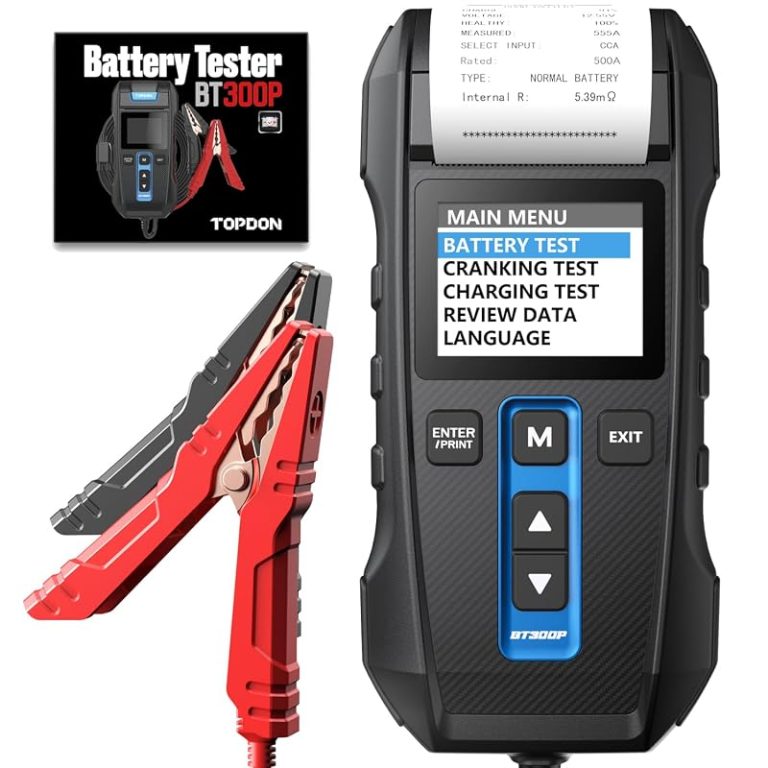
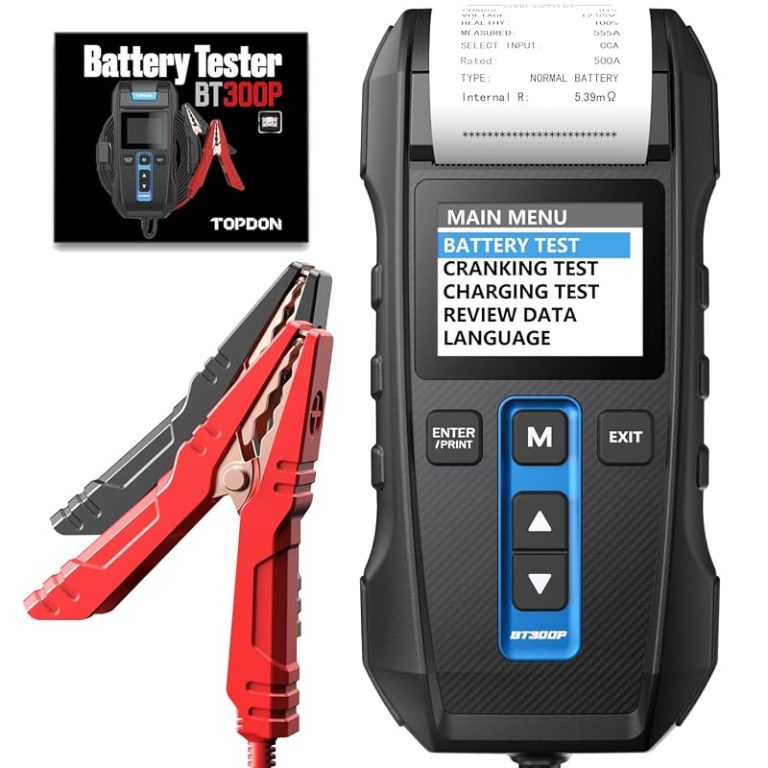
How does the Topdon battery tester work? It clips to a lead-acid battery, sends a small test signal through it, measures voltage and conductance, compares those readings with the battery type and rating you enter, then estimates cold-cranking ability, state of charge, state of health, and, on supported models, starter and charging-system performance.
A TOPDON tester gives owners a fast snapshot of battery condition without removing or deeply discharging the battery. It can also help identify weak starting or charging performance. The main limitation is that results depend on correct battery data, clean clamp contact, temperature, charge level, and the exact TOPDON model.
Most handheld TOPDON battery testers are conductance testers rather than old-style carbon-pile load testers. That means they use a small electrical signal and an algorithm instead of drawing a large amount of current for a long period. The tester can therefore produce a result in seconds without intentionally stressing a healthy battery.
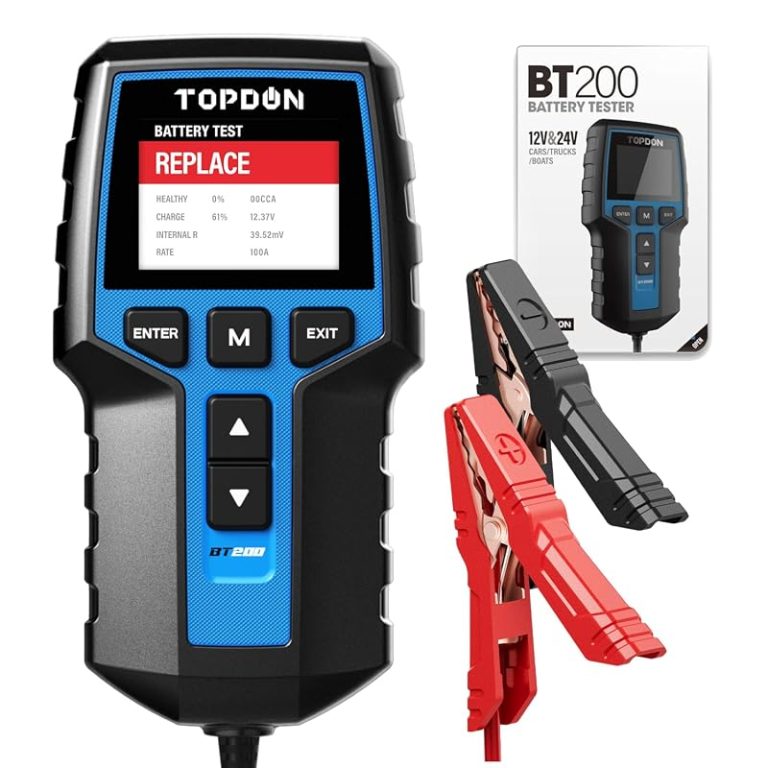
This article uses the current TOPDON BT200 as the main example because TOPDON publishes clear information for that model. Other TOPDON units may add Bluetooth, printing, app reports, wider test menus, or different voltage limits, so check the manual supplied with your tester.
How does the Topdon battery tester work?
The tester first measures the battery’s open electrical condition through its clamps. It then applies a very small signal and watches how the battery responds. Conductance describes how easily electrical current can move through the battery’s internal structure. As a lead-acid battery ages, corrosion, sulfation, and plate damage can reduce that ability.
Industry battery-testing guidance explains that conductance measurements can be correlated with available cold-cranking performance without using a long discharge test. Read the conductance-testing explanation from Midtronics for more detail on the general method.
The tester combines its measurements with the battery information you enter. That is why selecting the correct battery chemistry and the correct rating from the label matters. A tester cannot fairly compare a battery with its original rating when the wrong rating standard or value is entered.
What the tester measures
A battery result is more useful when you read several values together. Voltage alone mainly describes charge condition at that moment. It does not prove that the battery can still deliver strong starting current.
| Reading | What it means | Important limit |
|---|---|---|
| Voltage | Electrical pressure at test time | Charge level, not full health |
| SOC | Estimated state of charge | May improve after charging |
| SOH | Estimated state of health | Model algorithm, not lifespan |
| Measured CCA | Estimated starting-current ability | Compare with battery label |
| Resistance or conductance | Internal power-transfer condition | Affected by contact and temperature |
| Overall result | Good, recharge, retest, or replace | Wording varies by model |
TOPDON’s support guidance says its battery testers may display state of health, state of charge, cold cranking amps, voltage, internal resistance, and an overall judgment. It also warns that a health percentage should not be used alone. Review the current TOPDON battery tester support guidance for model-specific details.
Seeing charge condition, starting ability, and charging performance separately can prevent two common mistakes: replacing a usable battery that only needs charging, or trusting a charged battery that has lost much of its cranking ability.
How to use a TOPDON battery tester
The exact buttons vary, but the basic process is similar on clamp-on TOPDON testers. Keep the vehicle parked, set the parking brake, and work in a ventilated area away from flames or sparks.
Check the battery voltage, chemistry, capacity or cold-cranking rating, and the functions supported by your TOPDON model. Do not use a 12-volt lead-acid tester on a high-voltage EV traction battery.
Switch off the ignition, lights, climate control, chargers, and other electrical loads. Close doors and the trunk so interior lights do not affect the first battery reading.
Place the red clamp on the positive terminal and the black clamp on the negative terminal. The jaws must contact clean metal, not thick corrosion, loose caps, paint, or an extension lead.
Select the battery test, battery chemistry, rating standard, and rated value shown on the label. Use the nearest permitted value only when your model’s manual directs you to do so.
Wait for the tester to calculate voltage, charge condition, health estimate, measured starting ability, resistance, and the overall recommendation available on your model.
Choose the cranking test while the engine is off, then start the engine only when prompted. The tester records the voltage drop and cranking time during the start.
With the engine running, follow the tester’s exact prompts. It checks charging voltage and may assess loaded, unloaded, or ripple behavior depending on the model.
Check: TOPDON currently lists the BT200 battery test for 12-volt regular flooded, AGM, GEL, EFB, and VRLA lead-acid batteries. Its published page lists cranking and charging tests for 12- and 24-volt systems. Limitations: This does not mean every TOPDON model supports the same batteries or functions, and it does not authorize testing an EV high-voltage traction pack. Confirm the official BT200 product information or your own model manual.
Battery, cranking, and charging tests
These three tests answer different questions. A good battery result does not automatically prove that the starter or alternator is working correctly.
| Test | Vehicle condition | Main question answered |
|---|---|---|
| Battery test | Engine off | Can the battery store and deliver starting power? |
| Cranking test | Engine starts during test | Does voltage drop excessively during starting? |
| Charging test | Engine running | Is the charging system supplying suitable output? |
For more articles about voltage checks, starter-system tools, and charging-system diagnosis, visit our battery and electrical tester guides. Broader scan-tool and fault-finding topics are available in our diagnostics section.
Why a reading may look wrong
Unexpected readings do not always mean the tester is defective or the battery is finished. Start with the simple causes first.
- Clean corrosion from the terminal contact area safely
- Clamp directly to solid positive and negative terminals
- Enter the battery type and printed rating correctly
- Charge a deeply discharged battery and retest when instructed
- Compare repeated results under similar temperature conditions
- Judge battery life from voltage alone
- Test through loose jumper cables or poor extension leads
- Assume one health percentage proves failure
- Clear or ignore starting and charging symptoms
- Use the tool on unsupported battery chemistry or voltage
Cold weather, a low state of charge, recent charging, surface charge, corrosion, and loose clamps can all change the result. A battery that has just been charged may need time to rest before a meaningful comparison. Follow your model manual instead of applying one waiting period to every tester and battery.
Safety limits and stop conditions
Stop and seek qualified help when the battery is difficult to access, the vehicle manufacturer specifies remote test posts, the battery is part of a high-voltage system, the charging voltage is unstable, cables are overheating, or the vehicle repeatedly fails to start after charging. A handheld tester is a screening tool, not a complete electrical diagnosis.
What the tester cannot prove
A TOPDON result is a snapshot under the current conditions. It cannot predict the exact day a battery will fail. It also cannot rule out loose grounds, corroded cables, parasitic drain, starter faults, intermittent alternator problems, battery-management-system issues, or vehicle-specific software faults.
Conductance-only testing mainly estimates starting health. It may not fully measure reserve capacity or charge acceptance. When symptoms and tester results disagree, confirm the result with the vehicle service procedure or a qualified technician using additional equipment.
- Best for: Owners who want a quick lead-acid battery, cranking, and charging-system check before a no-start problem becomes urgent.
- Think twice if: You need high-voltage EV diagnosis, reserve-capacity testing, or a complete parasitic-draw and wiring investigation.
- Next step: Confirm your battery label and TOPDON model manual, clean the terminals, then record the battery, cranking, and charging results together.
Frequently Asked Questions
Most handheld TOPDON models use conductance testing rather than a long, high-current carbon-pile load. They apply a small signal, measure the response, and estimate starting ability. A cranking test records what happens under the real starting load, but it is not the same as a controlled carbon-pile test.
No. It gives a condition estimate at the time of testing, not an exact remaining lifespan. Temperature, driving pattern, charging history, vibration, storage, electrical loads, and internal aging can change future performance. Use the result with symptoms, battery age, and repeated test trends.
TOPDON lists the BT200 for several 12-volt lead-acid types, including AGM, GEL, EFB, VRLA, regular flooded, and supported deep-cycle batteries. You still need to select the correct battery type and rating. Check the current BT200 manual before testing a specialized marine or auxiliary battery.
State of charge and state of health are different. A battery may show normal voltage after charging but have high internal resistance or reduced cold-cranking ability. Confirm the label entry and clamp contact, then retest as directed. If the result remains poor, use a second diagnostic method.
It may test a supported 12-volt auxiliary lead-acid battery, but it must not be used on the high-voltage traction pack unless the specific tool and manufacturer procedure are designed for that work. High-voltage EV systems require specialized equipment, training, isolation procedures, and protective gear.
Conclusion
So, How does the Topdon battery tester work? It measures voltage and conductance, compares the response with the battery details you enter, and estimates charge, health, starting power, and supported system performance. Its main value is fast screening; its main limit is that one reading cannot replace correct setup or complete diagnosis. Confirm compatibility, follow the manual, and investigate persistent symptoms rather than relying on one percentage.


11 Comments