How to Check Tire Tread Depth Without a Gauge Using a Penny
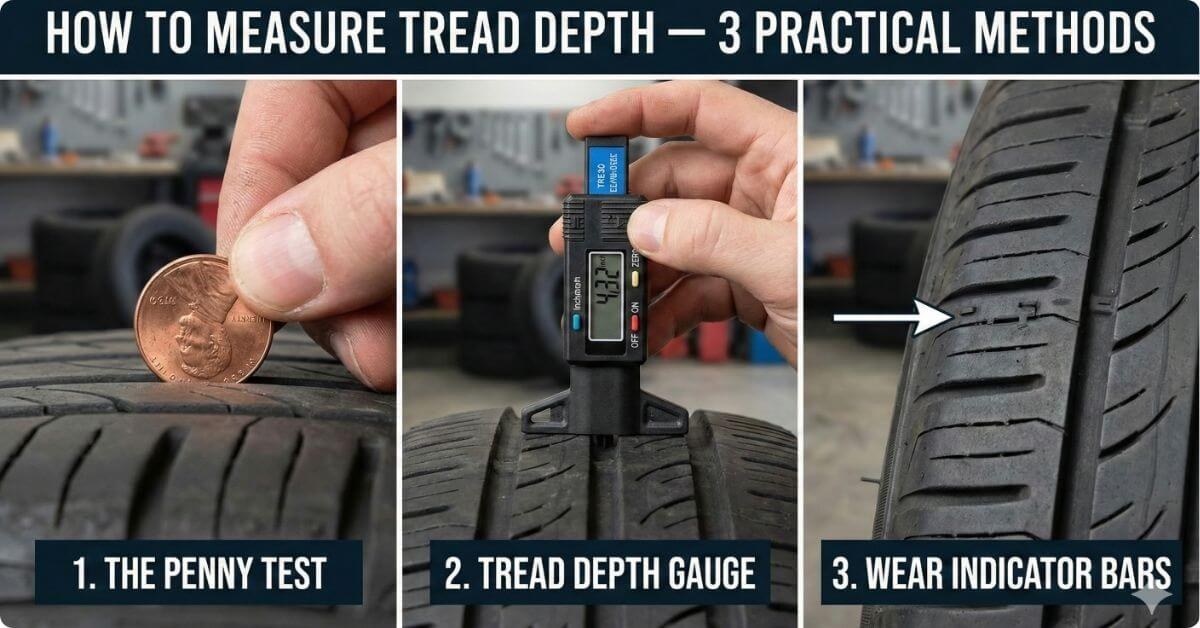
The penny test shows whether your tire tread has dropped to 2/32 inch, the legal minimum in most states. Insert a penny with Lincoln’s head down into the tread; if you can see the top of his head, it’s time for new tires.
Knowing how to check tire tread depth without a gauge is a simple skill that can help you spot worn tires before they become a safety problem. The penny test takes about 15 seconds, costs nothing, and uses a coin you probably already have in your pocket or glove box.
- Penny test: Insert a penny with Lincoln’s head down; a visible head means tread is at.
- Quarter test: Washington’s head flags tread at 4/32 inch, a safer margin for wet or snowy.
- Tread wear bars: Built into tire grooves at 2/32 inch; flush bars mean replacement time.
- Check monthly: Combine with tire pressure checks and test multiple spots on each tire.
- Uneven wear: Center, edge, or cupped patterns point to inflation, alignment, or suspension issues.
The Penny Test: How to Check Tread Depth Without a Gauge
What You Need: A Penny and 15 Seconds
The penny test is the most popular no-gauge method for measuring tire tread. You need a U.S. penny with Lincoln’s head on it — any year works. You also need enough daylight or garage lighting to see the coin clearly once it’s in the tread.
No tools, no batteries, no special equipment. Just a penny, a tire, and about 15 seconds per tire.
Step-by-Step Instructions for the Penny Method
Hold it between your thumb and index finger with Lincoln’s head pointing down toward the tire.
Push it straight down into one of the main grooves until the bottom edge touches the base of the tread.
If the top of his head is visible, your tread is at or below 2/32 inch. If his head is covered, you have more than 2/32 inch left.
Tires wear unevenly. Check the center, the inner edge, and the outer edge of each tire.
Rear tires wear differently from front tires, so every tire deserves the same check.
What the Penny Test Tells You (and What It Misses)
The penny test answers one specific question: Is your tread below 2/32 inch? That is the minimum legal threshold in most U.S. states, so it works well as a basic safety check.
What it misses is the bigger picture. The penny test cannot tell you if your tread is at 4/32 inch, where wet-road performance starts to drop noticeably. It also cannot detect uneven wear, cupping, or sidewall damage. Those issues need a closer look and sometimes a professional inspection.
Why Tread Depth Is Critical for Safety and Legal Compliance
Safety: Wet Roads, Hydroplaning, and Stopping Distance
Tread depth is not just about tire wear. The grooves in your tread channel water away from the contact patch. When tread gets shallow, the tire cannot push water out from under it as effectively, which increases the risk of hydroplaning.
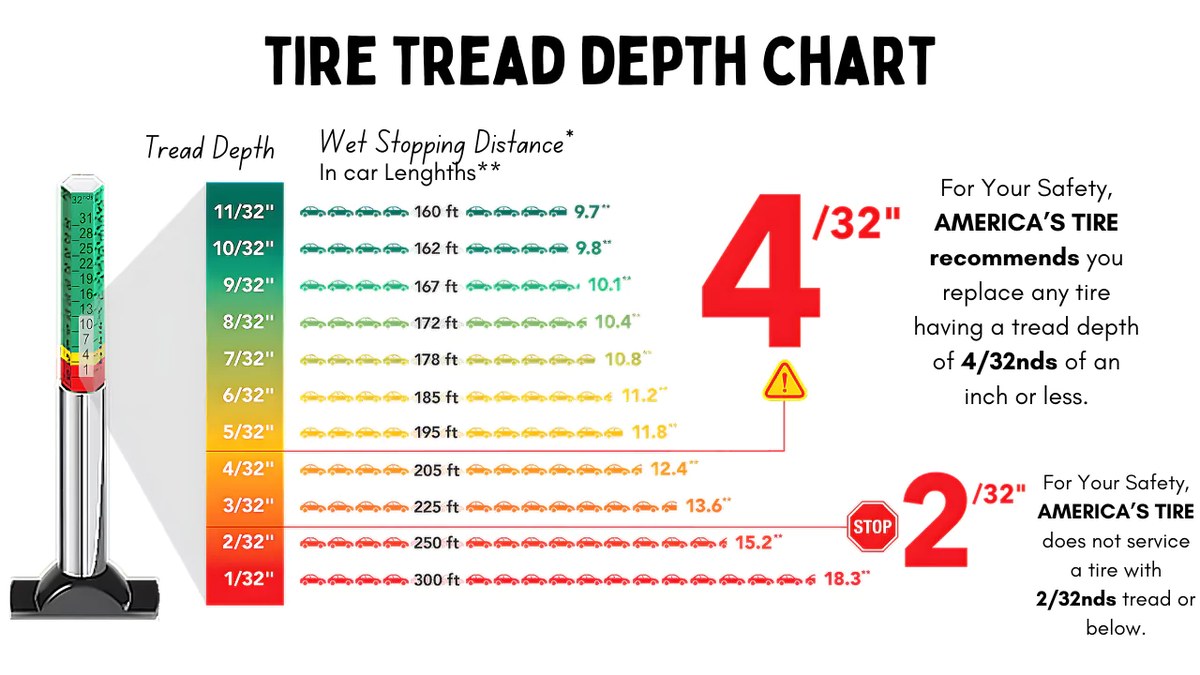
Shallow tread also increases stopping distance on wet roads. A tire with 2/32 inch of tread can take noticeably longer to stop than one with 8/32 inch, especially in rain. That extra distance can be the difference between a close call and a collision.
Legal Minimum Tread Depth in the U.S.
Most U.S. states set the minimum legal tread depth at 2/32 inch for passenger vehicle tires. That is the same threshold the penny test checks. However, state laws vary, and some states have different rules for commercial vehicles or specific tire types.
No-Gauge Alternatives: Quarter Test vs. Tread Wear Indicators
The Quarter Test: A Stricter 4/32 Inch Threshold
The quarter test works exactly like the penny test, but it uses a U.S. quarter instead. George Washington’s head is shorter than Lincoln’s, so the quarter test flags tread at about 4/32 inch.
If you can see the top of Washington’s head when the quarter is in the tread groove, your tires are at or below 4/32 inch. That is not a legal failure in most states, but it is a warning that wet-road performance is declining.
Built-In Tread Wear Indicator Bars
Most modern tires have molded tread wear indicator bars. These are small raised strips of rubber in the tread grooves, usually set at 2/32 inch. When the surrounding tread wears down to the same level as the bars, the tire needs replacement.
To check them, look at the bottom of the tread grooves across the tire. If the bars are flush with the surrounding tread, your tire has reached its wear limit.
Which Method Should You Use for Your Driving Conditions?
| Method | Best for | Owner consideration | Driver consideration |
|---|---|---|---|
| Penny test | Quick legal-limit check | Free, no tools, takes seconds | Only catches tread below 2/32 inch |
| Quarter test | Drivers in rainy or snowy regions | Also free and quick | Flags tires at 4/32 inch for a safer margin |
| Tread wear bars | Confirming replacement time | Built into the tire, no tools | Only shows the 2/32 inch limit |
For most drivers, the penny test is enough for a monthly check. If you drive often in heavy rain, snow, or highway conditions, use the quarter test to catch wear earlier. Tread wear indicator bars are a useful backup, but they only confirm the minimum.
Understanding Tread Depth Numbers: From 2/32 to 10/32
Safe, Caution, and Replace Zones
New passenger tires typically start with about 10/32 to 12/32 inch of tread. As you drive, that depth decreases. Here is how to read the numbers:
- 6/32 inch and above: Safe zone. Good wet-road performance and normal braking.
- 4/32 to 6/32 inch: Caution zone. Wet-road grip is declining. Start planning for replacement.
- 2/32 inch or below: Replace zone. Legal minimum in most states. Replace immediately.
How Tread Depth Affects Performance and Fuel Economy
Deeper tread provides better grip and traction, but it also creates slightly more rolling resistance. That means brand-new tires may reduce fuel economy by a small amount compared to half-worn tires.
As tread wears, rolling resistance decreases, which can improve fuel economy slightly. But the trade-off is reduced wet-road grip and longer stopping distances. The small fuel savings are not worth the safety risk.
How Often to Check Tread Depth and Signs of Uneven Wear
Recommended Checking Schedule for Year-Round Safety
Check tread depth at least once a month, ideally at the same time you check tire pressure. Also check before long road trips, after hitting a large pothole, and when you rotate tires.
Seasonal changes are another good reminder. If you switch between summer and winter tires, check both sets before installation so you know what you are putting on the vehicle.
Combine your tread check with a quick tire pressure check. Correct pressure helps tires wear evenly, which makes your tread readings more consistent. Check pressure when tires are cold, before driving, for the most accurate result.
Common Wear Patterns and What They Mean for Alignment and Suspension
Uneven tread wear is a clue that something else is wrong:
- Center wear: Usually overinflation. The tire bulges in the middle and wears faster there.
- Edge wear on both sides: Usually underinflation. The tire flexes too much at the shoulders.
- Wear on one edge only: Usually a wheel alignment issue. The tire is tilted and scrubbing.
- Cupping or scalloped wear: Usually a suspension problem, such as worn shocks or struts.
If you notice any of these patterns, have a professional inspect the tire and the vehicle. Fixing the underlying issue helps your next set of tires last longer.
Tire Pressure, TPMS, and Tread Wear: The Connection
Door-Jamb Placard and Cold Pressure: The Right Starting Point
The correct tire pressure for your vehicle is on the door-jamb placard, usually on the driver’s side door frame. That number is the cold pressure, meaning tires should be checked before driving or at least three hours after the last drive.
Proper tire pressure keeps the contact patch even, which helps tread wear evenly. Underinflated tires wear on the edges, and overinflated tires wear in the center. Both shorten tread life and can make your penny test readings misleading. Our guide on how to check tire pressure at home walks through the full routine.
TPMS Relearn Limits and Sensor Maintenance
Most modern vehicles have a Tire Pressure Monitoring System (TPMS) that warns you when pressure drops significantly. The system is helpful, but it does not measure tread depth. A tire with dangerously shallow tread can still show normal pressure.
After tire rotations or pressure adjustments, some vehicles require a TPMS relearn procedure to recalibrate sensor positions. If your TPMS light stays on after a rotation, see our guide on how to reset the TPMS light after tire rotation for the correct steps.
Gauge Accuracy and Inflator Duty Cycle: Why Precision Matters
Your tire pressure gauge is only useful if it is accurate. Digital gauges are generally more consistent than analog ones, but both can drift over time. If readings seem inconsistent, compare your gauge against a known-good one or replace it.
Portable tire inflators also have limits. Most are designed for occasional top-offs, not for filling a completely flat tire. Running an inflator too long can overheat it. Check the duty cycle and let the unit cool between uses.
When to Seek Professional Help: Puncture Repair and Replacement Thresholds
Puncture Location and Temporary Repair Limits
Not every nail or screw in a tire can be safely repaired. Repairable punctures are usually in the tread area, away from the sidewall and shoulder. Punctures in the sidewall or within about an inch of it are generally not safe to repair.
If you run over a nail and the tire loses pressure, do not just plug it and forget it. A plug alone is a temporary fix. Many tire shops recommend a patch-plug combination that seals the puncture from both sides. For more detail, see our article on how long you can drive with a nail in your tire.
Professional Repair Thresholds and Tire Replacement Rules
Tire manufacturers and most professional shops follow established repair guidelines. If a tire has multiple punctures in the same area, punctures larger than about 1/4 inch, or sidewall damage, replacement is usually the safer choice.
Age is another factor. Even if tread depth looks fine, tires older than six to ten years may have degraded rubber. Check the DOT date code on the sidewall to see the tire’s age. When in doubt, have a professional inspect the tire.
Next Steps: Extending Tire Life and Planning for Replacement
Rotations, Alignments, and Driving Habits That Maximize Mileage
Tire rotations help all four tires wear at a similar rate. Most manufacturers recommend rotating every 5,000 to 7,500 miles, but check your owner’s manual for the specific interval.
Wheel alignments also play a big role in tread life. A misaligned vehicle can wear a new tire unevenly within a few thousand miles. If your vehicle pulls to one side or the steering wheel is off-center, have the alignment checked.
Driving habits matter too. Hard braking, rapid acceleration, and aggressive cornering all wear tread faster. Smooth driving extends tire life and improves fuel economy.
Budgeting for New Tires: Ownership Costs and Value Considerations
Tires are one of the most important maintenance purchases you will make. Prices vary widely based on tire size, type, and brand. A basic all-season tire for a compact car costs less than a performance or all-terrain tire for a truck or SUV.
When budgeting, remember that tires are a safety item, not just a cost. Replacing tires before they reach the legal minimum protects you and your passengers. It also avoids the risk of a blowout, which can cause far more expensive damage than the cost of new tires.
Plan ahead. If the penny test shows your tires nearing the 2/32 inch mark, start shopping now. That gives you time to compare prices, check for rebates, and schedule installation at a convenient time.
- Best for: Any driver who wants a free, quick, and reliable way to spot tires at the legal minimum without buying a gauge.
- Think twice if: You drive often in heavy rain or snow, where the stricter quarter test at 4/32 inch gives a safer margin.
- Next step: Grab a penny, check all four tires in multiple spots, and combine the test with a monthly tire pressure check.
Frequently Asked Questions
Insert a penny into a tread groove with Lincoln’s head pointing down. If the top of his head is visible, the tread is at or below 2/32 inch, which is the legal minimum in most states. If his head is covered, the tread has more than 2/32 inch remaining.
The penny test checks the 2/32 inch legal minimum, while the quarter test flags tread at 4/32 inch. The quarter test uses Washington’s head, which is shorter than Lincoln’s, so it triggers earlier. Drivers in rainy or snowy regions often prefer the stricter quarter test.
Check at least once a month, ideally at the same time you check tire pressure. Also check before long road trips, after hitting a large pothole, and when rotating tires or switching seasonal sets.
In most states, 2/32 inch is the legal minimum, but it is not a safe operating zone. Wet-road grip and braking performance are significantly reduced at this depth. Replace tires before they reach this level, especially if you drive in rain or snow.
Tread wear indicator bars are thin raised strips of rubber molded across the tread grooves at 2/32 inch depth. When the surrounding tread wears down to the same level as the bars, they appear as a continuous band of rubber across the tire, signaling replacement time.
No. TPMS only monitors tire pressure, not tread depth. A tire with dangerously shallow tread can still show normal pressure. You need to check tread depth manually with a penny, quarter, or gauge.