What Tools Should Every Car Owner Keep in the Trunk for Breakdowns
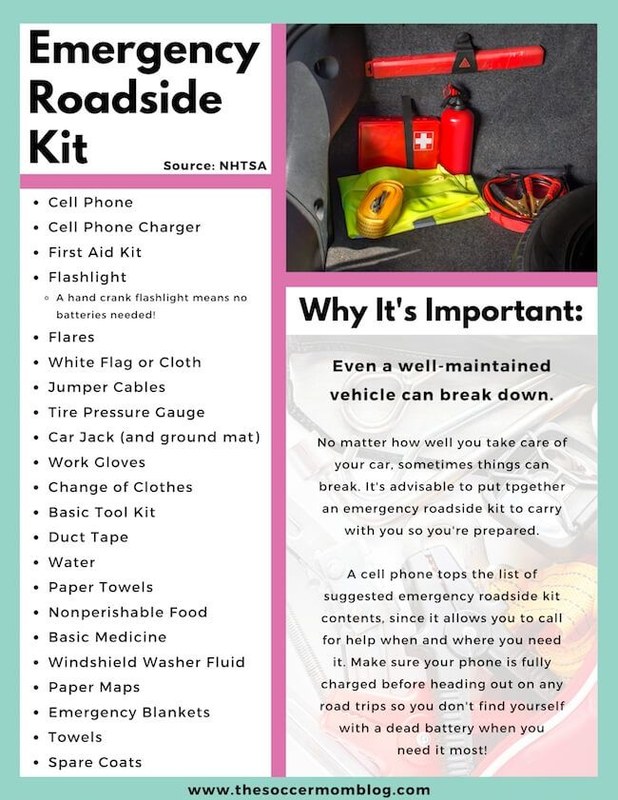
Every car owner should keep a small trunk kit for safety, battery trouble, tire problems, and basic diagnosis. The best kit starts with visibility gear, a flashlight, gloves, a jump-start option, tire tools, and a simple scanner if you want more information before calling for help.
what tools should every car owner keep in the trunk is a simple question, but the best answer depends on safety, your vehicle, and how much help you may need on the roadside. A smart trunk kit should help you stay visible, restart a dead battery, handle a flat tire, and get a basic diagnosis without creating more risk.
- Safety first: Warning triangles, lights, gloves, and a flashlight help you stay visible and work more.
- Battery tools: A jump starter is easier for solo use, but it must match your vehicle.
- Tire basics: Keep a gauge, inflator, and the proper spare-tire tools for your exact vehicle.
- Scanner limits: An OBD2 tool can read codes, but it cannot fix every warning light or.
- Maintenance matters: Check charge levels, hoses, cables, and expiration dates so the kit still works when.
What Tools Should Every Car Owner Keep in the Trunk for Breakdowns?
The short answer: start with visibility gear, a flashlight, gloves, a first-aid kit, a jump-start option, tire tools, and a basic OBD2 scanner if you want to understand warning lights before you call for help. If you drive long distances, carry wet-weather gear, a phone charger, and a compact air inflator too.
Quick answer: the must-have trunk kit for 2026 drivers
For most US drivers, the best trunk kit includes reflective triangles or LED warning lights, a flashlight or headlamp, work gloves, a rain jacket, a first-aid kit, jumper cables or a portable jump starter, a tire gauge, a compact inflator, and the tools needed for your spare tire. Add an OBD2 scanner if you want a better read on engine or emissions warnings.
What this guide covers for everyday drivers, commuters, and road-trippers
This guide focuses on the tools that solve the most common roadside problems without taking up too much space. It also explains what each tool can and cannot do, how compatibility matters, and when it is safer to stop and call roadside assistance.
Start with the highest-value essentials: safety, visibility, and basic roadside survival
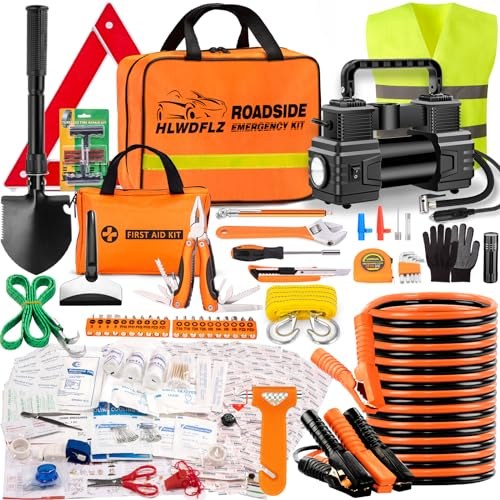
The first goal in a breakdown is not repair. It is making yourself visible, staying out of traffic, and giving yourself enough light and protection to think clearly.
Reflective triangles or LED warning lights: safe placement and traffic visibility
Reflective triangles and battery-powered warning lights help alert other drivers that your vehicle is stopped. They are especially useful on curves, hills, highways, and shoulder areas where a disabled car is harder to see.
Placement matters more than the brand. Follow the product instructions and local rules, and keep the devices far enough from traffic that you can place them safely without standing in a lane. On busy roads, your own safety comes before setting up any gear.
Flashlight or headlamp: storage conditions, battery life, and hands-free use
A flashlight belongs in every trunk kit, but a headlamp is often better because it keeps both hands free. That matters when you are checking a tire, reading a fuse label, or connecting jumper cables in the dark.
Store the light where heat and moisture will not damage it. Check the batteries regularly, and if the light uses rechargeables, make sure it still holds a charge after sitting in the car for weeks.
Gloves, rain gear, and a compact first-aid kit: what belongs in the trunk year-round
Work gloves protect your hands from hot metal, sharp debris, and dirty surfaces. A lightweight rain shell or poncho can keep you safer and more comfortable while you wait for help or change a tire in bad weather.
A compact first-aid kit should cover small cuts, scrapes, and minor bleeding. It is not a replacement for emergency care, but it can help you manage a minor injury until you reach a safer place.
Battery and electrical tools: what to keep, what to avoid, and when to stop
Dead batteries are one of the most common no-start problems. The right tool can get you moving again, but the wrong tool, or the wrong connection, can damage electronics or create a safety hazard.
Portable jump starter vs. jumper cables: system voltage, current limits, and vehicle fit
For most gas-powered passenger vehicles, a portable jump starter is easier to use than jumper cables because it does not require a second vehicle. Jumper cables are still useful, but they depend on another driver and proper cable handling.
Either option must match your vehicle’s system voltage and the type of battery setup under the hood or in the cargo area. If you drive a hybrid, plug-in hybrid, or EV, check the owner’s manual before assuming a standard jump-start method is appropriate.
Check: Verify make, model, year, trim, voltage, ports, mounting space, and OEM requirements. Limitations: Some hybrids, EVs, and vehicles with rear-mounted batteries need different procedures or should be handled by a professional.
Correct connection order, damaged-battery stop conditions, and hybrid/EV cautions
Always follow the vehicle and jump-starter instructions for the correct connection order. A reversed connection, a damaged cable, or corrosion on the terminals can turn a simple no-start into a bigger problem.
Hybrids and EVs can have low-voltage systems that are not the same as a conventional starter battery setup. Never guess with high-voltage components. If the manual does not clearly describe the procedure, do not improvise.
Battery chemistry, state of charge vs. battery health, and post-use inspection
A jump-start may get the engine running, but it does not prove the battery is healthy. A battery can be low on charge, weak from age, or failing internally, and those are different problems.
After use, inspect the terminals, clamps, and cable insulation for heat, cracking, or corrosion. If your jump starter has a built-in battery, recharge it as soon as practical so it is ready next time.
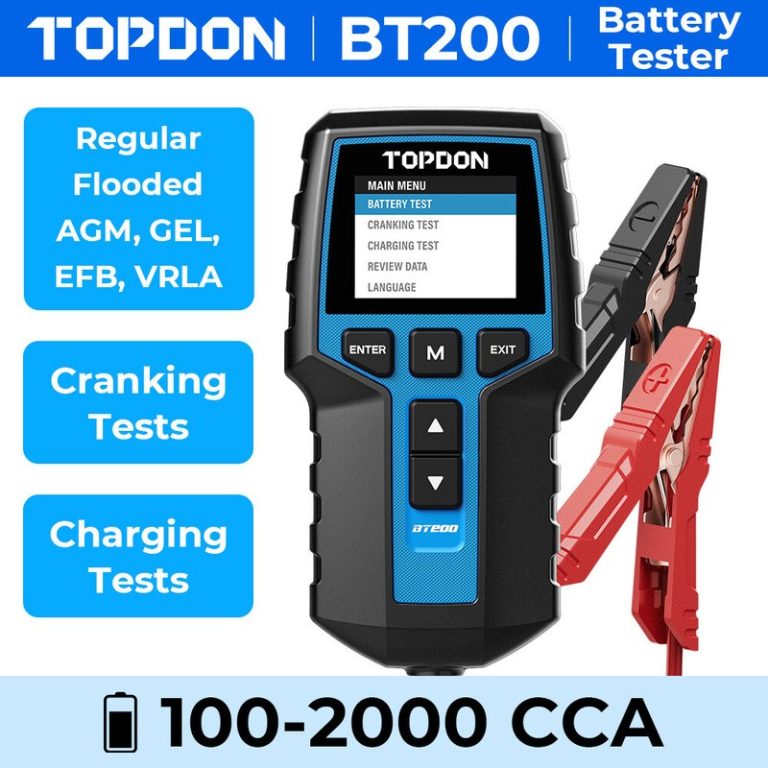
For readers building a better battery kit, our guide on common battery testing mistakes explains how easy it is to misread a weak battery. If you are comparing battery testers, see which Topdon battery tester to buy for a more focused breakdown.
Tire tools that actually matter on the roadside
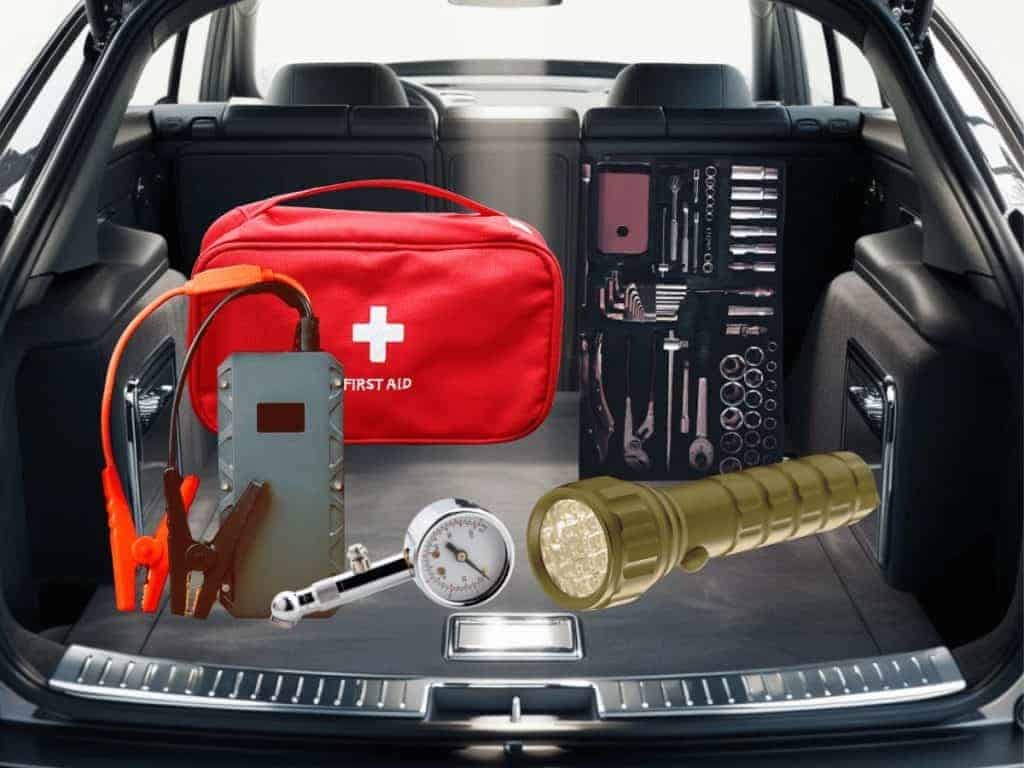
Flat tires and low pressure issues are another common reason drivers need trunk gear. The right tire tools help you confirm the problem, make a temporary fix when appropriate, and avoid driving farther than you should.
Spare tire, jack, and lug wrench: compatibility, load limits, and vehicle-specific fit
If your vehicle came with a spare tire, make sure it is actually in the car and properly inflated. A jack and lug wrench must fit your specific vehicle, and the jack must be rated for the vehicle’s weight and designed for the correct lift points.
Never use a jack on soft ground without checking stability. If the shoulder is unsafe, the road is uneven, or traffic is too close, calling for help is the better move.
Digital tire gauge and air inflator: door-jamb placard, cold pressure, and gauge accuracy
A digital tire gauge is one of the smallest tools with the biggest payoff. Use the pressure listed on the driver-door placard, and check pressure when the tires are cold for the most accurate reading.
A compact inflator can help you restore pressure after a slow leak or after replacing a spare with the original tire. It should not be treated as a cure for a damaged sidewall, a large puncture, or a bead problem.
TPMS limits, relearn issues, puncture location, and temporary-repair thresholds
TPMS warning lights are helpful, but they do not tell you everything. A tire can be underinflated before the system warns you, and some cars need a relearn procedure after tire service or wheel changes.
If the puncture is in the sidewall, near the shoulder, or too large for a temporary plug to be safe, the tire may need replacement. Temporary repair products should be used only within the product and vehicle limits, not as a permanent solution.
- Check the placard pressure before adding air
- Inspect the spare, jack, and wrench for fit and condition
- Replace a tire if the damage is outside repair limits
- Use an inflator to ignore a serious tire defect
- Assume TPMS shows the exact cause of the problem
- Drive long distances on a temporary spare without checking the manual
OBD2 diagnostic tools: what they can tell you and what they cannot
An OBD2 scanner can save time by telling you why a warning light came on, but it is not a magic fix. It is best for basic code reading, live data, and emissions-related checks on many gasoline vehicles and some light-duty trucks.
Model-year and protocol coverage, port location, and ignition mode requirements
Before buying a scanner, confirm that it supports your vehicle’s model year and communication protocol. Port location also matters, because some vehicles place the OBD2 port in an easy-to-reach spot while others hide it under the dash.
Many scanners require the ignition to be in a specific key or accessory mode. If the screen stays blank or the tool will not connect, the issue may be the ignition state rather than the scanner itself.
Code reading, live data, emissions readiness, and reset limitations
A basic scanner can read diagnostic trouble codes and sometimes show live data such as coolant temperature or oxygen sensor readings. Some tools also show emissions readiness monitors, which can matter before a state inspection.
Code clearing is where many drivers make mistakes. Clearing a code before writing it down can erase useful clues, and it may also reset readiness monitors that need time to complete again.
App permissions, firmware updates, privacy considerations, and compatibility with your phone
Phone-based scanners can be convenient, but they also add app and privacy questions. Check what permissions the app asks for, whether the tool needs a cloud account, and how firmware updates are handled.
If you want to narrow scanner choices, see our guide on what vehicles the Innova 5610 works on and what you can do with OBDLink MX for examples of coverage and feature differences.
When DIY diagnosis ends and a professional scan is the better move
If the vehicle has multiple warning lights, drivability problems, or repeated codes after a reset, a professional scan is often the better choice. That is especially true when the code points to a wiring issue, a module fault, or a safety-related system.
Comparison guide: jumper pack vs. cables, inflator vs. compact compressor, scanner vs. no scanner
Choosing trunk tools is partly about budget and partly about how much help you want on your own. The best kit for a solo commuter is not always the best kit for a family SUV or an older car.
Side-by-side comparison by cost, convenience, power, reliability, and driver skill level
| Option | Best for | Owner consideration | Driver consideration |
|---|---|---|---|
| Portable jump starter | Solo drivers and commuters | Needs periodic recharging and safe storage | Easier to use without another vehicle |
| Jumper cables | Drivers with roadside help nearby | Lower upfront cost, but depends on another car | Requires careful cable handling and coordination |
| Compact inflator | Slow leaks and low-pressure emergencies | Needs power and periodic hose inspection | Fast to use if the tire is repairable |
| OBD2 scanner | Drivers who want basic diagnostics | Compatibility and app support matter | Helps explain warning lights before a shop visit |
Best fit by vehicle type: sedan, SUV, truck, older car, hybrid, and EV
Sedans and compact cars usually benefit most from a compact kit that emphasizes space-saving tools. SUVs and trucks often have more cargo room, so a larger inflator, heavier gloves, and a better jack setup may be easier to carry.
Older cars may benefit more from a jumper pack and tire tools because they are more likely to have battery or charging issues. Hybrids and EVs need the most manual checking because battery and jump-start procedures can vary widely by model.
Which tools are worth buying first if you want the best value per dollar
If your budget is tight, buy in this order: warning triangles or lights, flashlight, gloves, tire gauge, jumper pack or cables, and then an inflator. Add a scanner after the basics if you want to understand warning lights and save time at the repair shop.
The best value usually comes from tools that solve multiple problems: a jumper pack, a tire gauge, a compact inflator, and a light source. That mix covers the most common roadside issues without overloading the trunk.
How to organize, maintain, and inspect your trunk kit so it works when needed
A trunk kit only helps if you can reach it quickly and trust that it still works. Organization and maintenance matter as much as the purchase itself.
Storage layout for fast access, secure placement, and climate protection
Keep the most urgent items near the top or in a side organizer: flashlight, gloves, triangles, and first-aid kit. Heavier items like a compressor, jumper pack, or lug wrench should be secured so they do not shift while driving.
Heat and cold can affect batteries, adhesives, and rubber hoses. If your climate swings widely, check the kit more often and avoid leaving delicate electronics loose in direct sun.
Monthly checks for charge level, cable condition, tool completeness, and expiration dates
Once a month, confirm that the jump starter is charged, the inflator hose is intact, and the tire gauge still reads consistently. Check the first-aid kit for expired supplies and replace anything used or damaged.
If you use a battery tester or scanner, keep the manual with the tool or save it on your phone. For readers comparing diagnostic options, our article on what the Topdon BT200 tests can help explain what a battery tester can reveal versus a scanner.
Post-use inspection after a breakdown, jump-start, or tire repair
After any roadside use, inspect the tool before it goes back into the trunk. Look for bent clamps, damaged cords, low battery charge, missing adapters, or tire sealant residue that could affect the next use.
If the breakdown involved a battery failure or repeated no-start condition, schedule a proper inspection instead of assuming the problem is solved. A temporary fix should always lead to a real repair plan.
Legal, warranty, and ownership-cost considerations for New Jersey and U.S. drivers
Most trunk tools are simple, but roadside use still involves legal and ownership questions. Emergency placement, code clearing, and temporary repairs can all be affected by local rules or vehicle-specific warranty guidance.
Roadside placement rules, safe shoulder practices, and state-by-state variation
Roadside repair and warning-device rules vary by state, and shoulder conditions can differ from one highway to the next. In New Jersey and elsewhere, the safest practice is to stay as far from traffic as possible and follow current state guidance and local law.
Warranty/support, replacement parts, and long-term ownership cost
Some tools look cheap at checkout but become expensive if they need special batteries, proprietary cables, or paid app access. Before you buy, check the warranty term, return policy, and whether replacement hoses, clamps, or adapters are easy to find.
Ownership cost also includes maintenance. A jump starter that sits uncharged, a scanner that needs paid updates, or an inflator with a worn hose can become a problem when you need it most.
What not to carry: unsafe, expired, or vehicle-incompatible tools
Do not keep damaged batteries, cracked cords, expired first-aid supplies, or tools that do not fit your vehicle. Also avoid carrying random adapters or repair products you have not verified against the vehicle manual.
- Best for: Drivers who want a practical trunk kit that covers visibility, battery trouble, tire problems, and basic diagnostics.
- Think twice if: Your vehicle has a unique battery setup, limited trunk space, or a tire repair situation that should go straight to a shop.
- Next step: Check your owner’s manual, confirm vehicle compatibility, and build the kit around the tools you are most likely to use safely.
Frequently Asked Questions
Start with warning triangles or lights, a flashlight, gloves, a first-aid kit, jumper cables or a jump starter, a tire gauge, and a spare-tire setup if your vehicle has one. Add a compact inflator and OBD2 scanner if you want more self-help options.
A portable jump starter is usually easier for solo drivers because it does not require another vehicle. Jumper cables can still work well, but they depend on correct handling and a second car.
It is not required, but it can help you understand warning lights and read basic codes before a shop visit. Check that the scanner supports your vehicle’s model year and protocol.
Check it about once a month, then again after any roadside use. Recharge battery-powered tools, inspect cables and hoses, and replace expired or missing items.
No. Roadside placement rules, emergency lighting use, and repair limits can vary by state, so verify current local guidance before relying on a specific method.
Avoid damaged batteries, cracked cords, expired first-aid supplies, and tools that do not fit your vehicle. Do not rely on temporary repair products as a permanent fix.