What Battery Voltage Is Too Low to Start a Car? 12.0v Is the Limit
12.0V resting is the no-start limit for most 12V vehicles. Charge the battery, let it rest, and load-test before deciding whether to replace it.
For most cars, the answer to what battery voltage is too low to start a car is simple: 12.0V resting is the hard line. Below that point, the battery may still run the dome light and the radio, but it usually cannot deliver the surge of current a starter motor demands on a cold morning. This guide explains how to measure voltage correctly, why state of charge and battery health are different problems, and what to do when your battery reads 12.0V or lower.
- 12.0V cutoff: A rested battery at 12.0V is the practical no-start line for most vehicles.
- Resting only: Test with the engine off after several hours; idle voltage near 14V reflects the.
- Charge vs. health: Voltage measures state of charge; a load test measures CCA and internal resistance.
- Jump safety: Connect dead positive first, ground last, and never jump a swollen or leaking battery.
- Next step: Charge, rest, and retest; a battery that falls back under 12.0V likely needs replacement.
The Short Answer: 12.0V Is the Hard No-Start Limit
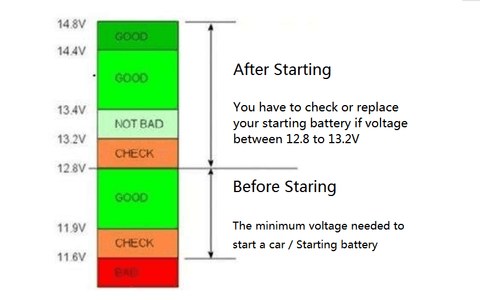
A healthy, fully charged 12-volt lead-acid battery rests at roughly 12.6V with the engine off. When that number falls to 12.0V, the battery has lost a large share of its usable energy. Most starter motors will not crank reliably at that point, which is why 12.0V is the practical no-start line for the majority of gasoline and diesel vehicles.
What 12.0V Means for a Typical Starter Motor
Cranking a cold engine is one of the hardest jobs a battery performs. A starter can draw 150 to 250 amps, or more on larger engines, during the first seconds of rotation. At 12.0V resting, the voltage sags well below that number the moment the starter engages. The result is usually a slow crank, a single click from the solenoid, or total silence.
Some cars will start at 12.1V or 12.2V on a warm engine, and others will fail at 12.3V if the battery is old and weak. The 12.0V figure is a warning floor. Once you see it, you should not trust the next start without charging first.
Why 11.9V and Below Is the No-Start Danger Zone
Below 12.0V, internal resistance climbs quickly, and the battery’s ability to deliver high current falls just as fast. The battery can hold enough energy for interior lights, the radio, and the computer, but not enough stable voltage under load for the starter.
At 11.9V or lower, engine computers, fuel pumps, and sensors can also behave erratically. A reading in this range after a failed start is even more concerning because the battery has not recovered from the cranking attempt. This is the danger zone where you will likely need a jump start, a charger, or a replacement battery.
Resting Voltage vs. System Voltage: Know What You’re Measuring
Resting Voltage: The Only Number That Counts for Diagnosis
Resting voltage is the battery’s output after the car has sat long enough for surface charge to fade. That normally takes several hours, and ideally a full overnight rest. The most reliable habit is to test a car battery after it has sat overnight, before the engine has run for the day.
A reading taken right after a drive can be inflated by a few tenths of a volt. That false high reading can make a weak battery look fine. Resting voltage is the number you compare against the 12.0V limit.
System Voltage at Idle (13.5–14.8V) and What It Reveals
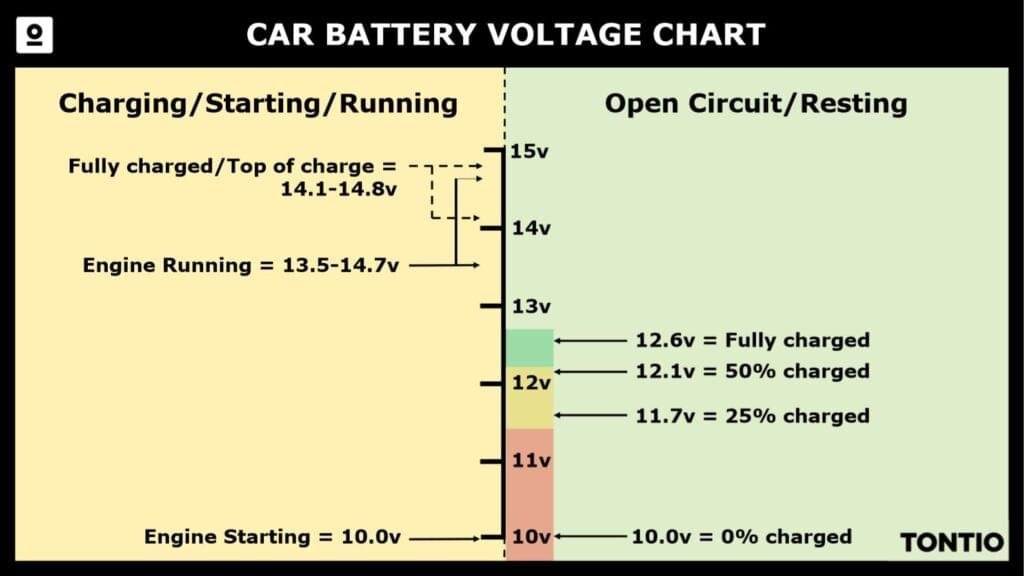
With the engine running, a healthy charging system should hold battery voltage around 13.5V to 14.8V. That reading is system voltage, not resting voltage. It tells you whether the alternator is charging and whether the charging system can handle the electrical loads.
If system voltage at idle stays near 12.6V, the alternator may not be charging the battery. If it climbs to 14V and then drops when you turn on the headlights, wipers, and fan, the charging system may be weak. A dashboard voltmeter is useful, but only a rested reading reveals the battery’s true condition.
State of Charge vs. Battery Health: Two Different Problems
Lead-Acid State-of-Charge Reference: 12.6V Is Full, 12.0V Is ~50%
Voltage is the simplest measure of state of charge. For a typical flooded lead-acid battery at rest, 12.6V is full, and 12.0V is around half charged on many simplified reference charts. Some manufacturer charts place 12.0V closer to 25%, because the open-circuit voltage curve varies with battery construction and temperature. The exact percentage matters less than the trend: at 12.0V the battery is too depleted to trust.
Battery Health: Cold Cranking Amps and Internal Resistance
State of charge answers “how full is the battery?” Battery health answers “can this battery still do its job?” A battery can rest at a healthy 12.6V and still fail a load test because high internal resistance makes voltage collapse the instant the starter draws current.
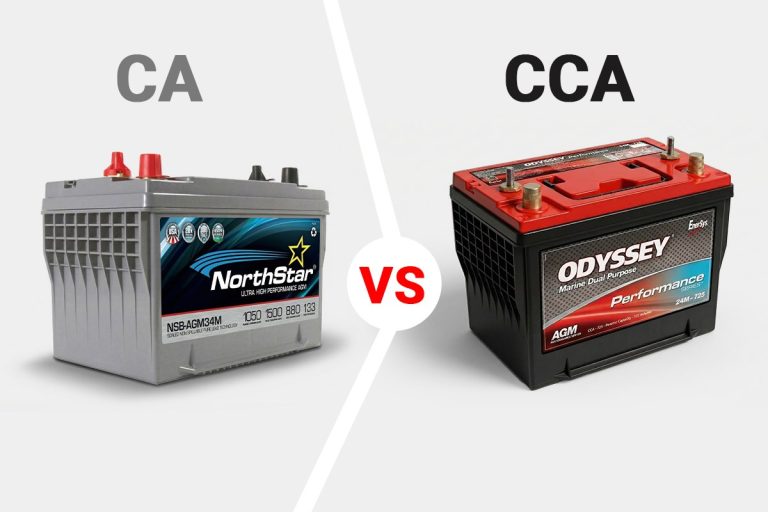
That is why voltage alone cannot tell you whether to charge or replace the battery. Cold cranking amps, or CCA, describes how much current a battery can deliver at 0°F. A conductance tester or a professional load test measures internal resistance and gives a clearer health picture than any single voltage reading.
How to Test Battery Voltage Correctly

Multimeter Testing: Avoiding Surface-Charge Errors
You can use a multimeter to check a car battery in about a minute. Set the meter to DC voltage on the 20V scale, touch the red lead to the positive terminal and the black lead to the negative terminal, and read the display.
The reading is only useful when the battery is at rest. Park the car, close all doors, turn off every load, and wait. For the most accurate result, test first thing in the morning before the engine runs. A multimeter confirms low state of charge, but it cannot prove whether the battery is healthy. A 12.0V reading tells you to charge the battery; it does not tell you whether the battery will hold that charge.
OBD2 Port Voltage: Model-Year Coverage, Port Location, and Ignition Mode
Many drivers check voltage with a scan tool instead of a multimeter. On US gasoline vehicles from 1996 and newer, the OBD2 port is normally under the dashboard on the driver’s side. Voltage is available on pin 16, and many apps display it as a live data value.
The catch is that most vehicles only power the OBD2 port with the ignition in the run position. That means the scan tool reports system voltage with the key on and modules awake, not resting voltage. The number can differ from a resting reading by several tenths of a volt, so treat OBD2 voltage as a charging-system check rather than a battery-state check.
Live-Data, Emissions-Readiness, and App-Permission Limits
Bluetooth and Wi-Fi scan tools display live battery voltage on a phone app, but the reading depends on the vehicle’s data rate and the app’s permission settings. Some apps also limit live data unless you give them broad access to your phone’s storage, microphone, or location.
You should also know that clearing diagnostic codes can reset emissions readiness monitors, which can cause a failed inspection in some US states. Record the codes before clearing them, and check current state rules before relying on any readiness result for a smog check.
Jump-Starting, Connection Order, and Damaged-Battery Stop Conditions
Correct Connection Order: Dead Positive First, Ground Last
When a battery below 12.0V leaves you stranded, the connection order matters. Attach the positive clamp to the dead battery first, then the positive clamp to the good battery. Next attach the negative clamp to the good battery, and finish by grounding the final clamp to bare metal on the dead car, away from the battery.
Grounding last, away from the battery, reduces the chance of a spark near hydrogen gas that a charging battery can release. The exact sequence can vary on some newer vehicles, so follow the owner’s manual and the jump starter instructions. Understanding how many amps a jump start really needs also helps you choose the right booster pack if you decide to buy one.
Stop Conditions: Swelling, Leaking, Cracks, and Sulfur Smell
Never attempt to jump start, charge, or even move a battery that shows signs of physical damage. Swollen case sides, leaking fluid, visible cracks, or a strong rotten-egg sulfur smell all mean the battery may be damaged internally. A damaged battery can fail suddenly and is not worth the risk to your health or your vehicle.
Hybrid and EV Cautions: The 12V Auxiliary Battery Still Matters
Hybrid and electric vehicles still depend on a 12V auxiliary battery to wake up the computers and close the high-voltage contactors. If that small battery drops too low, the car may not start even with a fully charged main battery.
Use the dedicated jump points shown in the owner’s manual, usually under the hood, and never touch orange high-voltage cables. When in doubt, call a professional rather than guessing on a hybrid or EV system.
Charge It or Replace It? Cost, Warranty, and Chemistry Choices
When a Full Charge Can Save a Battery (and When It Can’t)
A low resting voltage is not always a death sentence. If the battery is healthy but undercharged, a full charge on a compatible charger can restore it. Short-trip driving is a common cause of chronic undercharging because the alternator never gets enough time to replace the energy the starter used.
If the battery reads above 12.4V after a full charge and an overnight rest, and it passes a load test, it may still have useful life left. If it falls back below 12.0V within a day or two, the battery is likely sulfated and should be replaced. Knowing whether you should charge a car battery before testing it is one of the most common points of confusion among DIY owners.
Replacement Cost, Warranty Options, and Battery Chemistry (Flooded, AGM, EFB)
If replacement is the answer, the right chemistry matters. Flooded lead-acid batteries are the standard, least expensive choice for many older vehicles. AGM batteries cost more, handle higher electrical loads, and are often required or recommended on late-model vehicles with stop-start systems. EFB batteries sit between the two and appear on many stop-start cars as a factory option.
Warranty terms vary by retailer and brand. Some batteries offer a free-replacement period followed by a pro-rated period; others cover full replacement for a set number of years. Prices vary by size, chemistry, brand, and region, so compare current quotes from parts stores and online retailers. Note that AGM batteries also need a charger with an AGM charging profile.
Battery Disposal Laws: State-by-State Legal Notes
Lead-acid batteries are regulated recyclable materials in most US states. Many parts stores and recyclers accept old batteries at no charge, and some states require a refundable core deposit when you purchase a new battery.
Maintenance to Keep Voltage Above the 12.0V Line
Parasitic Draw Testing: The 50mA Rule
A parked car always draws a little power to keep the clock, security system, and computer memories alive. A normal parasitic draw is generally around 20 to 50 milliamps. When the draw climbs above 50mA, the battery can lose meaningful voltage overnight.
To test for a drain, use a multimeter or an amp clamp with everything off and all doors closed. Leave the meter connected, then remove fuses one at a time to find the circuit causing the drain. A battery that drops below 12.0V every morning is often the first clue that a draw exists.
Temperature Effects and Seasonal Terminal Care
Cold weather is the classic battery killer because low temperatures slow the chemical reaction inside the battery and raise its internal resistance. A battery resting at 12.0V in summer may easily fail to start the car in January. Heat is the quieter enemy, since high under-hood temperatures speed up plate corrosion and water loss.
Next Steps: What to Do When Your Battery Reads 12.0V or Lower
Immediate Actions: Charge, Retest, and Load-Test
Start with a full charge using a charger matched to the battery chemistry. Let the battery rest for several hours or overnight, then measure the resting voltage again. If it holds above 12.4V, the next step is a load test to confirm the battery can deliver its rated cranking amps.
If the battery reads 12.0V or lower again after a full charge, replacement is usually the honest answer. A parts store or shop can run a conductance test in minutes. Combine that result with your resting voltage readings for a much clearer picture than a single number can give.
Reset Limitations and When to Call a Professional
Many modern vehicles need a battery registration or reset after replacement so the charging system can adjust to the new battery. That step often requires a bidirectional scan tool or dealer-level equipment, and skipping it may shorten the new battery’s life or cause charging faults.
If the car starts intermittently, tests fine but still dies overnight, or produces odd charging voltage, a professional should check the alternator, belts, wiring, and hidden drains. Also plan for drive cycles after a battery disconnect, since some vehicles need them to reset emissions readiness before an inspection.
- Best for: Drivers who need a clear, trustworthy cutoff before calling for a jump or spending money on a new battery.
- Think twice if: You rely on a single voltage reading taken right after a drive, since surface charge can hide a battery that is actually below the 12.0V line.
- Next step: Measure resting voltage first thing in the morning, charge above 12.4V, and have a load test performed before you replace anything.
Frequently Asked Questions
Usually not, and it should not be counted on. At 12.0V resting, the battery is at the no-start line, and cranking can pull voltage below what the starter and engine computer need. Charge the battery and retest before trusting the next start.
Yes. Treat 11.9V as no-start territory, because it is below the 12.0V limit. The battery may click the solenoid or crank very slowly, especially in cold weather.
A fully charged lead-acid battery reads about 12.6V after an overnight rest. If it reads 12.0V or lower, the battery is undercharged and needs a charge and a load test.
No. OBD2 voltage is system voltage with the key on, so it mostly shows alternator output and electrical loads. Use a rested multimeter reading to judge the battery’s state of charge.
Yes, as long as the case is undamaged and the battery is not frozen. Use a charger matched to the battery chemistry, work in a ventilated area, and retest after a rest period.
A common shop rule is that cranking voltage should stay above about 9.5V to 10V, though the exact number varies by vehicle and temperature. A drop into the low 9s or below points to a weak battery or poor connections.