What Is a BT200 Cranking Test? Battery Health Check Guide
A BT200 cranking test checks how well a 12V battery holds voltage while the engine starts. It is useful for spotting weak batteries and starting-system stress, but it does not replace a full diagnosis.
What Is a BT200 Cranking Test? It is a battery-starting check that looks at how much voltage a 12V system holds while the engine is being cranked. In plain terms, it helps you judge whether the battery, starter circuit, or starting load may be causing a hard-start problem.
For many drivers, that matters more than a simple “battery good” result. A cranking test can show whether a battery still has enough strength under load, which is often where weak batteries fail first.
- Fast screening: A cranking test helps spot weak batteries before they fail in daily use.
- Not a full diagnosis: It can suggest starter or wiring trouble, but not prove the exact bad part.
- Compatibility matters: Check 12V support, battery chemistry, app needs, and OBD2 coverage before buying.
- Safety comes first: Stop if the battery is swollen, leaking, hot, or otherwise damaged.
- Best use case: It fits DIY drivers, used-car checks, and roadside emergency kits that need quick answers.
What Is a BT200 Cranking Test? Quick Answer, Purpose, and What It Reveals
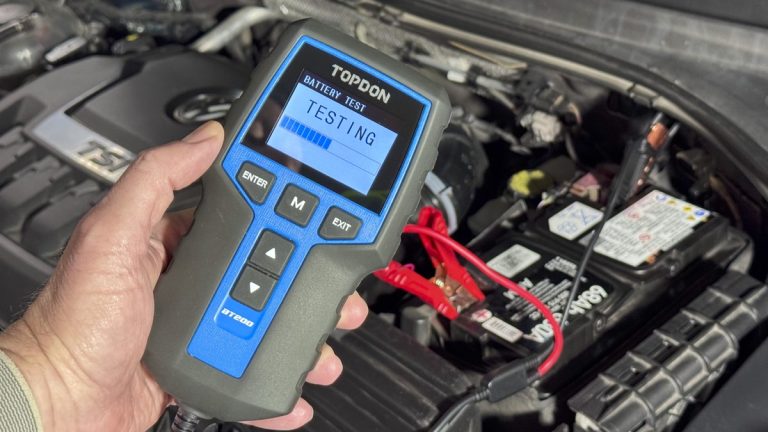
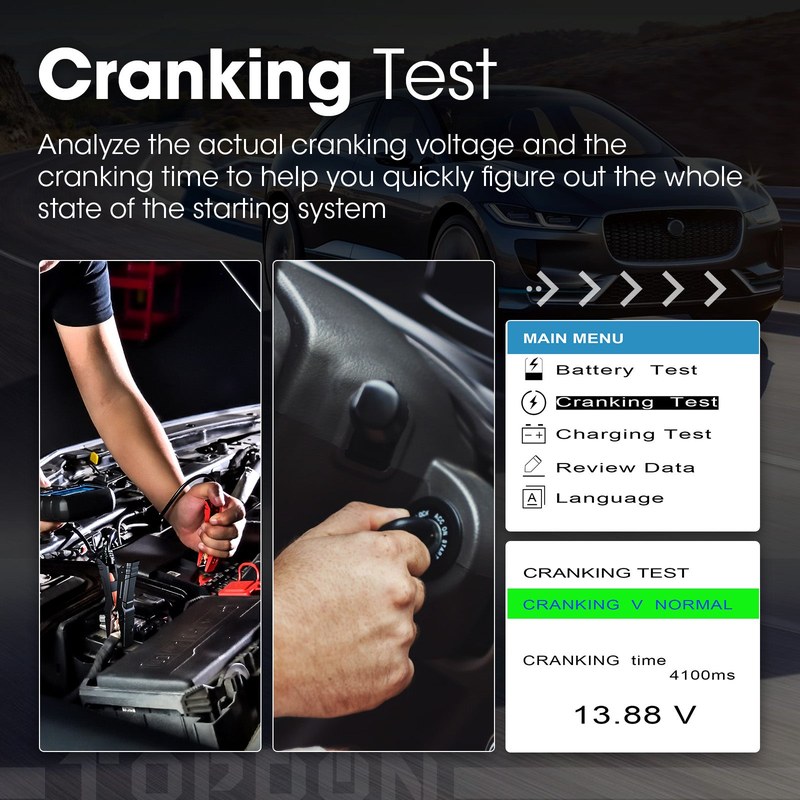
A BT200 cranking test is a starter-voltage test run through a BT200-style battery and electrical tester. It watches battery voltage during engine start and uses that drop to help judge whether the starting system is healthy enough.
The main purpose is to catch a battery that may look fine at rest but sags too much when the starter asks for high current. That kind of issue can leave you with slow cranking, intermittent no-starts, or a car that only struggles on cold mornings.
It can also point you toward starter draw problems or poor cable connections. Still, it is not a full diagnosis by itself, so the result should be read alongside the vehicle’s symptoms and any other scan data that is available.
How a BT200 Cranking Test Works on 12V Batteries, Starters, and Charging Systems
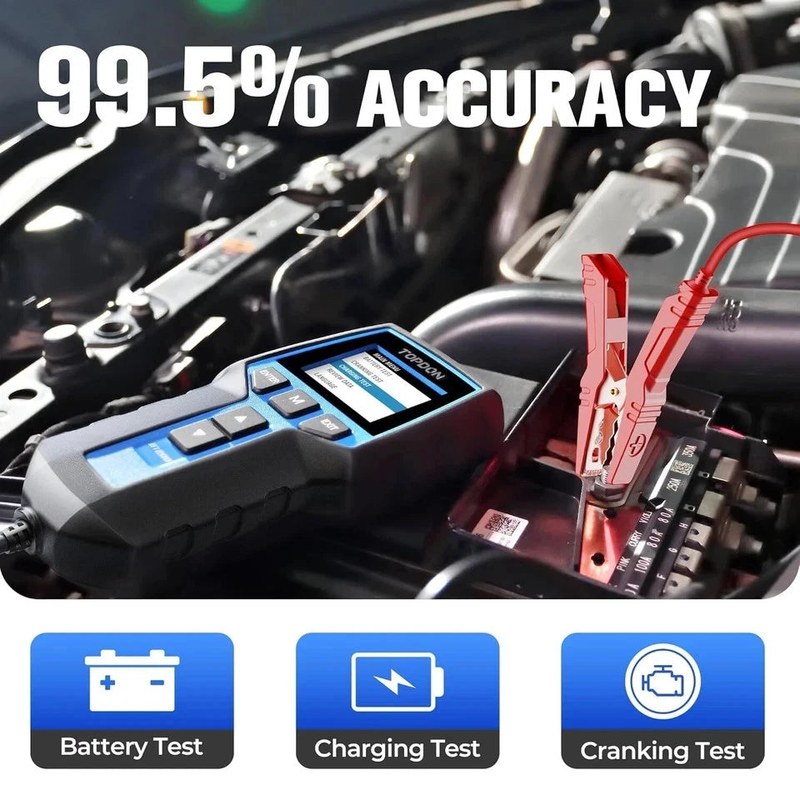
Most 12V passenger vehicles use a battery, starter motor, and charging system that work together. During cranking, the starter pulls heavy current, battery voltage drops, and the tester watches how far it drops and how quickly it recovers.
That voltage dip matters because a strong battery should hold up better under load than a worn one. If the drop is excessive, the tester may flag the battery as weak, the starting circuit as stressed, or both.
System voltage, battery state of charge, and battery health: what the numbers really mean
It helps to separate three ideas: system voltage, state of charge, and battery health. State of charge is how full the battery is right now, while battery health is how well it can still perform under load and over time.
A battery can be fully charged and still be worn out. It can also be low on charge because the vehicle sat too long, even if the battery itself is still serviceable. That is why a cranking test is useful, but only as one part of the picture.
Correct connection order, ignition mode, and damaged-battery stop conditions
Before any test, the tool should be connected exactly as the manual directs. In most cases, that means secure clamp contact on clean battery terminals, the vehicle in a safe parked state, and ignition behavior set to the requested mode.
Do not continue if the battery is swollen, leaking, hot, or visibly damaged. Those are stop conditions, not “test anyway” situations. A damaged battery can be unsafe to handle, and the safest next step is to follow the vehicle and battery manufacturer instructions or get professional help.
What the test can and cannot tell you about alternator, starter draw, and cold-weather performance
A cranking test can suggest whether the starter draw is too high or whether the battery voltage collapses too far during start. It may also hint that cold weather is exposing a weak battery that is already near the end of its useful life.
What it cannot do is prove the alternator is bad by itself. Charging-system problems usually need a separate charging test, and a starter issue may need current draw analysis or a professional diagnosis. If you want a broader diagnostic path, our guide to the best bidirectional scan tool for the money explains when deeper data becomes useful.
BT200 vs. Other Battery and Electrical Testers: Side-by-Side Comparison for Different Drivers
Different testers solve different problems. A cranking test is fast and practical, but it is not always the deepest or most complete method for every vehicle owner.
Cranking test vs. conductance test vs. load test: which method suits daily drivers, fleets, and DIY owners
A cranking test is good for a quick starting-system check. Conductance testing is often used to estimate battery condition without placing a heavy external load on the battery. A traditional load test applies a controlled load and can be useful when you need a more direct stress check.
Daily drivers and DIY owners often value speed and simplicity. Fleets and higher-mileage vehicles may benefit from a tester that stores results and helps track battery decline over time. If you are comparing battery-only tools, see our look at which Topdon battery tester is best for the kinds of features people usually compare.
Comparison criteria: speed, accuracy limits, data depth, battery chemistry coverage, and ease of use
Speed matters when you are testing in a driveway or parking lot. Data depth matters when you need more than a simple pass/fail result. Accuracy limits matter because no handheld tester can diagnose every starting issue on every vehicle.
Battery chemistry coverage also matters. Some tools support flooded lead-acid, AGM, EFB, or lithium 12V batteries differently, and some are not a fit for every hybrid or specialty setup. Ease of use includes clamp quality, screen clarity, app setup, and how much interpretation the tester does for you.
| Option | Best for | Owner consideration | Driver consideration |
|---|---|---|---|
| Cranking test | Quick start-system checks | Fast, simple, limited depth | Easy to use when parked safely |
| Conductance test | Battery health screening | Good for routine checks, depends on chemistry support | Low hassle, minimal setup |
| Load test | More direct battery stress testing | Can be more revealing, but less convenient | Needs careful handling and safe setup |
Which option fits gas cars, hybrid vehicles, light trucks, and occasional-use vehicles
Gas cars and light trucks usually fit the widest range of tester types, as long as the battery voltage and clamp access are appropriate. Hybrid vehicles need extra caution because their 12V battery may be only part of a larger electrical picture, and high-voltage systems should never be treated casually.
Occasional-use vehicles, like weekend cars or seasonal trucks, often benefit from a tester that can help spot voltage drop before a no-start happens. If you use a vehicle only a few times a month, a quick cranking check can be more useful than waiting for a roadside failure.
Compatibility Guide: Vehicles, Battery Types, OBD2 Coverage, and App Requirements
Because many BT200-style tools combine battery testing with scan features, compatibility is not just about the battery. It can also involve OBD2 access, app support, and vehicle model-year coverage.
Model-year and protocol coverage for OBD2 vehicles, port location, and ignition-state requirements
For OBD2 use, the vehicle must have a compatible diagnostic port and support the protocols the tool expects. In the United States, many gasoline vehicles use OBD2, but exact coverage still depends on model year, make, and system.
Port location also matters. Some vehicles place the connector low under the dash, while others hide it deeper than expected. The ignition state may need to be on without the engine running, so always follow the tool’s setup steps carefully.
Battery chemistry support: flooded, AGM, EFB, lithium 12V, and hybrid/EV cautions
Battery chemistry support is a major buying point. Flooded lead-acid, AGM, and EFB batteries are common in many vehicles, but not every tester handles each chemistry the same way.
Lithium 12V batteries are less common in everyday vehicles, so support should be checked in the product manual rather than assumed. Hybrid and EV caution is important too: the 12V battery may be testable, but the high-voltage system is a separate safety category.
OBD2 limits: code reading, live data, emissions readiness, reset limitations, and when a professional scan is needed
Many consumer tools can read and clear basic trouble codes, show some live data, and check emissions readiness. That is helpful for routine ownership, but it is not the same as a full professional scan.
Reset limits matter because some functions may be unavailable on certain vehicles or may require a subscription, special access, or a higher-level scan tool. If your concern is deeper module communication, our guide to what vehicles the Innova 5610 works on can help you think through coverage questions.
App permissions, firmware updates, privacy considerations, and supported phone/tablet expectations
If the BT200 uses an app, read the permission prompts before approving them. Some connected tools may request Bluetooth, location, storage, or account access, and you should know why each permission is needed.
Firmware updates can improve compatibility, but they can also change the app experience. Make sure your phone or tablet meets the supported operating system and connection requirements before you count on the tool in an emergency.
Installation and First-Use Setup: How to Connect, Configure, and Start Safely
First use should be simple, but safety still matters. A rushed setup near traffic, moving parts, or a weak battery can create avoidable risk.
Correct connection order, clamp placement, and cable condition checks before testing
Inspect the clamps and leads before use. Look for cracked insulation, bent jaws, corrosion, or loose connections, because poor contact can distort the test result and create heat at the terminal.
Clamp placement should be firm and clean. If the tool manual calls for a specific sequence, follow it exactly. Guessing at the order can lead to false readings or a failed test.
- Confirm vehicle, tool, voltage, port, tire, or battery compatibility
- Follow the vehicle and tool instructions in the correct order
- Inspect, store, and maintain the tool after use
- Clear codes before recording useful diagnostic information
- Work near traffic, moving parts, heat, or damaged batteries without proper precautions
- Rely on an unverified specification or temporary repair as a permanent fix
Safe location, traffic visibility, and roadside setup for emergency use
If you use the tool roadside, choose a location with as much visibility as possible. Turn on hazard lights if appropriate and legal where you are, stay out of traffic lanes, and avoid leaning over the engine bay more than necessary.
Roadside work is not the place to improvise. If the battery is damaged, the area is unsafe, or traffic exposure is too high, stop and call for help instead of continuing.
Tool completeness: adapters, leads, case storage, and what to inspect after use
Before buying, check whether the package includes the leads, clamps, adapters, or case you expect. Missing accessories can turn a simple tool into a frustrating one, especially if you need it in a glove box or emergency kit.
Tire, TPMS, and Roadside Use: Where a BT200 Fits in a Real-World Emergency Kit
Some BT200 bundles or related kits include tire-care or roadside functions, so it helps to think beyond battery testing alone. If your emergency kit includes inflation or tire checks, the same attention to safety and accuracy still applies.
Door-jamb placard, cold pressure, and gauge accuracy when checking tire pressure
Always use the vehicle door-jamb placard, not the sidewall, for target pressure. Tire pressure should be checked cold when possible, because driving heats the tire and can raise the reading.
Gauge accuracy matters too. A tool can be convenient and still be slightly off, so compare it with a trusted gauge if tire pressure is important to your routine. For inflation workflows, our guide on how to use a Viair 88P is a helpful companion read.
Inflator duty cycle, puncture location, temporary-repair limits, and when to stop and call for help
If the kit includes an inflator, duty cycle matters because small compressors can overheat if used too long. A slow leak may be manageable for a short top-off, but a large puncture or sidewall damage is a different situation.
Temporary repair products are not a permanent fix. If the puncture is in the sidewall, the tire is cut, or the damage is severe, stop and get professional help or replacement.
TPMS relearn limits and why some tire issues still require professional repair
TPMS tools and relearn functions can be useful, but they do not repair the tire itself. They also may not cover every vehicle procedure, especially when the relearn process varies by make and model.
When a tire warning persists after correct inflation, the issue may be a sensor fault, valve problem, or actual tire damage. In those cases, a shop inspection is often the safest next step.
Maintenance, Ownership Cost, and Long-Term Reliability
Ownership cost is not just the purchase price. It also includes charging habits, app support, cable wear, and how well the tool holds up in storage.
Charging, storage conditions, cable care, and post-use inspection routines
Keep the tool charged according to the manual, especially if you want it ready for roadside use. Store it in a dry place away from heat, and avoid tight bends in the cable that can break internal conductors over time.
Post-use inspection is simple but valuable. Check the clamps, screen, ports, and cable ends for wear before putting the tool away. That habit makes the next test faster and safer.
Firmware updates, app stability, and how support or warranty terms affect ownership cost
Firmware updates can improve compatibility, but they also depend on app stability and support quality. A tool with strong hardware but weak software support can become frustrating over time.
Warranty terms matter because battery and electrical tools are often used in hot, cold, or high-vibration settings. Check the current manufacturer warranty and return policy before buying, especially if you plan to rely on the tool for regular use.
Limitations, evidence gaps, and how to avoid overtrusting a single test result
One test result should not override common sense. If the car cranks slowly, the lights dim, or the battery is visibly failing, the result should be treated as part of a broader diagnosis, not the final word.
This is especially important when online listings make broad claims without enough detail. A tool can be useful and still have coverage gaps, app quirks, or vehicle-specific limits. That is why comparison research still matters, including articles like is the Topdon battery tester any good when you want to compare battery-focused tools.
Who Should Buy a BT200 Cranking Test Tool in 2026? Best Use Cases and Final Verdict
A BT200 cranking test tool makes the most sense for owners who want a fast answer about starting health without jumping straight to a shop visit. It is especially useful when the symptom is a slow crank, intermittent no-start, or a battery that seems fine until the engine is turned over.
Ideal user profiles: DIY owners, used-car shoppers, weekend drivers, and small-shop technicians
DIY owners can use it to screen a weak battery before winter hits. Used-car shoppers can use it as part of a pre-purchase check, though it should never replace a full inspection.
Weekend drivers and seasonal vehicles can benefit because infrequently used batteries often fail under cranking load first. Small-shop technicians may also value a quick starting-system screen when they need a fast triage tool.
When a simpler tester, a full scan tool, or professional battery service is the better choice
If you only need a basic battery health check, a simpler tester may be enough. If you need deeper module data, advanced code functions, or vehicle-specific reset work, a full scan tool may be the smarter buy.
Professional battery service is the better choice when the battery is damaged, the vehicle has a complex charging issue, or the starting problem keeps returning after basic checks. If you are still comparing scan-tool paths, our guide to what OBD scanners mechanics use can help set expectations.
Transparent verdict: value, drawbacks, and next steps before buying
The BT200 cranking test is valuable because it gives everyday drivers a fast look at starting-system health without much setup. Its biggest drawback is that it can suggest a problem without fully identifying the exact failed part.
Before buying, verify vehicle and battery compatibility, app requirements, and any supported test types that matter to you. If the tool fits your vehicle and your level of DIY work, it can be a practical addition to a home garage or roadside kit.
- Best for: Drivers who want a quick, practical check on battery and starting health before a no-start leaves them stranded.
- Think twice if: You need deep alternator, starter, or module diagnosis and expect one test to explain everything.
- Next step: Confirm your vehicle, battery chemistry, app support, and safety instructions before relying on the tool.
Frequently Asked Questions
It is mainly useful on 12V vehicles with accessible battery terminals and a compatible starting system. Exact coverage depends on the tester model, battery type, and any OBD2 features included.
It can be safe when the battery is intact and the manual is followed, but damaged batteries are a stop condition. If the case is swollen, cracked, leaking, or hot, stop and get help.
Not by itself. A cranking test mainly shows how the battery and starter circuit behave during engine start, while alternator problems usually need a separate charging-system check.
Some BT200-style tools use an app for extra data or OBD2 functions, while others work mostly from the handheld unit. Check supported phones, permissions, and firmware update requirements before buying.
Keep it charged, store it dry, and inspect the cables and clamps after use. That helps prevent bad readings and extends the tool’s usable life.
Confirm battery chemistry support, 12V compatibility, OBD2 coverage if needed, warranty terms, and whether the included accessories match your use case. Also check privacy and app requirements for connected models.