When Should You Replace a Tire Instead of Repairing It? Tread Depth
Replace a tire when tread is at 2/32 inch or below, when the puncture sits in the sidewall or shoulder, or when the hole is larger than 1/4 inch. Repair is only safe for small center-tread punctures on tires with healthy tread and age.
Knowing when should you replace a tire instead of repairing it comes down to four quick checks: tread depth, puncture location, tire age, and the type of damage. Get these right, and you avoid both wasted money and unsafe driving.
- Tread depth first: At 2/32 inch or less, replace the tire no matter how small the puncture.
- Repair zone: Only center-tread punctures under 1/4 inch are safely repairable.
- Sidewall means replace: Any sidewall puncture, cut, or bulge requires a new tire.
- Age counts: Tires over six years old should be replaced, not repaired.
- AWD matching: All-wheel-drive vehicles may need two or four new tires to protect the drivetrain.
When Should You Replace a Tire Instead of Repairing It? The Short Answer
You replace a tire when the damage makes a repair unsafe or when the tire is too worn to keep. You repair a tire only when the puncture is small, sits in the center tread, and the tire still has plenty of tread left.
Four Conditions That Instantly Make a Tire Unrepairable
Some damage rules out repair before anything else:
- Tread depth at or below 2/32 inch
- Puncture in the sidewall or shoulder
- Hole larger than 1/4 inch in diameter
- Visible bulge, cut, or impact damage
Any one of these conditions means the tire should be replaced. A repair cannot bring back the tire’s structural strength or safe wet-road grip.
Why Tread Depth Is the First Gatekeeper in the Decision
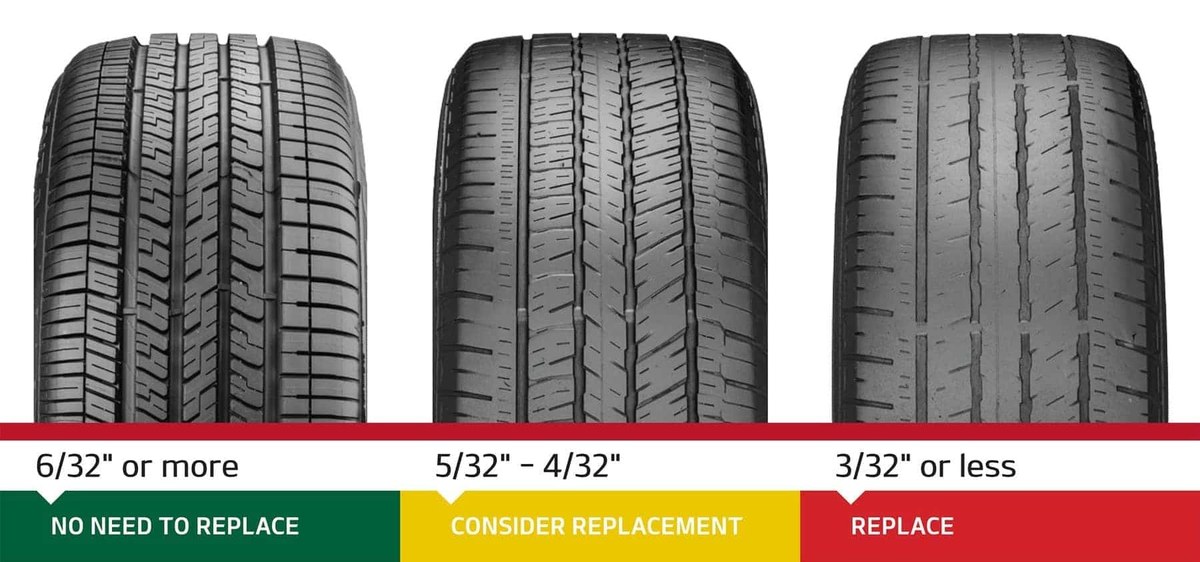
Tread depth matters more than the puncture itself. A tire with 7/32 inch of tread may be worth repairing. The same tire at 3/32 inch is not, because it is already near the end of its useful life. Spending money on a professional repair for a tire that needs replacement in a few thousand miles rarely makes sense.
Tread Depth: The Deciding Factor Before Any Repair
The 2/32-Inch Legal Minimum and State Variation
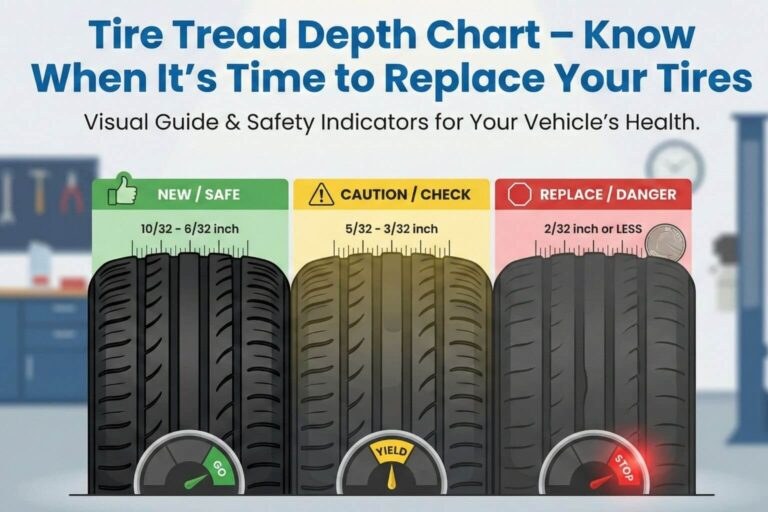
Most US states set 2/32 inch as the minimum legal tread depth for passenger tires. At this point, the tire has almost no wet-road grip. Some states allow less for certain vehicles or require more for front axles, so check your local rules before assuming 2/32 inch is legal where you drive.
Even where 2/32 inch is legal, it is not a safety recommendation. Many tire makers and safety groups suggest replacing tires at 4/32 inch for wet roads and 6/32 inch for snow. Think of the legal minimum as a floor, not a target.
How to Measure Tread Depth Correctly: Penny Test vs. Gauge
The penny test is a fast check. Insert a penny into the tread with Lincoln’s head pointing down. If you can see the top of his head, the tread is below 2/32 inch and the tire needs replacement.
A tread depth gauge gives an exact number. Place the probe in the center groove and in the outer grooves, then read the measurement. Check at least three spots across the tire because wear is rarely even.
You can also use the built-in wear bars. These rubber bars sit in the tread grooves. When they are flush with the surrounding tread, the tire has reached 2/32 inch.
Why Low Tread Depth Makes a Patch or Plug Unsafe
A patch or plug only seals the hole. It does not restore tread depth or wet grip. On a worn tire, the repaired area flexes differently, and the shallow tread means less water evacuation and a higher hydroplaning risk. A repair on a nearly bald tire gives you a sealed tire that still cannot stop safely in rain.
Puncture Location and Size: What the Repair Zone Allows
The Repairable Center Zone and Shoulder Limits
Industry guidelines allow repairs only in the center tread area. This is roughly the middle 75 percent of the tread width, excluding the shoulder and sidewall. The shoulder is the curved transition between tread and sidewall. Damage there weakens the tire’s structure, and a patch cannot hold reliably.
Size Thresholds: When a Puncture Is Too Large to Fix
Most tire makers and the US Tire Manufacturers Association limit repairs to punctures no larger than 1/4 inch in diameter. A nail or screw hole usually qualifies. A larger hole from a bolt, rod, or curb impact does not. The tire must also show no visible damage to the inner liner.
Sidewall Damage and Impact Bulges Always Mean Replacement
Sidewall punctures, cuts, and impact bulges are never repairable. The sidewall flexes with every revolution, so a plug or patch cannot seal it for long. A bulge means the internal belts have broken and the tire can fail suddenly at highway speed.
Tire Age and Wear Matching: When Repair Isn’t Worth It
The Six-Year Aging Rule and DOT Code Check
Tires age even when they look fine. Rubber hardens and loses flexibility over time. Many tire makers recommend replacing tires at six years regardless of tread depth. You can find the age by reading the DOT code on the sidewall. The last four digits are the week and year of manufacture. For example, 2321 means the 23rd week of 2021.
If your punctured tire is older than six years, replacement is usually the better call. A repair would extend the life of a tire already past its recommended service window.
AWD and 4WD Matching Requirements for Replacements
All-wheel-drive and four-wheel-drive vehicles are sensitive to tire circumference differences. If one tire is significantly newer or taller than the others, the drivetrain can suffer. Many manufacturers require all four tires to be within a small tread-depth difference, often 2/32 to 4/32 inch.
When one tire is unrepairable on an AWD vehicle, you may need to replace two or even four tires. That makes the decision more expensive, but it protects the transfer case and differentials from damage.
Buying Pairs vs. Singles: Cost and Handling Trade-Offs
On a two-wheel-drive car, replacing tires in pairs is common practice. Put the new tires on the rear axle for better stability, even on front-wheel-drive cars. A single new tire may be acceptable if the remaining tires have most of their tread left, but mismatched depths can cause pulling or uneven wear.
Buying a pair costs more now but keeps handling predictable. Replacing one tire saves money but may create a noticeable grip difference between axles.
Temporary Repairs vs. Professional Patch-Plug Repairs
Why Plug-Only Repairs Are Temporary by Design
A plug-only repair from a DIY kit seals the hole from the outside. It does not seal the inner liner, so air can migrate through the tire body over time. Plug-only repairs are meant to get you to a shop, not to last the life of the tire. For a deeper look, see our comparison of tire plug vs. patch safety.
Professional Repair Thresholds and Industry Standards
A professional patch-plug repair combines a patch on the inside with a plug filling the hole. This meets industry standards when done correctly. The tire must be removed from the wheel, inspected from the inside, and repaired only if it meets the location, size, and tread-depth rules above.
Not every shop follows these standards. Ask whether the shop removes the tire and inspects the inner liner. A repair done without removing the tire is not a professional patch-plug repair.
Temporary-Repair Limits: How Long You Can Drive Before Replacing
If you use a plug kit as a temporary fix, keep speed below the kit’s rated limit, often 50 mph, and have the tire inspected as soon as possible. A plugged tire should not be driven for thousands of miles. The longer you drive on a plug-only repair, the higher the risk of sudden air loss. How long you can drive with a nail in your tire depends on the same factors: location, size, and tread depth.
After Repair or Replacement: Pressure, TPMS, and Inflation Basics
Door-Jamb Placard, Cold Pressure, and Why It Matters
After a repair or new tire, set the pressure to the number on the driver’s door-jamb placard. This is the vehicle manufacturer’s recommended cold pressure. Check pressure when the tire has been sitting for at least three hours or driven less than a mile. For more detail, see our guide on how to check tire pressure at home.
Gauge Accuracy and Inflator Duty Cycle for Portable Compressors
A cheap gauge can read off by several psi. If you use a portable inflator, know its duty cycle. Many inflators need a cool-down period after a few minutes of running. Inflating a repaired tire to the correct pressure is easy, but keeping the inflator from overheating takes planning.
TPMS Relearn Limits and When Sensor Age Forces a New Tire
After tire service, the TPMS light may need a relearn procedure. Some vehicles do this automatically; others need a scan tool or a specific button sequence. If the TPMS sensor is old, its battery may fail soon after the new tire is installed. Replacing the sensor during tire service costs less than a second trip. Driving with a bad TPMS sensor is possible, but you lose low-pressure warnings.
Cost Comparison: Repair vs. Replacement in 2026
Side-by-Side Cost, Safety, and Longevity for Different Drivers
In 2026, a professional tire repair typically costs between $20 and $50 at most US shops. A new tire can range from about $80 for budget models to more than $300 for premium or specialty sizes. Prices vary by shop, region, tire brand, and vehicle.
| Option | Best for | Owner consideration | Driver consideration |
|---|---|---|---|
| Professional repair | Small center-tread puncture on a tire with 5/32 inch or more tread | $20-$50 plus labor, often covered by road-hazard warranty | Safe only if the tire passes all inspection checks |
| Replacement | Worn tread, sidewall damage, large puncture, or tire over six years old | $80-$300+ per tire, plus possible pair or set matching | Restores full grip and structural confidence |
Warranty and Road-Hazard Coverage: What Actually Protects You
Many tire retailers include road-hazard coverage that covers repairs or prorated replacement for a few years. Check the paperwork from your last tire purchase. If the punctured tire is covered, a repair may cost nothing, and a replacement may be discounted. This changes the math significantly.
When Replacing the Tire Is the Smarter Ownership Decision
Replacement is the smarter call when the tire is near the end of its life, when the damage is outside the repairable zone, or when the vehicle needs matching tires for AWD. A $40 repair on a tire with 3/32 inch of tread is wasted money because the tire must be replaced soon anyway.
Final Decision Checklist: Repair or Replace?
Step-by-Step Guide to Making the Call on Your Driveway
Use a gauge or the penny test in three spots. Below 2/32 inch means replacement, no matter what.
Find the object and check whether it sits in the center tread. Sidewall or shoulder damage means replacement.
Holes over 1/4 inch or tires past six years old should be replaced, not repaired.
If the tire passes every check, book a professional patch-plug repair. If it fails any check, replace the tire and verify AWD matching needs.
When a Professional Inspection Is the Only Safe Next Step
If you cannot confirm the puncture location, cannot see the inner liner, or feel any vibration from the damaged tire, stop guessing. Have a tire shop remove the wheel and inspect the tire from the inside. Some damage is invisible from the outside, and a professional inspection is the only way to know for sure.
- Best for: Small center-tread punctures on tires with at least 5/32 inch of tread and less than six years of age. A professional patch-plug repair is safe and cost-effective here.
- Think twice if: The tread is at 2/32 inch or below, the puncture is in the sidewall or shoulder, the hole exceeds 1/4 inch, or the tire shows a bulge. All of these mean replacement.
- Next step: Measure tread depth in three spots, check the DOT code for age, and book a professional inspection if you are unsure about the puncture location.
Frequently Asked Questions
Technically yes, if the puncture is small and in the center tread. But 3/32 inch is close to the 2/32-inch legal minimum, so the repair cost is hard to justify. The tire will likely need replacement within a few thousand miles anyway.
Plug-only repairs are temporary by design. They seal the hole from the outside but not the inner liner, so air can leak slowly over time. Drive at reduced speed and have a professional patch-plug repair done as soon as possible.
You should keep it short, ideally under 100 miles and below the kit’s rated speed, often 50 mph. A plug-only repair is not designed for thousands of miles of driving. The longer you wait, the higher the risk of sudden air loss.
Yes. Sidewall damage cannot be repaired safely because the sidewall flexes with every revolution. A patch or plug will not hold, and the tire can fail suddenly. Replace the tire or have the vehicle towed to a shop.
Most AWD manufacturers require all four tires to be within a small tread-depth difference, often 2/32 to 4/32 inch. If the remaining tires are worn, you may need to replace two or all four. Check your owner’s manual for the exact tolerance.
A professional patch-plug repair typically costs $20 to $50. A new tire ranges from about $80 to over $300 depending on size and brand. Road-hazard coverage can reduce or eliminate both costs, so check your warranty first.